







How Do You Compare BOPP Packing Tape Prices Correctly?
By hqt
Sep, 2026Related Posts
How Do You Compare BOPP Packing Tape Prices Correctly?
Sep 22, 2026

7 Things Importers Should Check Before Buying BOPP Packing Tape
Sep 21, 2026
Adhesive Packing Tape Testing Guide: Peel Adhesion, Tack, Holding Power and Tensile Strength
Sep 20, 2026
Polyester Strapping Supplier for Sustainable Recycled PET Packaging
Sep 20, 2026
When comparing price quotes for BOPP sealing tape, it is essential to standardize product specifications, actual tape length, adhesive performance, packaging format, and trade terms. A lower price per roll does not necessarily mean a more cost-effective overall purchase.
The most reliable method for importers to compare prices is to first standardize the quoting criteria across all suppliers, calculate the material cost per usable meter or per square meter, and then comprehensively evaluate freight charges, handling costs, and actual sealing performance.
Are the tape widths and roll lengths being compared identical?
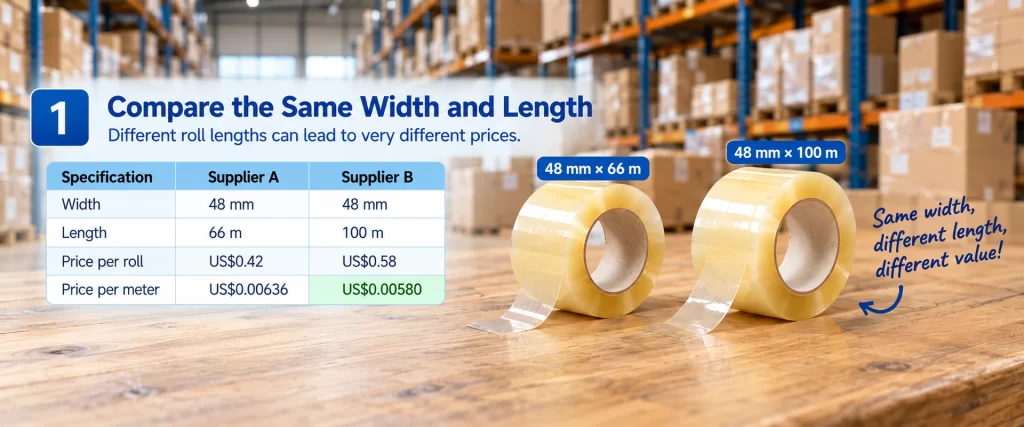
The first step is to confirm that the tape dimensions in all supplier quotes are exactly the same. For example, 48mm × 66m and 48mm × 100m rolls may look similar, but the latter offers a significantly greater usable length. Consider the two hypothetical quotes below:
| Specification | Supplier A | Supplier B |
| Tape width | 48 mm | 48 mm |
| Roll length | 66 m | 100 m |
| Price per roll | US$0.42 | US$0.58 |
| Price per meter | US$0.00636 | US$0.00580 |
Supplier B’s price per roll is higher, but the calculated cost per meter is lower.
If the tape widths differ, the purchaser can compare prices based on the cost per square meter:
Price per square meter = Price per roll ÷ (Width [m] × Length [m])
However, the price per square meter reflects only material consumption. Even if the cost per unit area is identical, tapes of different widths used on the same type of carton will yield different sealing results.
Therefore, before comparing prices, buyers must first confirm the required tape width and length.
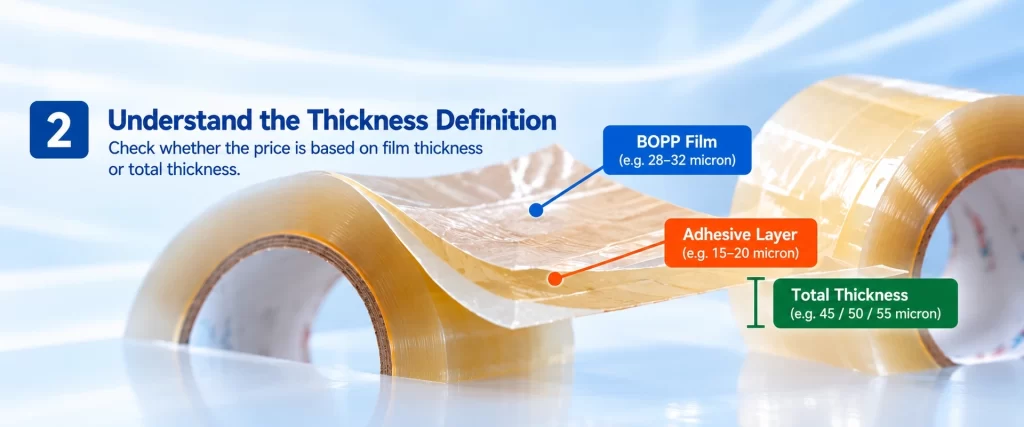
Does the quoted thickness include the adhesive layer?
The thickness of BOPP sealing tape is another key factor influencing the price quote.
The finished tape consists of two parts:
BOPP film backing + Adhesive layer = Total tape thickness
For example, two suppliers might both quote a "50-micron tape," yet the combination of BOPP backing and adhesive coating weight could differ significantly.
Buyers must verify whether the quoted thickness refers to the total thickness of the finished tape or only the thickness of the BOPP film backing.
If specific requirements exist regarding film thickness or adhesive coating specifications, buyers can request these detailed parameters from the supplier.
All else being equal, a thicker tape consumes more raw material. However, the thickness figure alone does not determine the product's cost-performance ratio.
If the adhesive type is unsuitable, a thicker tape might actually perform worse on certain cartons than a thinner tape with a more appropriate adhesive system.
When comparing options, it is essential to consider the tape's overall structure rather than focusing solely on the thickness figure in the quote.
How does the adhesive type affect the price of sealing tape?
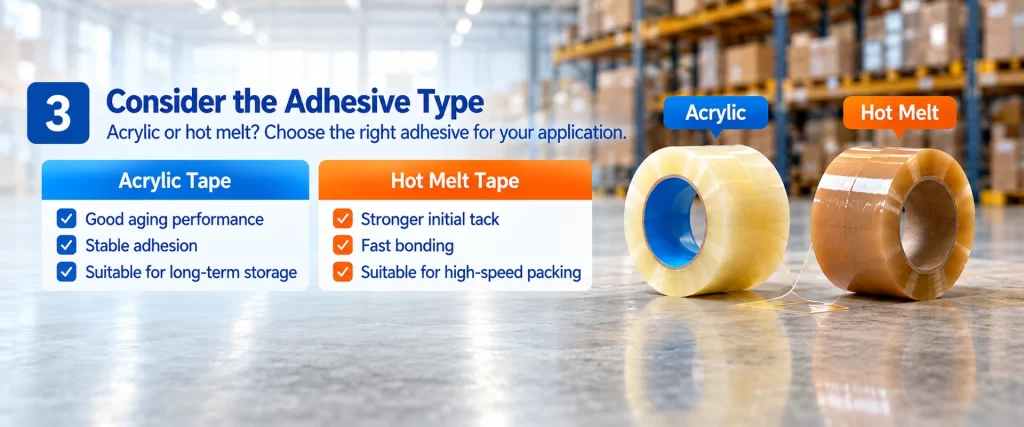
Water-based acrylic adhesive and hot-melt adhesive are the two mainstream adhesive systems for BOPP sealing tape.
Acrylic tape is commonly used for general packaging applications and is suitable for scenarios requiring both bonding stability and aging resistance.
Hot-melt tape is generally preferred when strong initial tack and rapid bonding are required.
Pricing for these two types of tape differs based on factors such as adhesive formulation, coating process, raw material costs, and manufacturing methods. Buyers should not automatically assume that a specific type of adhesive is necessarily more expensive or superior in performance.
For instance, if a low-cost tape frequently fails to adhere to recycled cardboard boxes, the warehouse may incur additional costs due to increased tape usage or the labor required to reseal the boxes.
Therefore, the key factor for comparison is not the price of the adhesive itself, but rather the tape's ability to maintain a secure bond on the specific boxes being used. Before placing a bulk order, it is advisable to request samples of different adhesive types and test them under actual packaging conditions to ensure a meaningful price comparison.
Do the weights of the tape roll and the paper core affect the price quote?
When comparing quotes for sealing tape, relying solely on the total roll weight can easily lead to misjudgment.
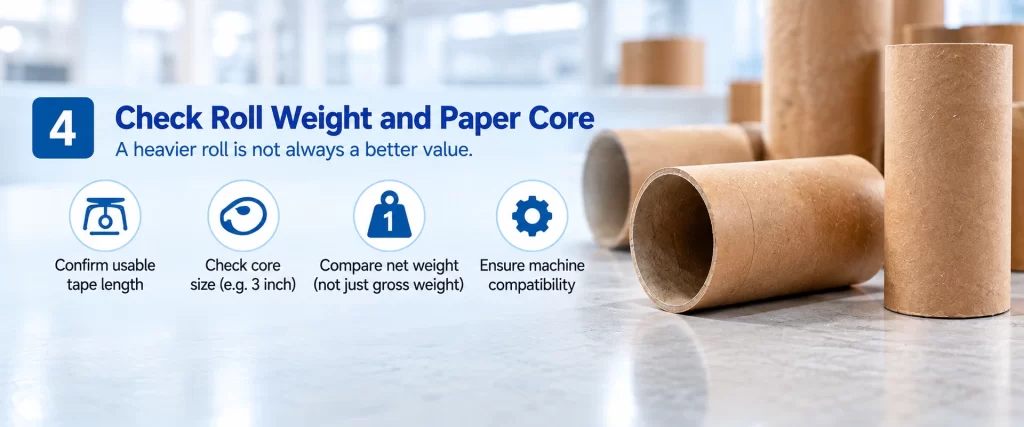
A roll of tape consists of two parts: the usable tape itself and the paper core. While the paper core is included in the total weight, it serves no function in the actual sealing process.
Even if two rolls have similar gross weights, the actual amount of usable tape can differ significantly due to variations in length, thickness, or paper core structure.
Therefore, a heavier roll does not necessarily offer better value for money.
When comparing prices, it is essential to verify the actual dimensions and structure of the tape rather than relying on gross weight alone.
For standard sealing tape, buyers should also clarify the paper core's inner diameter (the standard specification is 3 inches) to ensure compatibility with handheld dispensers or automatic sealing equipment.
If a supplier quotes a price per kilogram, it is crucial to confirm whether that weight includes the paper core and outer packaging.
Otherwise, a seemingly low price per kilogram might not translate to a lower actual cost per meter of usable tape.
How do carton packaging and container loading affect the total cost?
Export packaging significantly impacts the final procurement cost of imported BOPP tape.
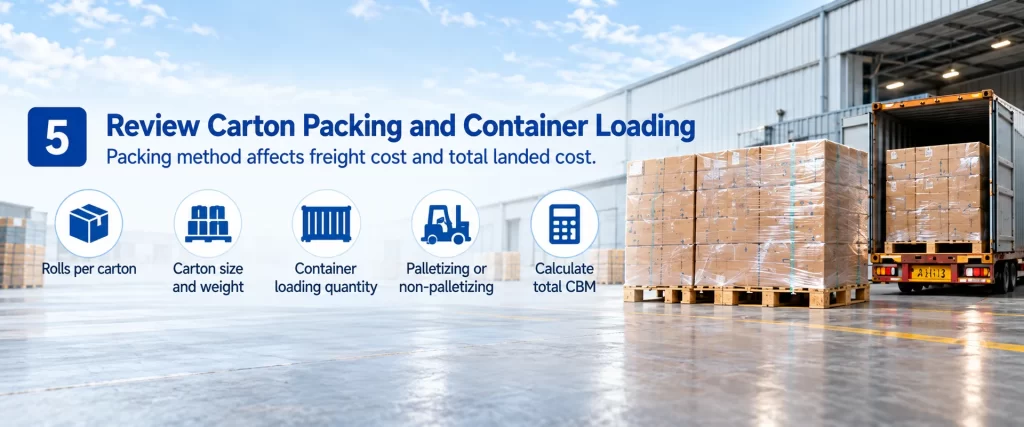
Depending on tape specifications and customer requirements, suppliers can offer various packing configurations—such as 36, 60, or 72 rolls per carton.
Different packing specifications affect carton dimensions, gross weight, handling efficiency, and container space utilization.
Before comparing prices, importers should confirm the number of rolls per carton, carton dimensions, gross weight, total shipment volume, and whether palletization is required.
For Full Container Load (FCL) orders, the total number of rolls loaded into the container helps amortize the shipping cost per roll.
Less-than-Container Load (LCL) orders are more sensitive to shipment volume, as freight and destination handling charges are typically calculated based on cubic meters (CBM).
Palletization can improve handling efficiency, but the pallets themselves occupy container space and increase the total weight.
Consequently, even if the unit price of the tape is slightly lower, the final landed cost may not be more economical if the packaging method drives up freight or handling expenses.
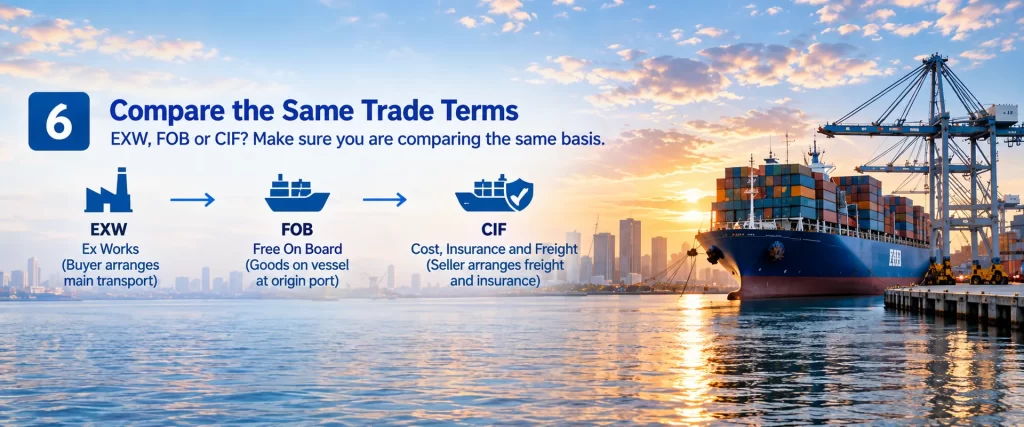
When comparing price quotes, have trade terms such as EXW, FOB, and CIF been standardized?
A quote for adhesive tape that lacks clear trade terms is incomplete and cannot be directly compared.
For instance, an EXW quote and a CIF quote cannot be compared side-by-side, as the costs covered and the division of responsibilities differ completely. Under EXW terms, the buyer assumes more responsibility, arranging transportation and export-related logistics independently.
Under FOB terms, the seller is responsible for loading the goods onto the vessel at the designated port of shipment.
Under CIF terms, the seller additionally covers the ocean freight and minimum cargo insurance to the designated port of destination; however, the risk regarding the goods transfers to the buyer the moment they are loaded onto the vessel at the port of shipment.
Importers need to confirm the designated location/port and the applicable version of Incoterms.
Simplified landed cost formula:
Landed Cost = Product Value + Ocean Freight + Insurance + Import Duties + Destination Port Charges + Inland Freight + Other Miscellaneous Fees
When calculating actual operating costs, refundable taxes should be accounted for separately.
When comparing multiple suppliers, it is essential to maintain consistency regarding the destination, purchase quantity, and cost calculation basis. Otherwise, price discrepancies may stem from logistics factors rather than the product itself.
How is the actual sealing cost per carton calculated?
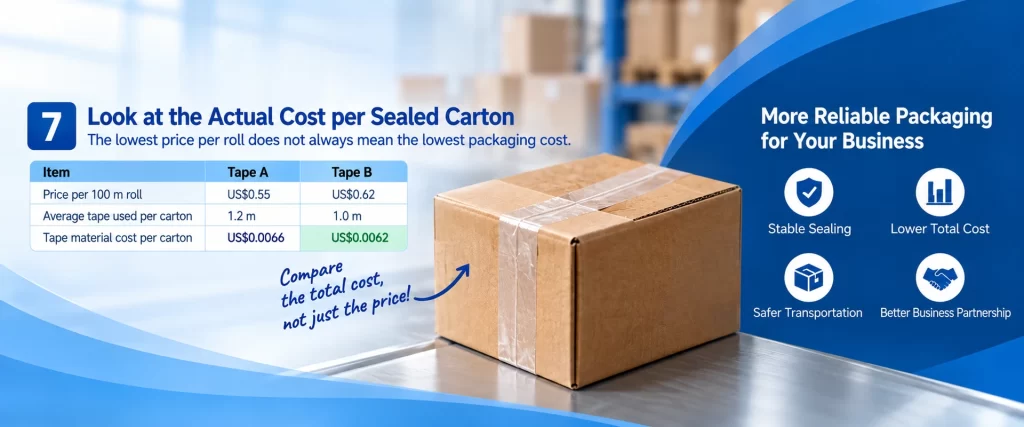
The lowest unit price per roll of tape does not necessarily equate to the most cost-effective overall packaging solution.
For high-volume carton sealing operations, purchasers need to calculate the cost of tape consumed per carton while also assessing the likelihood of various issues arising during use.
Insufficient tape adhesion often necessitates applying multiple layers or resealing the carton, whereas tape prone to breakage can cause downtime on manual or automated packaging lines.
| Item | Tape A | Tape B |
| Price per 100 m roll | US$0.55 | US$0.62 |
| Average tape used per carton | 1.2 m | 1.0 m |
| Tape material cost per carton | US$0.0066 | US$0.0062 |
How should an importer obtain comparable price quotes for BOPP sealing tape?
The most practical approach is to send the same Request for Quotation (RFQ) to all suppliers.
For example:
| Specification | Requirement |
| Product | Clear BOPP packing tape |
| Width × Length | 48 mm × 100 m |
| Total thickness | 50 micron |
| Adhesive | Water-based acrylic |
| Core inside diameter | 3 inches |
| Packing | 36 rolls/carton |
| Application | Export carton sealing |
| Order quantity | 10,000 rolls |
| Trade term | FOB Shenzhen, Incoterms 2020 |
Buyers can also request specific information from suppliers—such as film thickness, adhesion parameters, carton dimensions, gross weight, production lead times, and sample availability—based on their actual needs. Once specifications are standardized, supplier quotations can be evaluated by comparing the unit price per effective meter, the unit price per square meter, shipping costs, and actual sealing performance.
Yalan Pack supplies BOPP sealing tapes in a wide range of specifications, covering various widths, lengths, thicknesses, and adhesive types (such as water-based acrylic and hot-melt adhesives), with options including clear, colored, printed, and custom-branded tapes. For importers, the core principle is clear: first compare products of identical specifications, then evaluate the comprehensive costs associated with tape usage and the importation process.
Share on Social:


-
PREV:
7 Things Importers Should Check Before Buying BOPP Packing Tape
- NEXT: Null
Contact Us
In This Article
Related Posts
How Do You Compare BOPP Packing Tape Prices Correctly?
Sep 22, 2026
7 Things Importers Should Check Before Buying BOPP Packing Tape
Sep 21, 2026
Adhesive Packing Tape Testing Guide: Peel Adhesion, Tack, Holding Power and Tensile Strength
Sep 20, 2026
Polyester Strapping Supplier for Sustainable Recycled PET Packaging
Sep 20, 2026


