







What Packaging Specifications Should Buyers Include in an RFQ?
By hqt
Nov, 2026


A packaging RFQ (Request for Quotation) should include the product type, material, dimensions, thickness, performance requirements, quantity, packaging method, delivery terms, and any customization or documentation needs.
For industrial packaging products such as stretch film, BOPP packing tape, PP/PET strapping, and paper edge protectors, complete specifications help suppliers prepare accurate quotations and recommend suitable products.
Without clear requirements, suppliers may quote different materials, roll weights, lengths, or quality grades, making price comparisons difficult.
1. What Basic Information Should Every Packaging RFQ Include?
Before requesting prices, buyers should provide the basic purchasing requirements.
These typically include:
Product name and intended application
Material type and required specifications
Dimensions and tolerances
Required quantity and estimated purchasing frequency
Packaging and labeling requirements
Delivery destination and preferred Incoterms
Required delivery date
Technical documents or certifications, if applicable
Buyers should also explain how the packaging will be used.
For example, stretch film used for manual pallet wrapping may require different specifications from film used on a high-speed wrapping machine.
Providing the application helps suppliers identify unsuitable specifications before quoting.

2. What Specifications Should Be Included in a Stretch Film RFQ?
Stretch film quotations can vary significantly depending on film dimensions, thickness, roll weight, and application.
Buyers should specify whether they require hand stretch film, machine stretch film, or pre-stretched film.
Important specifications include:
| Specification | Example |
| Film type | Hand stretch film |
| Material | LLDPE |
| Width | 18 inches (457 mm) |
| Thickness | 80 gauge (approximately 20 microns) |
| Roll length | 1,500 feet (457 m) |
| Core diameter | 3 inches |
| Color | Transparent |
| Packaging | 4 rolls per carton |
When purchasing machine-grade stretch film, buyers should provide details regarding packaging equipment specifications, the target pre-stretch ratio, and information about the palletized goods.
If purchasing by weight, it is crucial to distinguish between the net weight of the film and the gross weight of the entire roll.
Two rolls with the same gross weight may have different paper core weights, which means the actual usable length of the film will differ.
Therefore, buyers must clarify whether the quoted weight includes the paper core.

3. What information is required for an RFQ (Request for Quotation) for BOPP packaging tape?
BOPP tape comes in various specifications regarding film thickness, adhesive formulation, width, and roll length.
A complete RFQ should include the following information:
Tape width and roll length
Total thickness (including the adhesive layer)
Type of adhesive (e.g., water-based acrylic, hot-melt)
Color (e.g., clear, tan/brown)
Inner diameter of the paper core
Application method (manual use or automated machine sealing)
Purchase quantity (quoted by the carton)
Custom printing requirements (if applicable)
Example of an RFQ:
BOPP packaging tape: 48 mm × 66 m × 50 microns, clear, water-based acrylic adhesive, 36 rolls per carton.
For custom-printed tape, buyers should also provide the design file, the number of printing colors, and the estimated order volume.
When selecting an adhesive type, consider factors such as the material of the cartons, storage temperatures, and the specific operating environment.
If a buyer is unsure which adhesive to choose, they can simply describe the intended application, and the supplier will recommend an appropriate solution.

4. What are the key specifications for PP and PET strapping?
PP strapping and PET strapping are suited for different applications.
PP strapping is generally used for light-duty bundling, while PET strapping is typically used for securing heavy industrial loads.
Buyers should provide the following information:
| Specification | Example |
| Material | PET |
| Width | 16 mm |
| Thickness | 0.9 mm |
| Breaking strength | 330 kgf |
| Color | Green |
| Core diameter | 406 mm, if required |
| Application | Machine strapping |
| Packaging | Coils on pallets |
Whenever possible, it is recommended to specify the breaking strength, the corresponding units of measurement, and the testing standards.
Buyers should also indicate the type of strapping equipment being used—such as manual, pneumatic, semi-automatic, or fully automatic strapping machines.
Whether a strapping material is compatible with a given machine depends on the strap’s specifications, surface characteristics, coil configuration, and the machine’s parameter settings.
If a buyer is unsure about the appropriate breaking strength, they can provide details such as the weight of the goods, the dimensions of the outer cartons, and information about the strapping machine, allowing the supplier to make an assessment and recommendation.
Please note: The breaking strength of the strapping material alone does not determine the maximum safe load capacity for the entire strapped shipment.

5. What specifications should a buyer define when purchasing paper edge protectors?
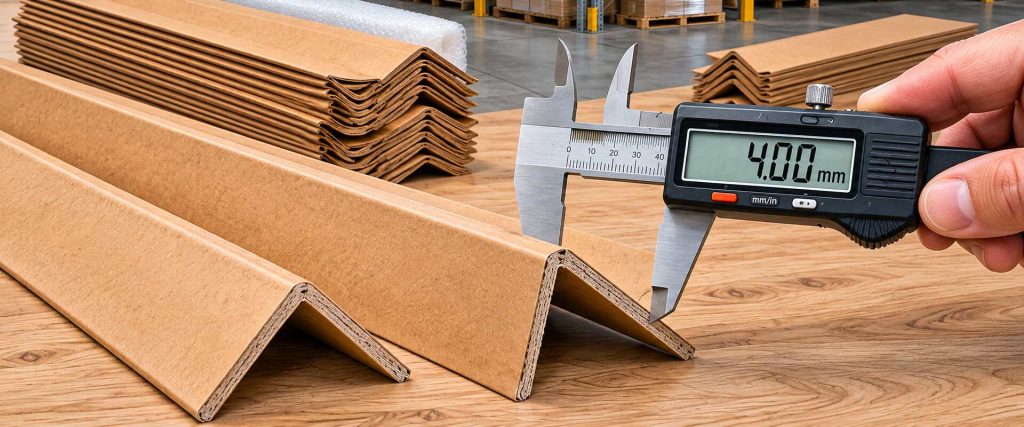
Paper edge protectors (corner boards) are used to safeguard the edges and corners of cartons and to distribute the localized pressure exerted by strapping.
When purchasing, the following specifications should be confirmed:
Width of each side of the edge protector
Thickness of the material
Length of the edge protector
Material composition and strength standards
Color or surface finish
Custom printing requirements (if applicable)
Purchase quantity and external packaging method
Example:
Paper edge protector: 50 × 50 × 4 mm, 1200 mm in length, made of natural-colored kraft paper.
When used for heavy palletized goods, the buyer should clarify the intended purpose of the edge protectors—whether for edge/corner protection, pressure distribution, or structural support during stacking.
The selection of dimensions and performance characteristics should be based on the actual load and the packaging structure.
6. Why should buyers clearly define packaging and labeling requirements?
The external packaging format of a product affects handling, warehousing, transportation costs, and warehouse operational workflows.
For instance, stretch wrap can be supplied in individual cartons or as large industrial-sized rolls.
Packing tape can be shipped as individual rolls, or it can be shrink-wrapped in bundles or packed into cartons.
Strapping coils may require specific pallet-stacking configurations or additional protective packaging. Buyers should specify the following:
Quantity per carton
Carton dimensions or maximum weight limits (if applicable)
Pallet stacking specifications
Shipping marks and barcode labels
OEM/private-label packaging requirements
For customized products, design drafts and label files must be confirmed before production begins. Clear packaging requirements help avoid the need for reworking or repacking, thereby preventing delays in delivery schedules.

7. What commercial details should be included in a Request for Quotation (RFQ)?
Providing technical specifications alone is not enough for a supplier to offer an accurate quote.
Suppliers also require information regarding commercial and logistical aspects.
| Commercial detail | Example |
| Order quantity | 10,000 rolls |
| Purchasing frequency | Monthly |
| Trade term | FOB Shenzhen |
| Destination | Houston, USA |
| Packaging requirement | Export cartons on pallets |
| Target delivery | Within 30 days after order confirmation |
| Payment terms | To be discussed |
| Sample requirement | Samples requested before bulk order |
Buyers should distinguish between the required production lead time and the expected arrival date.
When international shipping is involved, factors such as transit time, customs clearance procedures, and inland delivery all impact the final delivery date.
A comprehensive Request for Quotation (RFQ) ensures that suppliers provide quotes based on consistent commercial terms, making price comparisons more meaningful and reliable.
8. What common pitfalls should buyers avoid when issuing an RFQ?
Incomplete specifications often lead to discrepancies in quotes or necessitate extensive follow-up communication.
Common errors include:
Inconsistent standards for net weight: Two rolls of stretch film may have the same gross weight but contain different amounts of usable material.
Missing thickness parameters: The performance of films and adhesive tapes varies significantly based on their thickness and raw material composition.
Ambiguous units of length: Always specify the unit—such as meters, yards, or feet.
Failure to provide equipment details: Stretch films and strapping materials intended for machine use must be compatible with the specific equipment being operated.
Vague packaging requirements: Costs vary depending on the quantity per carton and the pallet stacking configuration.
Unclear delivery terms: International commercial terms (Incoterms) like FOB and CIF carry different cost implications and responsibilities.
Lack of performance metrics: Providing only dimensions fails to account for the required strength or specific functional needs of the product.
Before comparing quotes from multiple suppliers, buyers should carefully verify each of these details.

What is the best approach to preparing an RFQ for packaging products?
A high-quality RFQ for packaging should clearly outline technical specifications, actual usage scenarios, and procurement-related information.
Buyers should provide details on dimensions, materials, performance requirements, order quantities, outer packaging methods, and delivery terms.
If precise parameters are not yet available, including product photos, existing samples, equipment documentation, or descriptions of the usage environment can help suppliers better understand your requirements.
Yalan Pack manufactures hand-applied and machine-applied stretch film, as well as BOPP packing tape. The company also supplies PP/PET strapping and paper edge protectors, with products suitable for a wide range of industrial and export packaging applications. When requesting a quote, the buyer can provide detailed specifications, estimated order quantities, and shipping requirements.
A well-prepared request for quotation (RFQ) not only accelerates the supplier's response time but also facilitates direct product comparisons, minimizes information discrepancies, and supports more informed procurement decisions.
Share on Social:


-
PREV:
How Can Better Packaging Reduce Logistics Costs?
- NEXT: Null


