







Why Is Cost per Pallet More Important Than Price per Roll?
By hqt
Oct, 2026Related Posts

Why Is Cost per Pallet More Important Than Price per Roll?
Oct 30, 2026

What Packaging Documents Do European Buyers Commonly Request from Suppliers?
Oct 29, 2026

How Do You Calculate the Real Cost of Pallet Packaging?
Oct 28, 2026
What Packaging Materials Are Commonly Used in North American Warehouses?
Oct 23, 2026
When evaluating costs, the cost per pallet is a more meaningful metric than the price per roll, as it reflects the actual amount of stretch film consumed to wrap a single pallet. Some stretch films may have a lower price per roll, but they often require higher consumption, take longer to apply, and necessitate more frequent roll changes—all of which ultimately drive up total operational expenses.
Warehouse managers and procurement professionals responsible for packaging supplies can easily make poor decisions if they focus solely on the price per roll. A more sound approach involves assessing the actual usable film content, the amount of film consumed per pallet, operational efficiency, and the stability of the load once wrapped.
1. Why can the price per roll be misleading for procurement decisions?
Many stretch films look similar, yet the amount of usable material they contain can vary significantly.
Even if two rolls of stretch film have the same width and stated thickness, they may still differ in the following areas:
Total length of the film
Net weight of the film
Weight of the paper core
Thickness uniformity
Stretch performance (stretchability)
Packaging efficiency
For instance, a stretch film might be priced lower, but it could have a shorter length and a heavier paper core, resulting in less actual, usable film.
Conversely, another film might have a higher price per roll, yet it could wrap more pallets under the same conditions.
When selecting products, procurement teams should focus on the net weight of the film rather than the gross weight of the entire roll.
In the North American market, standard manual stretch film typically comes in an 18-inch (approx. 46 cm) width with a thickness of 60–80 gauge (where 1 gauge = 0.01 mil).
However, relying solely on width and thickness parameters is not enough to accurately calculate the packaging cost per pallet.
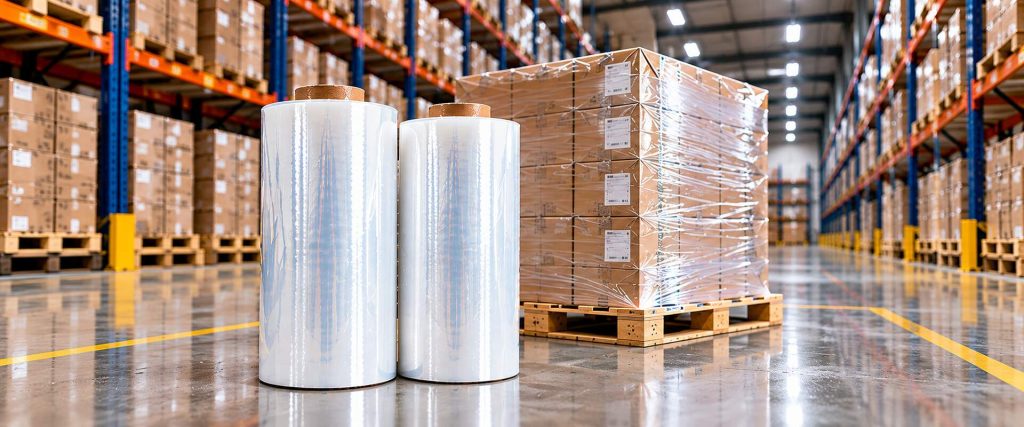
2. How do you calculate the stretch film cost per pallet?
Basic formula:
Cost per pallet = Price per roll of stretch film ÷ Number of pallets that can be wrapped per roll
We can illustrate this by comparing two different stretch film products:
| Item | Film A | Film B |
| Price per roll | $8.00 | $9.50 |
| Pallets wrapped per roll | 12 | 16 |
| Film cost per pallet | $0.67 | $0.59 |
At first glance, stretch film A appears to offer better value, as its purchase price per roll is $1.50 lower than that of film B.
However, film B can wrap 4 more pallets per roll.
Without rounding the figures, opting for film B reduces the film cost per pallet by approximately 11%.
The data above is provided for reference only. This comparison assumes that both products can achieve an acceptable level of load stability under the same pallet-wrapping conditions.
This example illustrates that procurement decisions should be based on actual performance in use, rather than solely on the initial price per roll.

3. Why is the net weight of the film a key metric?
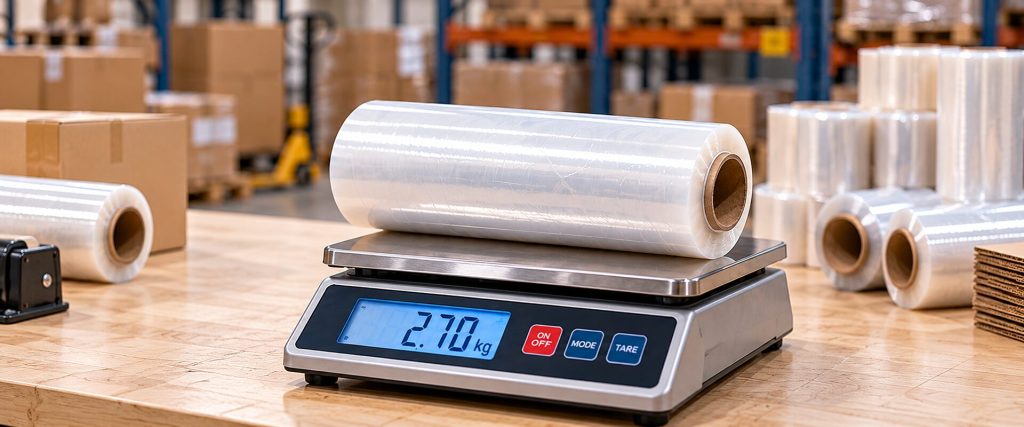
The net weight of the film represents the actual amount of stretch film available for use, excluding the paper core and any other secondary packaging components.
The gross weight of a roll refers to the total weight of the film combined with its paper core.
For example:
| Specification | Roll A | Roll B |
| Gross weight | 3.0 kg | 3.0 kg |
| Paper core weight | 0.5 kg | 0.3 kg |
| Net film weight | 2.5 kg | 2.7 kg |
Even if two rolls of stretch film have the same total weight, Roll B may contain 8% more "effective" material—that is, a greater amount of usable film.
Assuming the density, thickness, and stretching characteristics of the two films are similar, this difference means Roll B provides a longer usable length.
However, a higher net weight does not necessarily equate to better performance.
When evaluating products, procurement teams should consider a combination of factors: net weight, thickness, roll length, and actual film consumption.
4. How do a film’s stretching properties affect costs?
Stretch film is designed to be elongated during the wrapping process.
Machine-applied stretch film is typically used with a wrapping machine, which pre-stretches the film before it is applied to the pallet.
Different types of film require different pre-stretch settings.
For instance, if a film supports a higher pre-stretch ratio and is used with the appropriate equipment, it can cover a larger surface area on a pallet using the same amount of material.
Of course, a higher stretch ratio does not automatically guarantee lower packaging costs.
The final outcome depends on several variables:
The film’s formulation
Wrapping machine settings
Pallet dimensions
Cargo weight and stability requirements
Required containment force
The likelihood of the film tearing during the wrapping process
In manual (hand-wrapping) scenarios, the operator’s technique also influences the rate of film consumption.
Procurement teams should compare films under standardized testing conditions, rather than relying solely on the elongation or pre-stretch ratios stated in product marketing materials.

5. Can thinner stretch film reduce packaging costs?
While thinner stretch film can potentially reduce material usage, thickness alone does not determine packaging efficiency.
For example, if a warehouse currently uses a 20-micron film, they might test a 17-micron version.
If this thinner film—when paired with the right wrapping method—can still provide sufficient containment force, it becomes possible to achieve material reduction. However, using stretch film often requires increasing the number of wraps; furthermore, it is not well-suited for pallets containing goods with sharp edges, nor for use in harsh transport environments.
To conduct an objective and fair comparative assessment, the following dimensions must be considered:
| Evaluation factor | Why it matters |
| Film thickness | Influences material consumption and performance |
| Film strength | Affects resistance to tearing and breakage |
| Wrapping pattern | Determines coverage and reinforcement |
| Containment force | Helps maintain load stability |
| Film used per pallet | Determines actual material consumption |
| Load stability | Confirms suitability for transportation |
Our goal is not simply to select the thinnest possible stretch film.
The core objective is to identify the film specification that offers the best overall performance—maximizing packaging efficiency while ensuring the safety of palletized goods.

6. How do film breakage and wrapping time affect costs?
Material consumption is only one component of the total cost equation.
Frequent film breakage disrupts the packaging process, leads to material waste, and forces operators to re-wrap the load.
In high-turnover warehouses, such interruptions directly reduce operational efficiency.
The time spent on the wrapping process itself is also significant.
If a film is difficult to handle or fails to secure a load effectively, operators must spend extra time reinforcing each pallet.
In machine-wrapping scenarios, the compatibility between the film and the wrapping equipment is particularly critical.
Therefore, when evaluating film performance, focus on these key metrics:
Frequency of breakage
Time required to wrap a single pallet
Amount of material wasted
Equipment downtime
Number of instances requiring re-wrapping
A more stable, reliable product—even if it carries a higher price per roll—can often lower total operational costs in the long run.
Naturally, such benefits should be verified through on-site testing in the warehouse.

7. Why must pallet stability be included in cost comparisons?
Reducing film consumption is only truly valuable if the palletized load remains stable and secure.
If a packaging strategy is inadequate—leading to shifting cargo, damaged cartons, or the need for re-wrapping—what initially appears to be a cost-effective solution can actually result in additional expenses.
For instance, a 15% reduction in film usage might sound very attractive.
However, if the new wrapping method significantly increases the risk of cargo damage during transit, the overall cost will actually rise.
Consequently, a comprehensive cost evaluation must account for both material efficiency and pallet stability.
Key factors to assess include:
Cargo shape and weight distribution
The film’s binding and containment force
The effectiveness of securing the base layer of goods
Environmental conditions during transit
Requirements for loading, unloading, and handling
When necessary, standardized testing—simulating actual transport conditions—can be used to verify pallet stability. If the packaging fails to provide reliable protection for the goods, then even if the unit price of the stretch film is the lowest, the overall total cost may not be the most optimal.

8. How should a buyer compare different stretch film suppliers?
When initiating a request for quotation (RFQ), the buyer should provide a unified set of specifications and require suppliers to submit data that allows for direct, "apples-to-apples" comparison.
A rigorous and effective comparison checklist should include the following:
| Purchasing information | What to confirm |
| Film width | Inches or millimeters |
| Thickness | Gauge or microns |
| Roll length | Feet or meters |
| Net film weight | Excluding paper core |
| Gross roll weight | Including paper core |
| Film type | Hand or machine |
| Stretch performance | Suitable application conditions |
| Price | Per roll or per kilogram |
| Actual consumption | Film used per pallet |
For instance, when purchasing hand-applied stretch film—typically specified as 18 inches wide, 80 gauge thick, and 1,500 feet long—buyers should ensure that the supplier’s quote aligns with the actual usable length, true thickness, and packaging configuration.
For machine-applied stretch film, buyers should also provide the supplier with details regarding their packaging equipment model and operational parameters.
Conducting sample tests under standardized conditions is the most reliable way to compare the actual performance of different products.
How can you effectively reduce the cost of stretch film used for pallet wrapping?
The most effective approach is to track the amount of film consumed per pallet while simultaneously verifying the stability of the goods after they have been wrapped.
When making purchasing decisions, do not rely solely on the price per roll, the stated thickness, or the pre-stretch ratio.
Instead, conduct a comprehensive evaluation that considers the actual amount of material used, packaging efficiency, damage rates, labor requirements, and how the load performs during actual transit.
Yalan Pack produces a wide range of industrial stretch films—including both hand-applied and machine-applied options—suitable for various warehousing and logistics applications.
Buyers can provide their current film specifications, pallet dimensions, wrapping methods, and estimated purchase volumes; we can then help evaluate more suitable alternatives.A lower price per roll does not necessarily mean a lower total packaging cost. The core question to focus on is: what is the actual cost required to wrap a single pallet securely and stably?
Share on Social:


Contact Us
In This Article
Related Posts
Why Is Cost per Pallet More Important Than Price per Roll?
Oct 30, 2026
What Packaging Documents Do European Buyers Commonly Request from Suppliers?
Oct 29, 2026
How Do You Calculate the Real Cost of Pallet Packaging?
Oct 28, 2026
What Packaging Materials Are Commonly Used in North American Warehouses?
Oct 23, 2026


