







What Packaging Documents Do European Buyers Commonly Request from Suppliers?
By hqt
Oct, 2026Related Posts

Why Is Cost per Pallet More Important Than Price per Roll?
Oct 30, 2026

What Packaging Documents Do European Buyers Commonly Request from Suppliers?
Oct 29, 2026

How Do You Calculate the Real Cost of Pallet Packaging?
Oct 28, 2026
What Packaging Materials Are Commonly Used in North American Warehouses?
Oct 23, 2026
Before finalizing a partnership with a supplier, European packaging buyers typically request a range of documentation, including Technical Data Sheets (TDS), Certificates of Analysis (COA), declarations of material composition, test reports, and various compliance certificates.
Depending on the product category and its intended use, buyers may also request information related to REACH regulations, proof of recycled content, declarations of suitability for food contact, or documentation demonstrating compliance with the EU’s Packaging and Packaging Waste Regulation (PPWR).
Naturally, not every packaging product requires the full suite of these documents. Buyers distinguish between different types of documentation, such as technical specifications, batch-specific quality records, mandatory regulatory compliance certificates, and voluntary certifications.
1. Why do European buyers require supporting documentation for packaging?
Packaging-related documentation helps buyers verify product quality, confirm that technical parameters meet requirements, clarify their own regulatory obligations, and establish standardized criteria for procurement and acceptance.
For industrial packaging consumables—such as stretch film, BOPP adhesive tape, or PP/PET strapping—technical documentation is particularly crucial when comparing offerings from multiple suppliers.
Even if two products share the same stated dimensions, their actual performance can vary significantly due to differences in raw material formulations, production processes, and testing methodologies.
Consequently, European buyers often mandate a document review during the sample approval stage, trial orders, or prior to the shipment of full container loads.
The specific documentation required depends on the product itself, its intended application, and the responsibilities the buyer holds within the EU supply chain.

2. What is a Technical Data Sheet (TDS)?
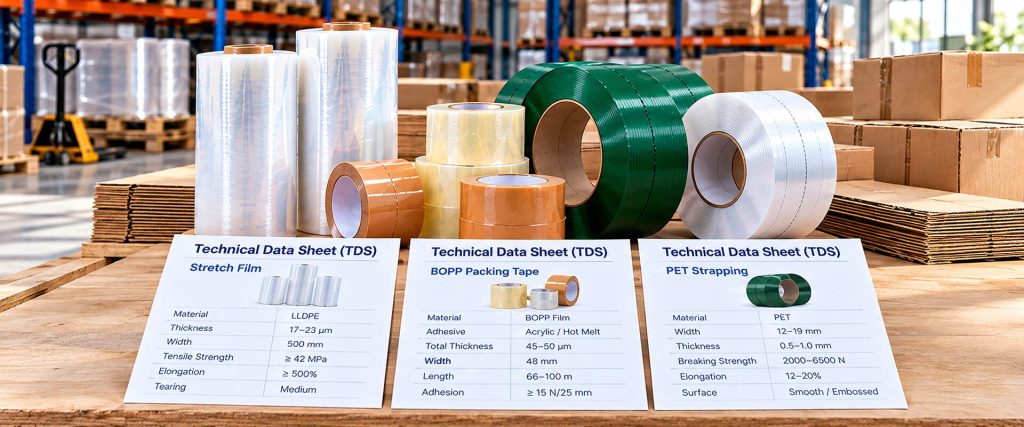
A Technical Data Sheet (TDS) outlines the core technical parameters of a product and is the most frequently used document in the procurement of industrial packaging.
For stretch film, a TDS typically includes the following information:
· Material composition
· Film thickness and width
· Tensile strength
· Elongation at break
· Self-adhesion (cling) properties
· Recommended storage conditions
For BOPP adhesive tape, a TDS generally specifies the total thickness, adhesive type, adhesion strength, and tensile properties.
For PET strapping, the TDS focuses on width, thickness, breaking strength, and elongation. While a Technical Data Sheet (TDS) is convenient for buyers to compare product specifications, it does not serve as proof of regulatory compliance. When comparing parameters, it is essential to also verify the corresponding testing standards and test conditions.
3. What is the difference between a Technical Data Sheet (TDS) and a Certificate of Analysis (COA)?
Although both documents relate to product quality, they serve entirely different purposes.
A Technical Data Sheet (TDS) presents the typical indicators or standard specifications of a product.
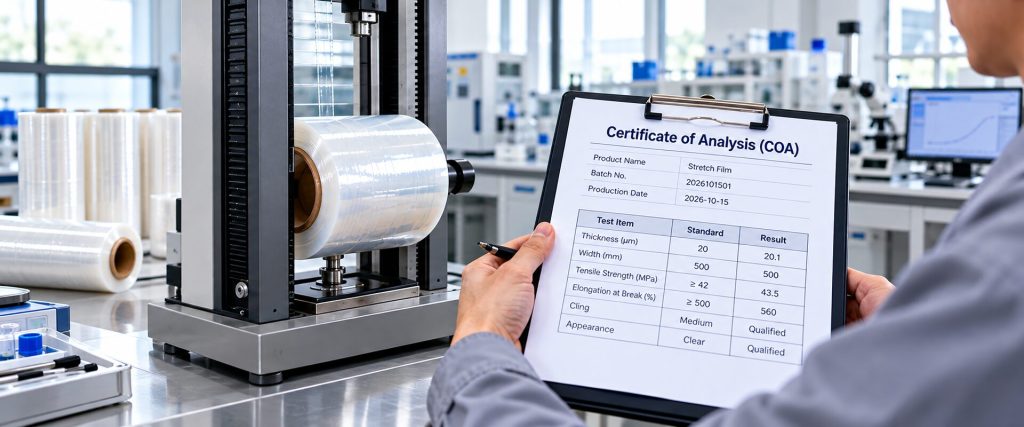
A Certificate of Analysis (COA) records the actual test data for a specific production or shipment batch.
For example, the TDS for stretch film might list its nominal thickness and standard mechanical properties, whereas a COA would specify the actual measured thickness, width, and other test results for that particular batch.
| Document | Main purpose |
| TDS | Describes product specifications and technical characteristics |
| COA | Reports batch-specific inspection or test results |
| Test report | Records results obtained using identified test methods |
| Declaration of conformity | States conformity with identified regulatory requirements |
Buyers should specify which testing parameters must be included in the Certificate of Analysis (COA) before production begins.
Not all suppliers automatically provide a batch-specific COA for every packaged product.
European buyers frequently ask suppliers about the chemical substances present in their packaging materials.
The REACH regulation is particularly significant, as it governs chemical substances within the European Union and outlines the associated compliance obligations.
Under Article 33 of the REACH regulation, if a product contains substances listed on the "Candidate List of Substances of Very High Concern" (SVHC) in a concentration exceeding 0.1% by weight, the supplier must provide specific information to the recipient. Depending on the circumstances, other obligations may also apply.
Buyers may request REACH-related declarations or supporting test data from suppliers to assess restrictions on specific substances and determine information-sharing obligations.
RoHS-related documentation is different.
The RoHS Directive primarily concerns restricted substances in electrical and electronic equipment. For standard items like stretch wrap, packaging tape, or plastic strapping, RoHS certification should not be automatically assumed as a mandatory requirement.
While a client might request RoHS-related testing due to their internal procurement policies, suppliers should clarify the purpose and scope of such requests.

5. What PPWR compliance documentation might buyers require?
The EU Packaging and Packaging Waste Regulation (PPWR)—Regulation (EU) 2025/40—introduces requirements for packaging conformity assessment and associated documentation.
Under Article 16 of the regulation, suppliers of packaging or packaging materials must provide manufacturers with the necessary information and documentation to demonstrate compliance with the PPWR’s requirements.
The regulation also mandates the preparation of technical documentation and an "EU Declaration of Conformity," with specific procedures and formats detailed in Annexes VII and VIII.
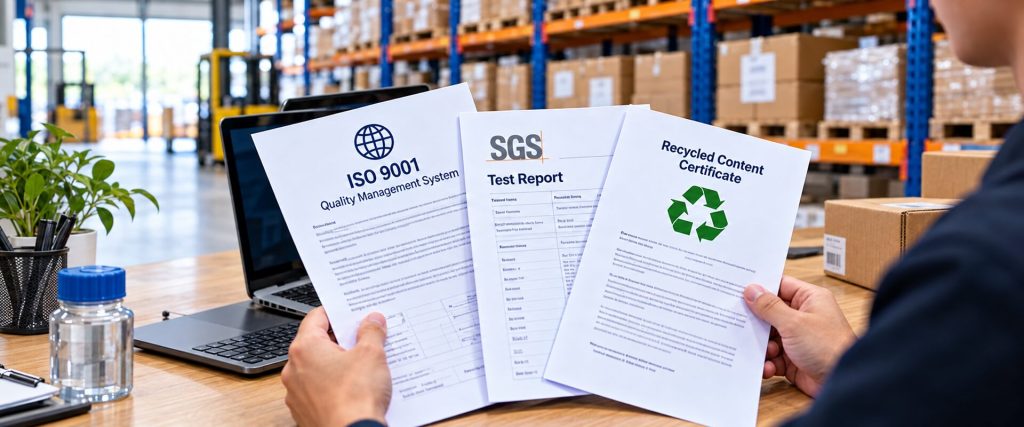
Depending on the type of packaging, supporting information may include material composition, technical specifications, test results, or documentation verifying the content of recycled materials. Buyers should not assume that an SGS test report, an ISO 9001 certificate, or a Technical Data Sheet (TDS) alone is sufficient to prove full compliance with the requirements of the Packaging and Packaging Waste Regulation (PPWR).
Relevant documentation must pertain to the specific type of packaging and align with the regulatory requirements applicable to that packaging at a given point in time.

6. When are a Declaration of Compliance for food contact and migration testing required?
Packaging intended for food contact is subject to stricter, additional requirements compared to standard industrial transport packaging. For plastic materials and articles intended to come into contact with food, EU Regulation (EU) No 10/2011 stipulates specific requirements, including a Declaration of Compliance and supporting documentation.
To demonstrate that a material meets the relevant requirements under its intended conditions of use, migration testing or other appropriate evidence of compliance may be necessary.
For instance, polyethylene film intended for direct food contact may require documentation that would typically not be needed for industrial pallet stretch wrap.
Buyers should clarify whether the product will come into direct contact with food.
A standard Technical Data Sheet (TDS) for industrial stretch wrap or a generic material declaration should not be accepted as proof that a product meets food-contact requirements.

7. Are ISO, SGS, and GRS certificates mandatory?
European buyers may request certificates or third-party verification documents.
However, these documents serve different purposes.
ISO 9001 relates to quality management systems.
SGS test reports provide independent test evidence regarding specific performance characteristics or the presence of certain substances.
GRS (Global Recycled Standard) is a voluntary certification system concerning recycled materials and "chain-of-custody" requirements.
None of the aforementioned documents should be considered universally mandatory certificates required for all packaging products entering the EU market.
Buyers should verify whether a specific certificate is required by law, internal procurement policies, or the specifications of their end customers.
Suppliers should also ensure that any claims regarding certification align with the actual scope and validity period of the certificates themselves.
8. What should buyers verify before accepting documents from a supplier?
Simply receiving a document does not equate to completing the verification process. Before approving a packaging supplier, buyers should verify that the information in the documentation aligns with the actual products being procured.
Key details to check include:
Product name and specifications
Manufacturer or issuing authority
Document issue date and version
Applicable test methods
Test results and units of measurement
Relevant regulations or standards
Batch identification (where applicable)
Certificate validity period and scope of product coverage
For example, a test report for PET strapping of a specific width and thickness cannot be automatically considered proof of compliance for products with different specifications. Similarly, certificates regarding recycled material content should be reviewed to ensure they cover the specific products in question and the relevant supply chain.
Clear documentation helps minimize misunderstandings prior to production and shipment.
The following checklist serves as a practical starting point.
| Document | When buyers commonly request it |
| Technical Data Sheet | Product specification evaluation |
| Certificate of Analysis | Batch quality verification |
| Material composition declaration | Material identification and compliance review |
| Test reports | Verification of mechanical or chemical properties |
| REACH-related information | Relevant chemical compliance assessment |
| PPWR supporting documents | Applicable EU packaging conformity assessment |
| Food-contact declaration | Relevant food-contact packaging applications |
| Recycled-content evidence | Where recycled content is specified or regulated |
| ISO or voluntary certifications | Supplier qualification or customer-specific requirements |
Before placing an order, it is essential to confirm the required documentation—a step that is particularly important when dealing with European clients who may have specific regulatory or technical requirements.
Yalan Pack offers stretch wrap, BOPP packaging tape, PP/PET strapping, and paper edge protectors, designed for industrial and export packaging applications.
During the inquiry stage, the buyer should provide product specifications, intended use, and documentation requirements. This allows both parties to evaluate existing technical data and determine whether additional testing is necessary.
An optimal documentation preparation process should begin with clear product specifications and a precise understanding of the applicable requirements—rather than simply collecting as many certificates as possible.
Share on Social:


Contact Us
In This Article
Related Posts
Why Is Cost per Pallet More Important Than Price per Roll?
Oct 30, 2026
What Packaging Documents Do European Buyers Commonly Request from Suppliers?
Oct 29, 2026
How Do You Calculate the Real Cost of Pallet Packaging?
Oct 28, 2026
What Packaging Materials Are Commonly Used in North American Warehouses?
Oct 23, 2026


