







7 Things Importers Should Check Before Buying BOPP Packing Tape
By hqt
Sep, 2026Related Posts

7 Things Importers Should Check Before Buying BOPP Packing Tape
Sep 21, 2026

Adhesive Packing Tape Testing Guide: Peel Adhesion, Tack, Holding Power and Tensile Strength
Sep 20, 2026

Polyester Strapping Supplier for Sustainable Recycled PET Packaging
Sep 20, 2026

How a Polypropylene Strap Supplier Develops PP Strap for High-Speed Packaging Machines
Sep 20, 2026
Before importing BOPP sealing tape, buyers should verify seven key aspects: tape dimensions, total thickness, adhesive type, paper core specifications, carton and pallet packaging methods, performance requirements, and shipping details.
If a quotation merely lists 48mm sealing tape or states only the price per roll, it is insufficient for a reliable price comparison. Products from two suppliers might appear identical on paper, yet differ significantly in actual roll length, adhesive coating weight, paper core weight, or quantity per carton.
For importers, the goal is not simply to find the product with the lowest price per roll. The primary objective is to ensure all suppliers quote based on standardized product specifications and trade terms.
1. Confirm tape width and roll length
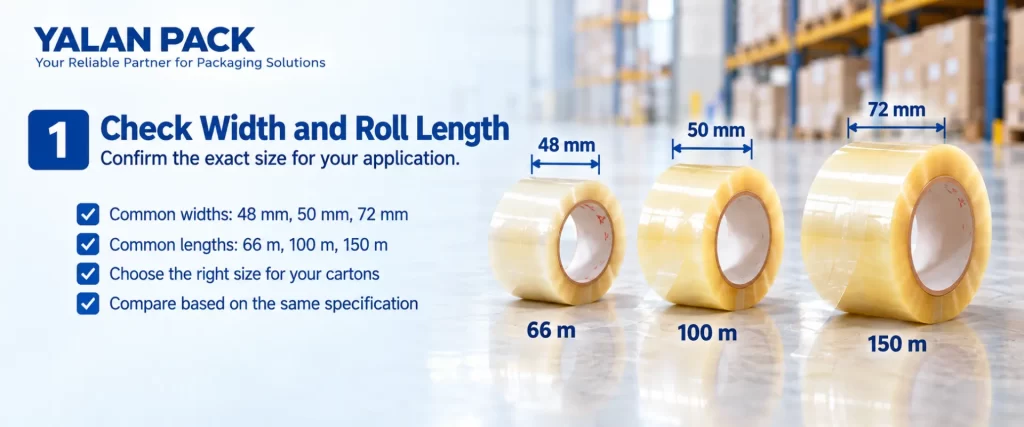
Importers must first verify the actual dimensions of the tape.
Common widths for sealing tape include 48mm, 50mm, and 72mm, while roll lengths vary widely depending on the market and application.
Examples:
48mm × 66m
48mm × 100m
50mm × 100m
72mm × 100m
These products cannot be compared solely on the price per roll.
Tapes with longer roll lengths contain more material and reduce the frequency of roll changes in high-volume packaging operations. Tape width directly affects the bonding surface area at carton seams.
Importers should require suppliers to clearly specify Width × Length and confirm the method used to measure roll length.
In bulk orders, even a slight deviation in roll length per unit can result in a significant cost difference when aggregated across thousands of rolls.
2. Confirm whether thickness refers to the film alone or the total thickness
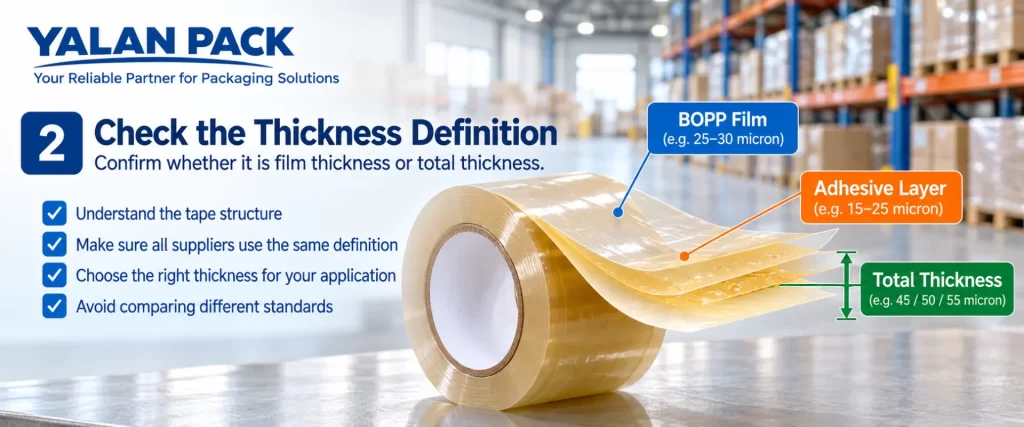
Thickness is the parameter most prone to misunderstanding when comparing BOPP sealing tape quotations.
Finished BOPP tape consists of two components:
BOPP film backing + Adhesive layer = Total tape thickness
Therefore, when a supplier quotes 45 microns, 50 microns, or 55 microns, the importer must confirm whether this figure represents the total thickness of the finished tape or merely the thickness of the BOPP film backing. If different suppliers define thickness differently, two tapes labeled 50 microns may not actually share the same internal structure.
Furthermore, the choice of thickness must match the specific application. A tape structure suitable for standard, lightweight cartons may not be appropriate for heavy-duty export cartons subject to repeated handling.
Key procurement principle:
Do not directly compare micron values until all suppliers use a standardized definition of thickness.
Price and performance comparisons are only meaningful when based on consistent standards.
3. Selecting the Right Adhesive: Acrylic or Hot-Melt
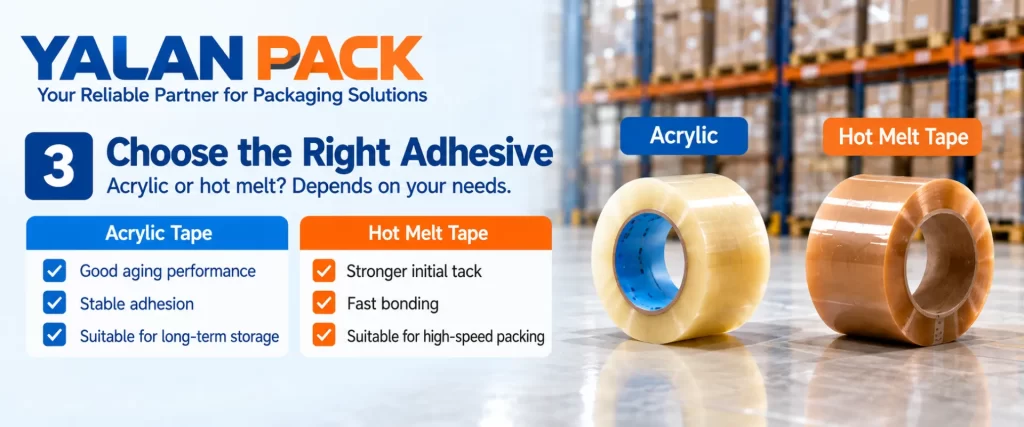
The adhesive system is just as important as the tape thickness.
Water-based acrylic BOPP tape is commonly used for standard carton sealing and is suitable for applications requiring balanced adhesion and aging resistance.
Hot-melt sealing tape is ideal for scenarios demanding high initial tack and rapid bonding, particularly on high-speed packaging lines.
No single type of adhesive is superior in every scenario.
Importers should conduct a comprehensive assessment based on:
Carton surface characteristics → Packaging speed → Storage duration → Usage environment → Required initial tack
For example, if tape detaches from rough recycled-paper cartons, simply increasing the thickness from 45 to 55 microns may not solve the problem; the type of adhesive is likely the root cause.
Before placing large import orders, it is advisable—conditions permitting—to test candidate adhesive types on the actual cartons used in your warehouse.
4. Confirming Paper Core Specifications
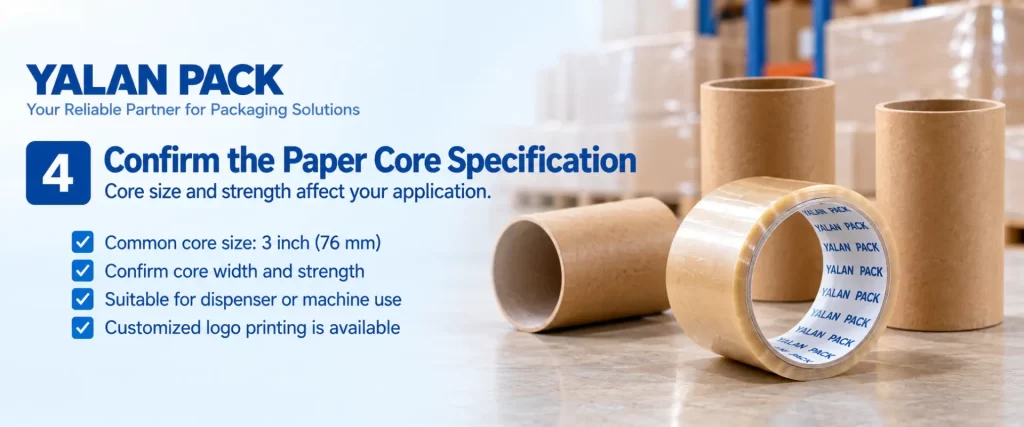
The paper core is a detail easily overlooked; while it plays no role in the actual sealing process, it directly determines roll compatibility, net packaging weight, and total procurement costs. When sourcing, importers must verify three key parameters: inner diameter, width, and load-bearing strength.
The 3-inch core is the standard specification for BOPP sealing tape, but manufacturing standards vary by region and supplier. Do not simply assume the standard size; specific requirements must be clearly stated. This is particularly critical for tapes used with handheld dispensers or fully automatic sealing machines, where even slight deviations in core dimensions can render the tape unusable on the equipment.
Customers with customization needs can also specify the core finish, choosing between plain cores or those printed with a brand logo. Additionally, when comparing prices based on roll weight, note that the core weight is included in the total roll weight but contributes nothing to the usable tape length. Only by clearly defining the full paper core specifications can you avoid procurement discrepancies where rolls look identical but differ vastly in actual adhesive quantity.
5. Verify Outer Carton Packaging, Pallet Stacking, and Container Loading Quantities
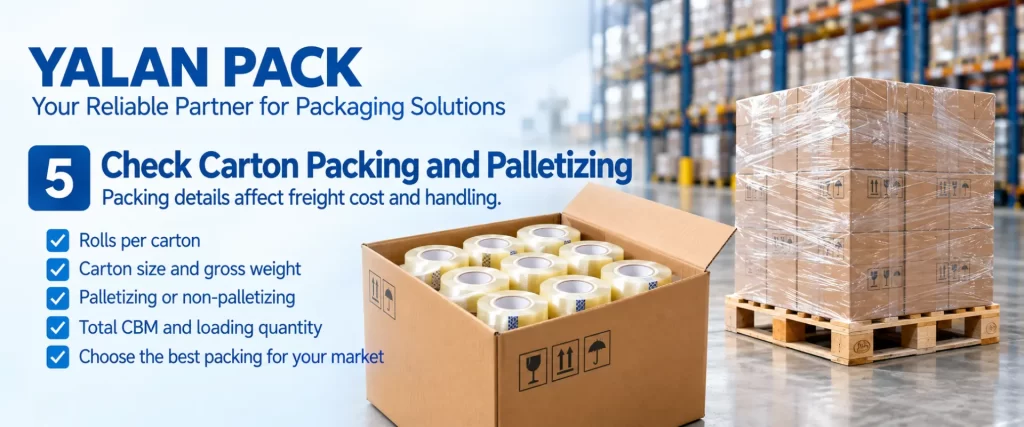
Product specifications represent only one aspect of purchasing adhesive tape; standardized export packaging directly impacts loading and unloading efficiency, logistics volume, freight costs, and the final landed cost. Before placing an order, importers must thoroughly verify key packaging and container loading details:
Number of rolls per carton, outer carton dimensions, gross carton weight, number of cartons per pallet, pallet dimensions, palletization requirements, total volume (CBM), and total container loading capacity.
Even if tape specifications are identical, different packaging standards can lead to significant differences. For instance, packaging configurations of 36 rolls per carton versus 72 rolls per carton differ vastly in terms of outer carton dimensions, warehouse stacking, and handling operations. Furthermore, while pallets stabilize cargo and facilitate loading and unloading, they also occupy limited container space, thereby reducing the effective cargo capacity.
For full container load (FCL) purchases, the focus should be on calculating the actual effective number of rolls rather than simply comparing the total number of cartons. For less-than-container load (LCL) purchases, the priority is total volume, as freight charges and destination port fees are calculated based on volume, which directly determines the overall logistics cost.
6. Verify product performance parameters based on specific needs
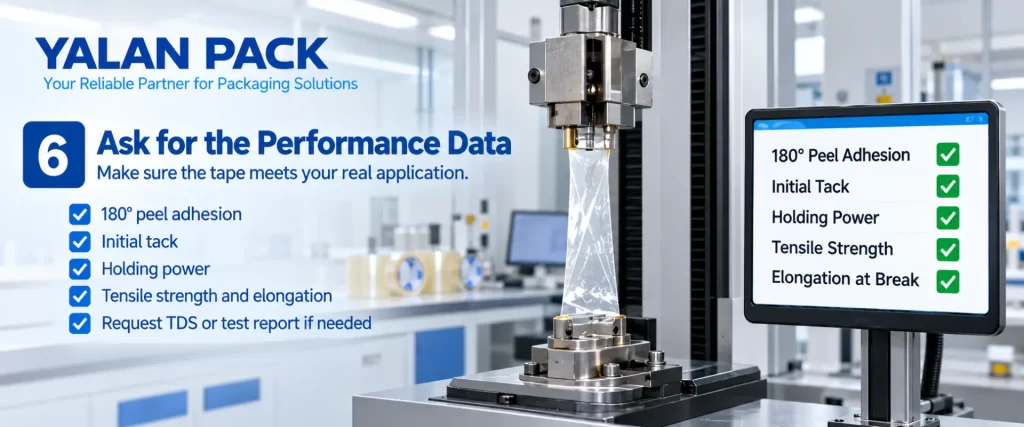
Professional technical specifications for BOPP tape go far beyond basic details like dimensions, thickness, and color. Depending on actual packaging conditions, importers should request key performance metrics from suppliers, such as 180° peel strength, initial tack, holding power, tensile strength, and elongation at break.
For routine procurement, there is no need to demand an exhaustive set of laboratory parameters; a targeted verification approach is more efficient. If tape detachment is a concern, focus on adhesive compatibility and peel adhesion; if tape breakage is the issue, prioritize substrate strength, thickness, and tensile properties; if failure occurs after prolonged storage, focus on the adhesive's aging resistance and storage suitability.
When engaging new suppliers, placing large orders, or handling high-end export projects, it is advisable to request a Technical Data Sheet (TDS), samples, and test reports prior to mass production to verify product suitability for your specific packaging, storage, and transportation scenarios. All performance parameters should align with actual operational challenges rather than relying solely on data on paper.
7. Confirm shipping standards, customs clearance documents, and trade terms
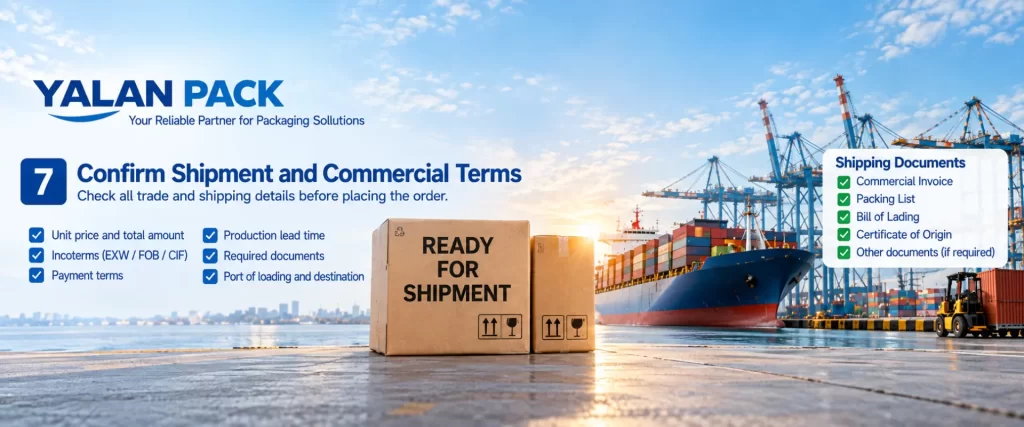
Once specifications are confirmed, trade terms and logistics documentation are the final critical factors ensuring smooth order delivery and hassle-free customs clearance. Before placing an order, both parties must reach a consensus on unit price, purchase quantity, Incoterms, payment terms, production lead time, port of shipment, packaging standards, and the full set of customs clearance documents.
Trade terms such as EXW, FOB, and CIF entail vastly different cost structures and scopes of liability; therefore, blindly comparing prices across different terms is inappropriate. For instance, an EXW price cannot be directly compared to a CIF quote that includes ocean freight and insurance.
It is also essential to confirm in advance the documentation required for customs clearance in the destination country, including commercial invoices, packing lists, bills of lading, certificates of origin, and various compliance test reports. All qualification documents must be finalized before mass production begins to prevent issues such as missing paperwork, customs clearance hurdles, or delivery delays after the goods have been shipped. A standardized final review helps mitigate procurement risks at the source—preventing situations where the product is technically sound but the logistics process fails.
Best Approach for Comparing BOPP Sealing Tape Suppliers
The core principle for comparing suppliers is to standardize all specifications before evaluating price and service. Price comparisons are only meaningful when based on identical procurement standards.
Recommended Standard RFQ Template:
Product: Transparent BOPP sealing tape
Dimensions: 48mm × 100m
Total thickness: 50μm
Adhesive type: Water-based acrylic
Core: 3-inch standard paper core
Color: Transparent
Packaging: 36 rolls/carton
Application: Export carton sealing
Order quantity: 10,000 rolls
Trade terms: FOB Shenzhen
When comparing prices, do not focus solely on the unit price per roll; instead, conduct a comprehensive assessment covering product specifications, adhesive performance, packaging standards, container utilization, documentation services, after-sales support, and the total landed cost.
Yalan Pack supplies BOPP sealing tapes featuring the two mainstream adhesive systems—water-based acrylic and hot-melt—covering transparent, colored, printed, low-noise, and customized options. We support customization across various widths, lengths, and thicknesses to meet all carton sealing and export packaging requirements.
Core Principle for Procurement: Standardize specifications first, then compare prices. Without standardized specifications, the lowest price does not necessarily represent the most cost-effective solution.
Share on Social:


Contact Us
In This Article
Related Posts
7 Things Importers Should Check Before Buying BOPP Packing Tape
Sep 21, 2026
Adhesive Packing Tape Testing Guide: Peel Adhesion, Tack, Holding Power and Tensile Strength
Sep 20, 2026
Polyester Strapping Supplier for Sustainable Recycled PET Packaging
Sep 20, 2026
How a Polypropylene Strap Supplier Develops PP Strap for High-Speed Packaging Machines
Sep 20, 2026


