







Adhesive Packing Tape Testing Guide: Peel Adhesion, Tack, Holding Power and Tensile Strength
By hqt
Sep, 2026Related Posts

Adhesive Packing Tape Testing Guide: Peel Adhesion, Tack, Holding Power and Tensile Strength
Sep 20, 2026

Polyester Strapping Supplier for Sustainable Recycled PET Packaging
Sep 20, 2026
How a Polypropylene Strap Supplier Develops PP Strap for High-Speed Packaging Machines
Sep 20, 2026

How a PP Strapping Factory Ensures Consistent Quality for Industrial Packaging
Sep 20, 2026
For industrial carton sealing, Adhesive Packing Tape should not be judged by hand tack, total thickness, or one laboratory number. A useful specification needs to separate four different functions: peel adhesion, initial tack, holding power, and tensile strength. Elongation and unwind behavior should also be reviewed when tape runs through automatic case sealers.
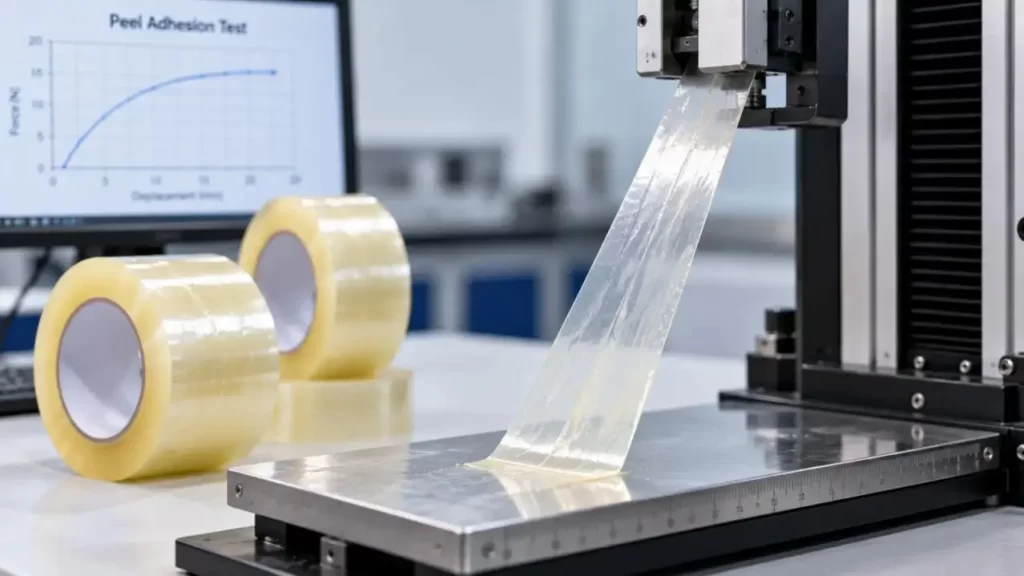
From Yalan Pack's manufacturing perspective, these properties need to work as a system. Its packaging tape range includes acrylic, hot melt, and solvent-rubber adhesives, while its machine tape is designed around consistent unwinding, adhesion, tensile performance, and continuous high-speed application.
What Each Adhesive Packing Tape Test Actually Measures
| Test | Typical Reporting | What It Explains |
| Peel Adhesion | N/25 mm, N/cm or oz/in | Resistance to tape removal |
| Tack | Rolling distance or loop-tack force | Immediate adhesive grab |
| Holding Power | Time under a specified shear load | Resistance to adhesive creep |
| Tensile Strength | N/25 mm, N/cm or lb/in | Backing strength before break |
| Elongation | % at break | Stretch behavior under tension |
A technically sound Adhesive Packing Tape specification should state the test method and conditions next to the numerical result. Without substrate, temperature, specimen width, dwell time, and test speed, a number may have little purchasing value.
Peel Adhesion: Measure Bonding Under Controlled Conditions
ASTM D3330/D3330M is the established test method for pressure-sensitive tape peel adhesion. Method A measures a single-coated tape at a 180° peel angle, while Method F uses a 90° angle. The standard is intended for evaluating adhesion uniformity within rolls, between rolls, and between production lots.
Peel results are affected by:
• Substrate: Stainless steel, kraft paper, recycled linerboard
• Dwell time: Immediate testing versus bond development after conditioning
• Peel angle and speed
• Application pressure
• Backing stiffness
• Adhesive coat weight
• Temperature and humidity
This matters because higher peel force does not automatically mean better carton performance. ASTM itself notes that peel adhesion does not always have a direct relationship with functional end-use requirements.
For Yalan Pack, peel testing is therefore most meaningful as a batch-control indicator, followed by validation on the customer's actual corrugated board.
Tack: Measure How Quickly the Tape Grabs
Initial tack becomes critical when Adhesive Packing Tape must secure a carton within seconds.
Typical situations include:
• Automatic carton sealing
• High-speed e-commerce fulfillment
• Stiff carton flaps
• Immediate conveyor transfer
• Rough recycled corrugated surfaces
ASTM D3121-25 uses a rolling ball to compare pressure-sensitive adhesive tack. Importantly, ASTM states that the method is primarily comparative and is not recommended by itself as an end-use product specification.
That distinction is important.
A hot-melt formulation may produce aggressive initial grab, while another adhesive may develop its final bond more gradually. Neither behavior alone determines whether an Adhesive Packing Tape will remain closed during a two-week warehouse period.
Holding Power: Detect Delayed Seal Failure
Holding power evaluates resistance to shear creep.
ASTM D3654/D3654M applies a sustained load parallel to the bonded tape surface and measures how the adhesive performs over time. The current standard includes shear-adhesion testing for pressure-sensitive tapes.
In a carton, the mechanism can be simplified as:
Flap recovery → sustained shear load → adhesive deformation → tape movement → edge lifting
Holding-power testing becomes particularly important for:
• Heavy cartons
• Double-wall corrugated cases
• Long-term warehousing
• Export shipments
• Elevated storage temperatures
This explains one common purchasing error:
High Tack ≠ High Holding Power.
An Adhesive Packing Tape can feel extremely sticky immediately after application while still showing creep under continuous load.
Tensile Strength and Elongation: Test the BOPP Backing
The adhesive cannot secure a carton if the backing film stretches excessively or breaks.
ASTM D3759/D3759M-05(2025) describes the breaking strength and the breaking strength elongation of pressure-sensitive tapes. It permits tests along the machine and cross directions. The method can be used in specifying a product, checking its quality, and characterizing the back-up material.
Tensile Strength Controls Breakage
Insufficient tensile strength may cause:
• Tape rupture in case sealers
• Failure during dispensing
• Damage across sharp carton edges
• Production interruptions
Elongation Controls Application Stability
Excessive stretch can cause:
• Tape necking
• Reduced effective width
• Uneven application tension
• Wrinkling
• Poor cutting
• Post-application rebound
Yalan Pack specifically positions its machine packaging tape for automatic carton sealing with consistent unwinding, reliable tensile strength, strong adhesion, and stable high-speed application.
Why Steel-Panel Results Must Be Verified on Corrugated Board
Laboratory steel provides repeatability. Corrugated board does not.
Real cartons vary in:
• Recycled fiber content
• Surface roughness
• Dust
• Moisture
• Ink coverage
• Coatings
• Porosity
• Flap stiffness
For a new Adhesive Packing Tape, a practical qualification program can therefore include:
- Immediate seal inspection after 1–5 minutes
- Peel and edge-lift inspection after 24 hours
- Recheck after 48–72 hours
- Temperature-conditioned carton tests
- Multiple carton-production batches
The objective is not the highest laboratory value. It is predictable carton closure under real shipping conditions.
Thickness Is Only One Part of Tape Construction
Total Adhesive Packing Tape thickness consists of:
BOPP Backing + Adhesive Layer
Two tapes with identical nominal thickness can produce different performance if the film gauge, adhesive coat weight, corona treatment, or adhesive chemistry changes.
A better purchasing specification combines:
| Parameter | Engineering Role |
| Total Thickness | Overall construction |
| Film Gauge | Mechanical strength |
| Adhesive Coat | Bonding behavior |
| Peel | Removal resistance |
| Tack | Initial grab |
| Holding Power | Creep resistance |
| Tensile | Breaking resistance |
| Elongation | Stretch control |
| Unwind Force | Machine stability |
Yalan Pack supports customized tape width, length, thickness, color, core size, printing, and adhesive system, allowing construction to be adjusted for different packaging equipment and markets.

Batch Consistency Matters More Than One Strong Sample
For distributors and industrial users, quality means repeatability across thousands of rolls.
Yalan Pack's packaging-tape production uses coating and slitting equipment, IQC, in-process inspection, finished-product testing, and 100% batch inspection. Its packaging-tape production capacity is listed at more than 5 million m² per month.
At that scale, quality control should track:
• Adhesive coat uniformity
• Peel and tack trends
• Holding performance
• Tensile and elongation
• Slitting accuracy
• Winding tension
• Roll-to-roll variation
Final Takeaway
Reliable Adhesive Packing Tape testing requires more than asking whether a tape is "strong."
Peel adhesion, tack, and holding power describe the strength and properties of adhesives. Peel adhesion and tack describe short-term resistance to removal and immediate grab. Holding power and creep resistance describe long-term shear force resistance. Tensile strength and percent elongation describe the extension and strength of BOPP backing.
The best qualification combines all these laboratory measurements with packaging cartons, storage conditions, temperature, and machine sealing.
As a packaging manufacturer, Yalan Pack has Adhesive Packing tape with the option on dimensions and the grade of the machine. For customers developing a new specification, and if customers provide the carton material, the sealing speed, the storage environment, and the desired test requirements to Yalan Pack, this allows a more useful technical basis for constructing the tape to meet the requirements of the packaging process.
FAQs
Q1. What types of Adhesive Packing Tape does Yalan Pack manufacture?
Yalan Pack manufactures BOPP Adhesive Packing Tape for carton sealing, warehousing, shipping, e-commerce packaging, and automatic case-sealing applications. Different adhesive and dimensional options can be selected according to the application.
Q2. What adhesive systems are available for Yalan Pack Adhesive Packing Tape?
Yalan Pack offers packaging tape with acrylic, hot melt, and solvent-rubber adhesive options. The appropriate system depends on carton surface, sealing speed, storage conditions, temperature, and required bonding performance.
Q3. How does Yalan Pack test Adhesive Packing Tape quality?
Adhesive Packing Tape quality can be evaluated through peel adhesion, initial tack, holding power, tensile strength, elongation, dimensional inspection, and finished-roll checks. Actual carton testing is also important for application validation.
Q4. Can Yalan Pack provide Adhesive Packing Tape for automatic carton sealing machines?
Yes. Yalan Pack supplies machine-grade Adhesive Packing Tape designed for automatic carton sealing and high-volume packaging lines where consistent unwind force, tensile strength, cutting behavior, and adhesion are important.
Q5. Does Yalan Pack support customized Adhesive Packing Tape specifications?
Yes. Yalan Pack supports customization of tape width, roll length, thickness, color, core size, adhesive system, and printing to match different carton-sealing equipment and packaging requirements.
Share on Social:


-
PREV:
Polyester Strapping Supplier for Sustainable Recycled PET Packaging
- NEXT: Null
Contact Us
In This Article
Related Posts
Adhesive Packing Tape Testing Guide: Peel Adhesion, Tack, Holding Power and Tensile Strength
Sep 20, 2026
Polyester Strapping Supplier for Sustainable Recycled PET Packaging
Sep 20, 2026
How a Polypropylene Strap Supplier Develops PP Strap for High-Speed Packaging Machines
Sep 20, 2026
How a PP Strapping Factory Ensures Consistent Quality for Industrial Packaging
Sep 20, 2026


