







Does Thicker Stretch Film Always Mean Stronger Pallet Packaging?
By hqt
Nov, 2026Related Posts

Why Does Stretch Film Not Stick Properly? 7 Common Causes and Solutions
Nov 11, 2026

Does Thicker Stretch Film Always Mean Stronger Pallet Packaging?
Nov 10, 2026

How Packaging Material Selection Impacts Your Total Logistics Cost
Nov 09, 2026

What Packaging Specifications Should Buyers Include in an RFQ?
Nov 06, 2026
A thicker stretch film does not necessarily result in a more secure palletized load. While increasing thickness can, to some extent, enhance certain mechanical properties, the overall stability of a palletized load also depends on the film’s formulation, puncture resistance, stretch characteristics, containment force, and the wrapping process itself.
Under identical usage conditions, a high-performance 17-micron stretch film may provide better load containment than a conventional 20-micron film. Naturally, the final outcome depends on the specific materials of the films being compared and the wrapping method employed.
By understanding this, procurement professionals can ensure reliable protection for palletized goods while avoiding unnecessary material waste.
1. What does the "thickness" of a stretch film actually represent?
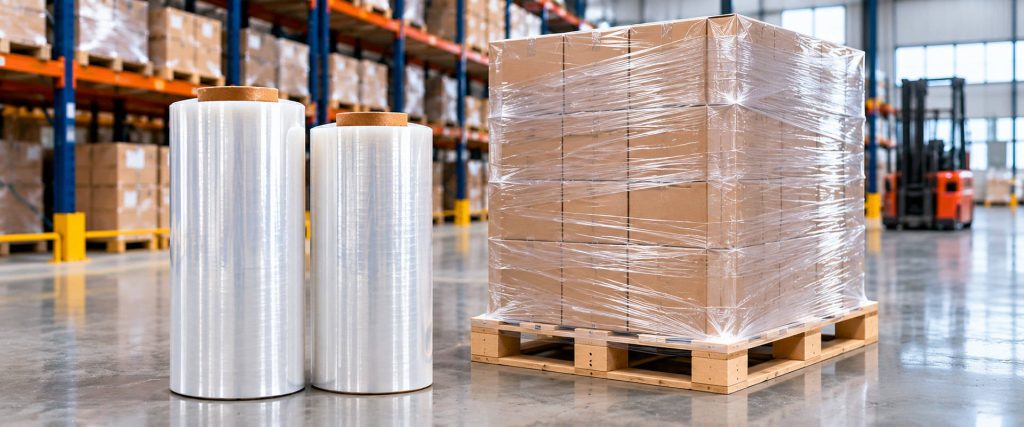
The thickness of a stretch film refers to its physical gauge, typically measured in microns (μm) or gauge units.
Common industrial specifications include 15μm, 17μm, 20μm, and 23μm.
Thickness influences the amount of material consumed and is linked to mechanical properties such as tensile strength, tear resistance, and puncture resistance.
However, thickness alone is not a complete indicator of a stretch film’s overall performance.
Even if two films have the same thickness, differences in resin formulation, production processes, and film structure can lead to significant variations in their mechanical performance.
Therefore, procurement teams should not simply assume that a thicker film automatically guarantees a more secure palletized load.
2. Why do some thinner stretch films perform better?
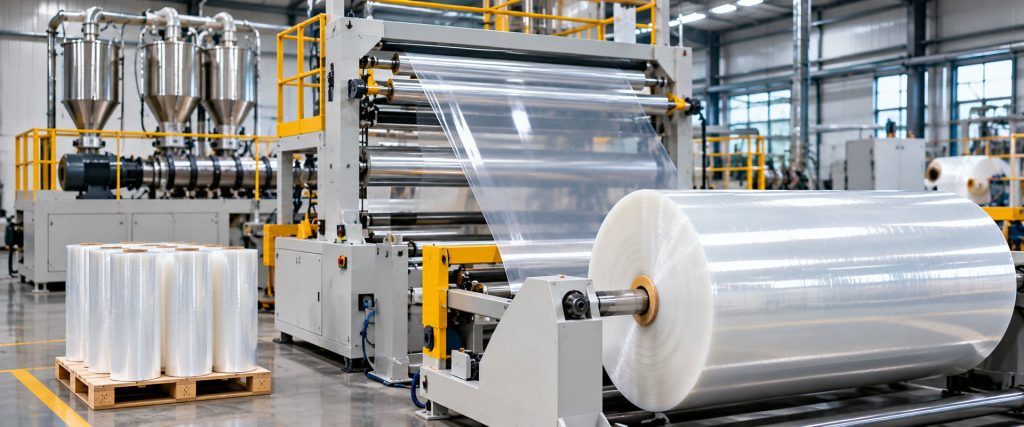
Modern stretch films are produced using specific polyethylene formulations and multi-layer co-extrusion structures; these factors directly determine how the film performs when stretched and applied to a pallet. A high-quality 17-micron stretch film can offer the following characteristics:
・Appropriate stretch properties
・Good elongation in real-world application
・Excellent puncture and tear resistance
・Consistent and uniform thickness
・Reliable load containment force
While a traditional 20-micron film uses more material, it does not necessarily perform better in every scenario.
Such performance differences must be verified through standardized comparative testing.
One cannot simply assume a product is superior to a thinner alternative just because a vendor labels it high-performance.
Actual performance is determined by a combination of the film’s formulation, the wrapping equipment used, and the specific characteristics of the goods being wrapped.
3. Is tensile strength more important than thickness?
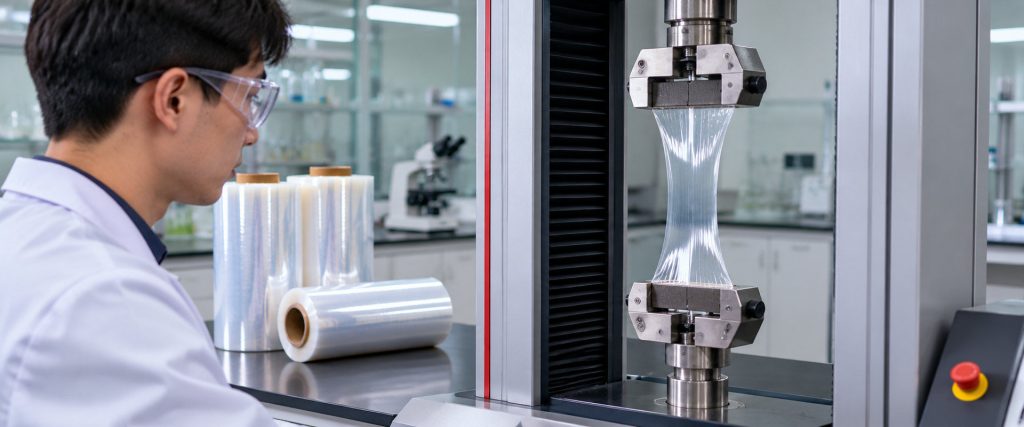
Tensile strength—the ability of a material to withstand tension under standardized test conditions—is a core metric for stretch film; however, it cannot determine pallet stability on its own.
For instance, some films may exhibit high tensile strength in a laboratory setting, yet fail to meet the elongation requirements for practical use, leading to poor results during the actual wrapping process.
Similarly, if the tension in the film decays too rapidly after application, it will fail to provide sustained, effective load containment, regardless of how well it stretches.
When evaluating products for procurement, one must consider a combination of factors: stretch properties, elongation, puncture resistance, and load containment force.
It is also important to distinguish between two concepts: tensile strength (expressed as stress) and the total tensile force a strip of film can withstand.
Because thicker films contain more material, they can generally withstand a higher total tensile force—even if the base material’s intrinsic tensile strength is identical to that of a thinner film.
Therefore, when comparing technical data sheets, always pay close attention to the testing standards, units of measurement, and specimen dimensions.
4. How does puncture resistance affect pallet protection?
Puncture resistance is particularly critical when goods feature sharp corners, irregular shapes, or protruding parts.
Throughout the wrapping process and long-distance transport, stretch film is constantly exposed to the sharp corners of cartons, the edges of pallets, or rough, uneven surfaces.
If the film is punctured or torn, its ability to secure and stabilize the palletized load is compromised. Generally, thicker films offer greater puncture resistance; however, their ultimate performance is determined by the resin formulation and the film's structural design.
When dealing with irregularly shaped or difficult-to-package goods, purchasers should prioritize the following:
・Puncture resistance metrics under standard test conditions
・Film toughness and tear/elongation resistance
・The presence of sharp corners or protrusions on the cargo
・Stretch-wrapping tension settings
・Supplementary edge and corner protection solutions
In some scenarios, paper edge protectors can safeguard vulnerable corners.
However, such protectors are not a substitute for proper pallet stacking methods or correct stretch-wrapping techniques.

5. Why is containment force critical to pallet stability?
Containment force—the force exerted by the stretch film to bind the load together and keep it secure—is the primary factor determining the stability of a palletized load.
If the wrapping tension is not set correctly, even a thick, highly tear-resistant film will fail to provide sufficient containment force. Conversely, when a film’s specific properties are well-matched to the application, even a thinner stretch film can achieve an ideal level of load containment.
Factors that influence the effectiveness of load containment include:
| Factor | Why It Matters |
| Film formulation | Influences stretch and recovery behavior |
| Wrapping tension | Affects the force applied to the load |
| Film overlap | Influences coverage and reinforcement |
| Number of wraps | Affects material distribution |
| Load geometry | Influences stability requirements |
| Film relaxation | May reduce containment after wrapping |
When conducting an assessment, one must consider both the containment force (securing force) and the stability of the load.
Applying excessive tension can easily crush cartons or damage the products; therefore, a higher containment force is not necessarily better.

6. Is the wrapping process more important than film thickness?
The wrapping process has a significant impact on the actual performance of stretch film.
If the wrapping method is improper, even high-quality film will struggle to secure a load on a pallet.
Common issues encountered in operations include insufficient containment force at the base, uneven overlap of film layers, excessive film tension, and inadequate reinforcement wrapping.
For instance, even if a 23-micron thick film is used, the load may remain unstable if the wrapping operation fails to secure it firmly to the pallet.
Conversely, when the wrapping process is executed correctly, a 17-micron or 20-micron film can actually perform better under the same handling conditions.
Of course, this does not mean that thinner film is always sufficient.
The core principle is that film thickness and the wrapping process must be evaluated in tandem.
To achieve stable and reliable packaging, warehouses should establish standardized wrapping procedures and verify load stability under actual handling conditions.
7. How do equipment parameters affect the performance of stretch film?
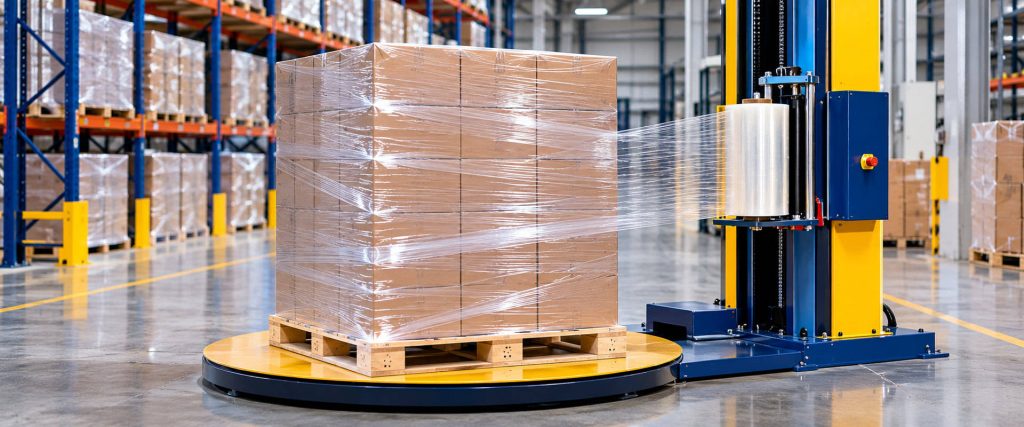
The effectiveness of machine-grade stretch film depends on how well it is matched with the wrapping equipment.
Key parameters include the pre-stretch ratio, film delivery tension, wrapping speed, number of wraps, and wrapping position.
If machine parameters are set incorrectly, a film designed for a specific pre-stretch ratio will fail to deliver its nominal performance.
For example, excessive stretching increases the risk of film breakage and weakens its long-term holding power.
Conversely, insufficient stretching merely increases material consumption without improving the quality of the packaging.
When comparing stretch films of different thicknesses, procurement teams should conduct comparative tests using the same type of palletized load, while ensuring that equipment parameters remain consistent and appropriate. The most reliable evaluation metrics are actual stretch film consumption, the frequency of film breaks, the effectiveness of load containment, and the stability of the palletized goods.

8. Can using a thinner stretch film reduce packaging costs?
Opting for a thinner stretch film can indeed reduce material consumption—provided that the required level of packaging protection is still met.
Consider the following case study:
| Specification | Film A | Film B |
| Thickness | 20 μm | 17 μm |
| Price per kg | $1.70 | $1.85 |
| Film used per pallet | 0.45 kg | 0.35 kg |
| Film cost per pallet | $0.77 | $0.65 |
Although the unit price per kilogram for Film B is higher, the lower quantity of material required per pallet results in a lower total material cost per pallet.
In this specific case, calculations based on precise, unrounded data show a cost saving of approximately 16%.
However, this cost saving is contingent upon one condition: both wrapping methods must ensure that the palletized goods remain sufficiently stable.
If switching to a thinner film necessitates an increase in the number of wraps, or if the likelihood of the film tearing rises significantly, the overall packaging cost may not necessarily decrease.
How should a buyer compare the strength of stretch films?
When selecting stretch film, buyers should not rely solely on thickness; instead, they should evaluate key performance indicators in the context of their specific operational requirements.
A practical assessment approach includes:
| Evaluation Item | What Buyers Should Check |
| Thickness | Actual thickness and tolerance |
| Tensile properties | Test values and measurement methods |
| Elongation | Suitability for the wrapping process |
| Puncture resistance | Performance around corners and edges |
| Containment force | Ability to restrain the intended load |
| Film consumption | Actual material used per pallet |
| Wrapping compatibility | Hand or machine application |
| Load stability | Performance during relevant handling and transport tests |
To ensure an accurate comparison, buyers should request Technical Data Sheets (TDS) and, if necessary, test samples under comparable conditions.
Yalan Pack manufactures hand-applied and machine-applied stretch films, as well as other industrial stretch-wrapping products, in a variety of thicknesses and roll specifications.
When evaluating potential alternatives, buyers can provide details such as current film specifications, pallet dimensions, wrapping methods, and specific performance requirements.
The most secure pallet wrap is not necessarily achieved by using the thickest stretch film; rather, the key lies in selecting a film with the appropriate performance characteristics and applying it correctly to the goods being wrapped.


Contact Us
In This Article
Related Posts
Why Does Stretch Film Not Stick Properly? 7 Common Causes and Solutions
Nov 11, 2026
Does Thicker Stretch Film Always Mean Stronger Pallet Packaging?
Nov 10, 2026
How Packaging Material Selection Impacts Your Total Logistics Cost
Nov 09, 2026
What Packaging Specifications Should Buyers Include in an RFQ?
Nov 06, 2026


