







What Thickness of BOPP Packing Tape Is Best for Carton Sealing?
By hqt
Sep, 2026Related Posts

Yalan Pack at the 140th Canton Fair 2026
Sep 18, 2026

Why Does Packing Tape Peel Off Cartons?
Sep 17, 2026

Pallet Film Wholesale Cost Analysis: Factors That Influence Bulk Stretch Film Pricing
Sep 17, 2026

Industrial Pallet Wrap for Automated Packaging Lines: Film Performance Requirements
Sep 17, 2026
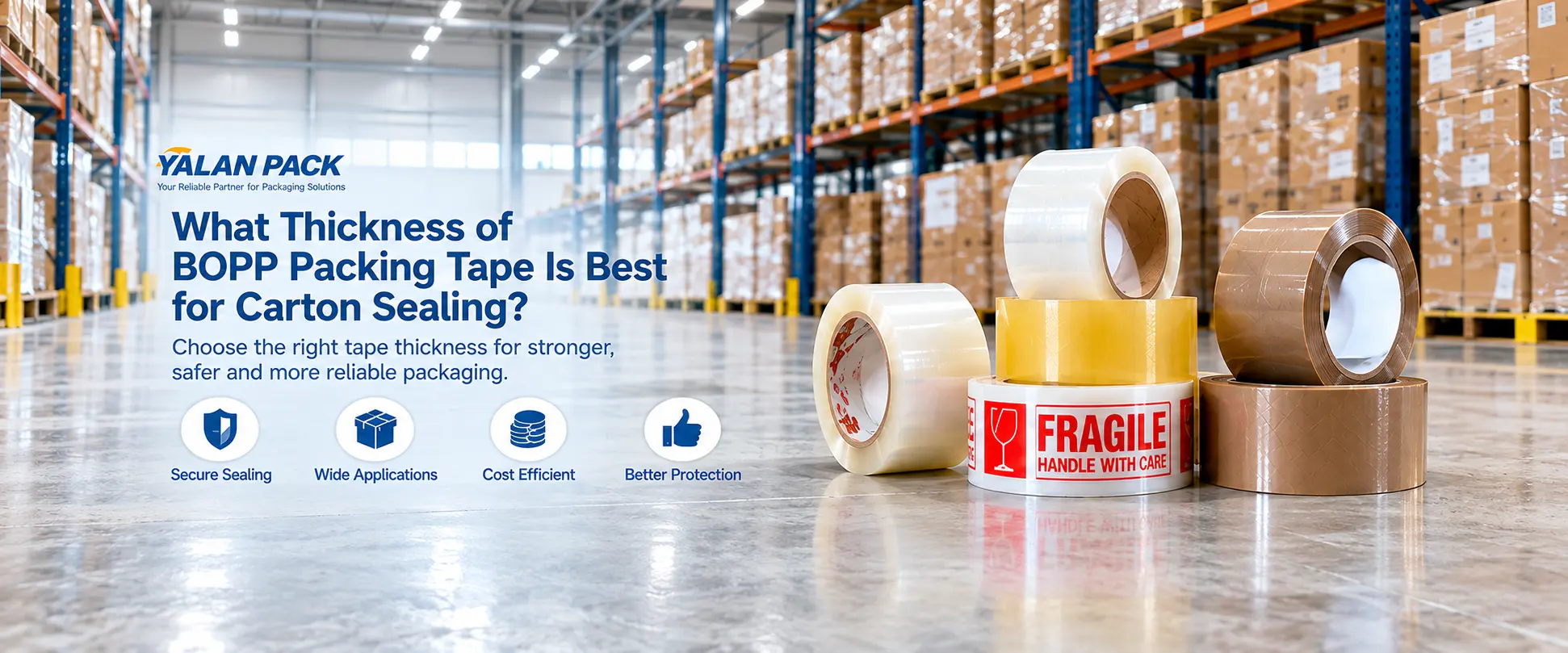
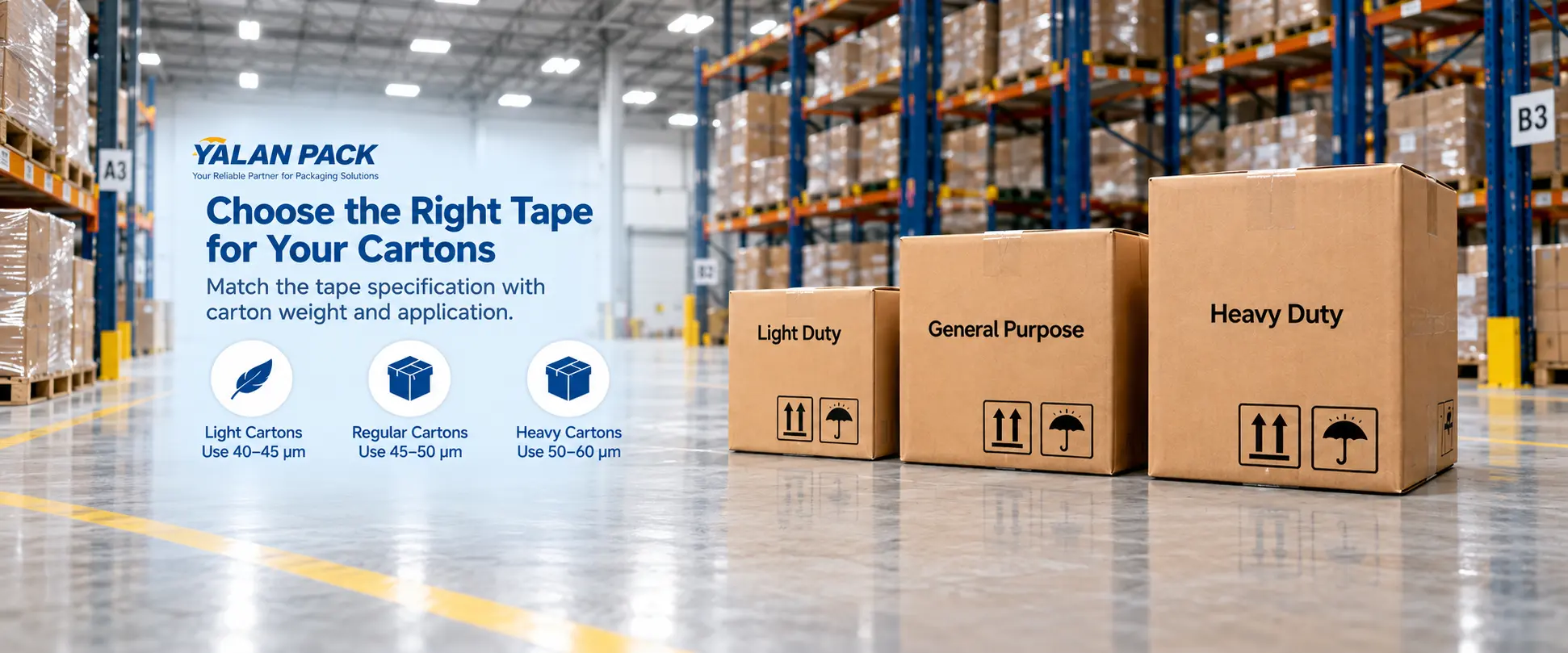
For most standard carton sealing applications, BOPP sealing tape with a total thickness of 40–50 microns is the standard choice. Thinner tape may be used for lighter cartons, whereas heavier cartons, rough handling, or harsh shipping environments require higher-specification tape.
However, there is no single universally optimal thickness that suits every carton. Selecting the right tape requires a comprehensive assessment of factors such as carton weight, board quality, surface condition, adhesive type, sealing method, and shipping environment; one cannot rely solely on the thickness metric.
What exactly does thickness mean for BOPP sealing tape?
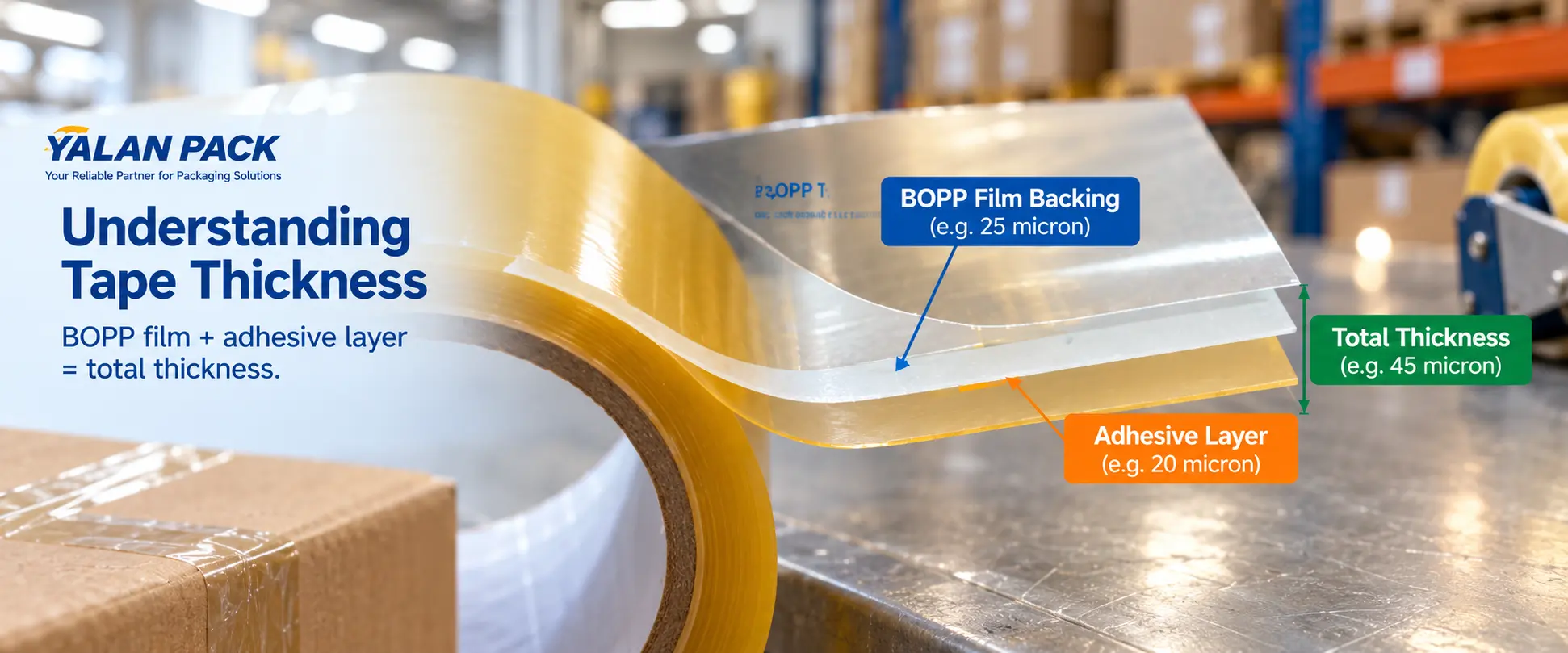
Before comparing price quotes, buyers must clarify the definition of thickness used by the supplier. Standard BOPP sealing tape consists of two core components: the BOPP film backing + the adhesive layer = total tape thickness.
A simple example: Tape with a nominal total thickness of 45 microns does not mean the BOPP backing film itself is 45 microns thick. Example structure: BOPP film: 25 microns; adhesive layer: 20 microns; total thickness: approx. 45 microns.
Actual ratios vary depending on product formulations and coating processes. This is a crucial point: if two suppliers quote 45-micron tape, the internal combination of film and adhesive may differ significantly. When requesting quotes, professional buyers should confirm whether the specified figure refers to the total tape thickness or only the thickness of the BOPP backing film.
How do 40, 45, 50, 55, and 60-micron sealing tapes compare?
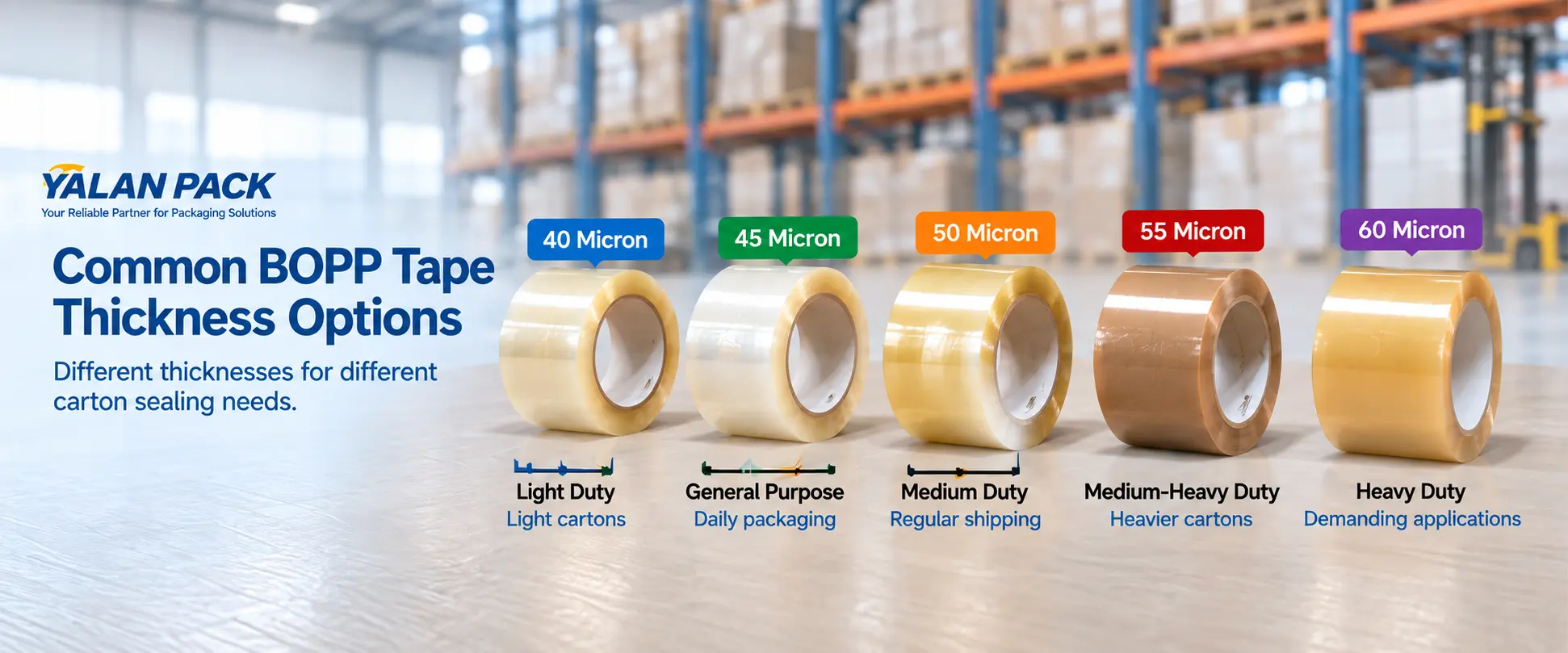
The table below serves as a general reference for selection rather than a universal load-bearing standard.
| Total Thickness | General Positioning | Typical Application |
| 40 micron | Economy / light duty | Light cartons, internal packing |
| 45 micron | General purpose | Everyday carton sealing |
| 50 micron | Medium duty | Regular shipping and export cartons |
| 55 micron | Medium-heavy duty | Heavier cartons, demanding handling |
| 60 micron+ | Heavy duty | Stronger sealing requirements |
These thickness ranges are for reference only.
High-quality 45-micron tape can sometimes outperform poorly designed, thicker tapes, as sealing performance also depends on film quality, adhesive formulation, coating uniformity, and the condition of the carton surface.
For this reason, thickness should never be the sole criterion for purchasing.
Is 45-micron BOPP tape suitable for sealing cartons?
Yes. When paired with the right adhesive and applied to suitable carton surfaces, 45-micron BOPP sealing tape is perfectly adequate for standard carton sealing operations.
It strikes a practical balance between material usage, ease of handling, and sealing performance.
For businesses handling standard corrugated cartons in warehouses, factories, or order fulfillment centers, 45 microns is a sensible specification to consider.
However, buyers should still test the tape if the cartons have the following characteristics:
·Heavy weight
·Made from a high percentage of recycled materials
·Rough surface
·Dusty surface
·Stored under special temperature conditions
·Subjected to harsh shipping environments
In these cases, simply increasing the tape thickness may not solve the underlying problem.
When should you consider using 50-micron or thicker sealing tape?
Thicker BOPP sealing tape may be more appropriate when cartons are subjected to significant mechanical stress.
For example, 50–60 micron tape should be considered for heavy cartons, export shipments, long-distance logistics, or applications requiring greater backing strength.
A thicker backing generally offers higher mechanical strength and tear resistance.
However, one point is crucial:
Backing strength and adhesive performance are two different concepts.
If the tape detaches from the carton, the issue may lie with the adhesive, the carton surface, or the operating environment, rather than insufficient total tape thickness.
Simply increasing the thickness from 45 microns to 50 microns will not automatically resolve all sealing failure issues.
Does a thicker BOPP tape necessarily mean better adhesion?
Not necessarily. Tape thickness and adhesion should not be viewed as the same specification metric.
Thicker tape offers a more robust backing, but adhesion depends largely on the adhesive system and coating.
Common adhesive systems for BOPP carton sealing tape include:
Water-Based Acrylic
Acrylic BOPP tape is widely used for general carton sealing and demonstrates good aging resistance in many standard packaging applications.
Hot Melt Adhesive
Hot melt tape is typically chosen when strong initial tack and rapid sealing performance are required.
Solvent-Based Adhesive
Depending on the required adhesion and environmental conditions, solvent-based tape may be selected for certain demanding applications.
Therefore, if a customer reports:
The tape doesn't stick well enough.
The correct solution is not necessarily:
Switch to a thicker tape.
Suppliers should first determine the type of adhesive used, the condition of the carton surface, and the application environment.
How does carton quality affect the required tape thickness?
The quality of the carton itself significantly impacts sealing performance.
Corrugated cartons with smooth, clean surfaces are generally easier to seal than those with rough or dusty surfaces, or those made from a high percentage of recycled materials.
Recycled cartons can present unique challenges, as their surface characteristics may reduce the effective contact area for the adhesive.
This means that two cartons of similar weight might require different tape specifications.
Before opting for thicker tape, buyers should consider:
Carton weight → Board quality → Surface condition → Adhesive → Tape structure
...rather than focusing solely on carton weight.
For cartons that are difficult to seal, improving adhesive adaptability is sometimes more effective than simply increasing the BOPP film thickness.
Are tape width and thickness equally important?
Yes. Width and thickness address different packaging issues. Common sealing tape widths on the market are 48mm and 50mm, while wider specifications—such as 72mm—are used for specialized packaging scenarios. Wider tape provides a larger bonding surface area at carton seams, while thicker tape generally implies more material and higher backing strength.
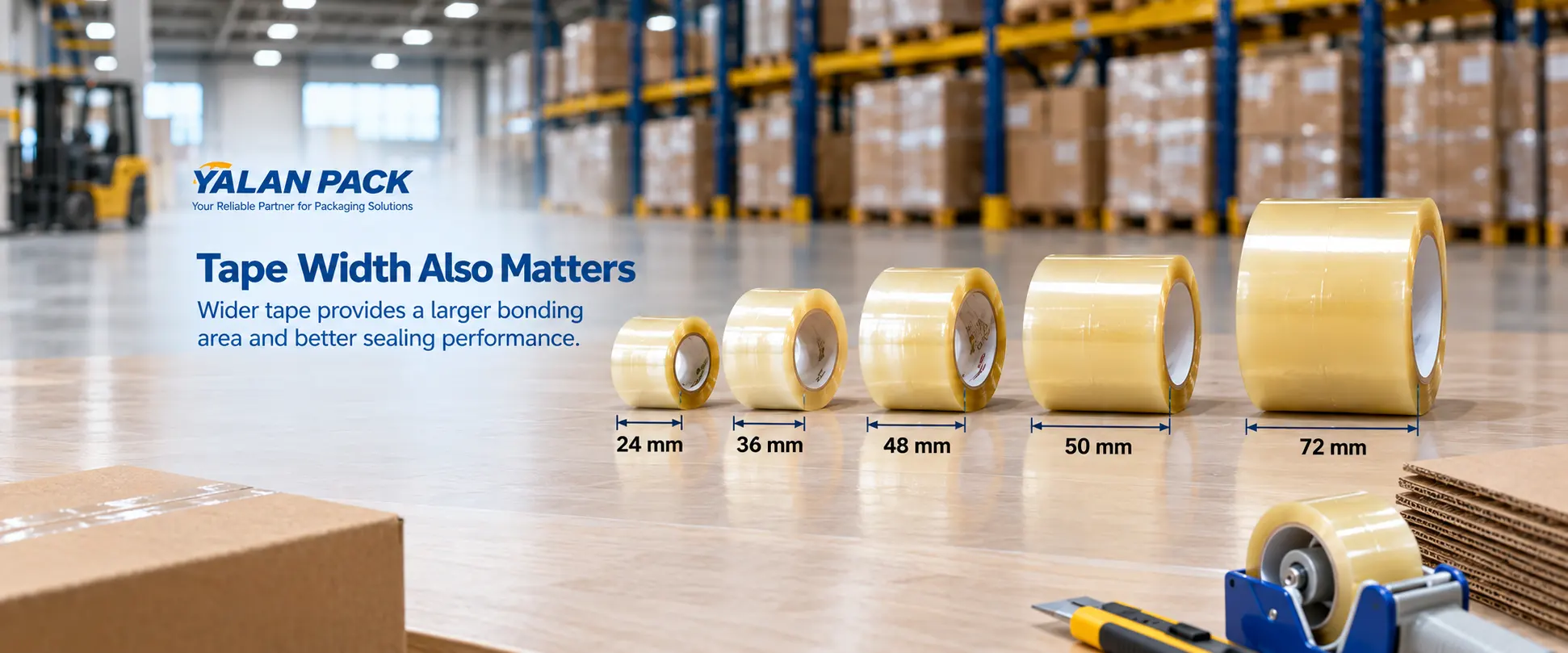
Therefore: Width ≠ Thickness ≠ Adhesion. These three metrics must be evaluated separately.
Example: Increasing tape width from 48mm to 72mm significantly expands the bonding area but does not alter the adhesive formula or the inherent properties of the backing material.
What is the difference between manual and automatic sealing?
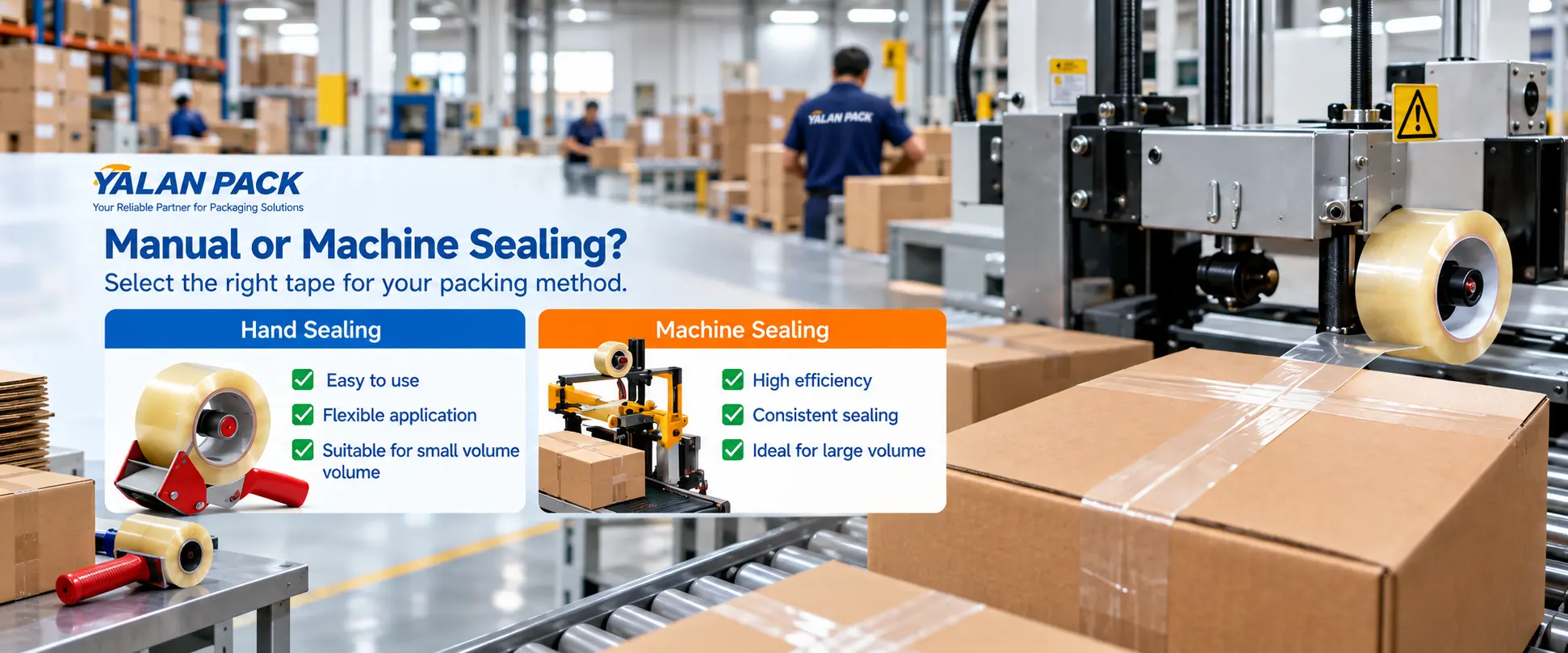
Application method is another key factor for purchasers to consider. For manual sealing, the tape must be compatible with dispensers, allowing for smooth unwinding and cutting while ensuring sufficient adhesion to the carton.
In contrast, automatic sealing machines demand higher standards regarding roll specifications, unwinding performance, adhesive consistency, and batch uniformity. Tape that fails to meet specifications directly reduces equipment operating efficiency.
Therefore, bulk purchasing decisions should not be based solely on the price per roll. Frequent tape breakage, sealing failure, or equipment downtime can lead to additional labor and production costs.
Should you buy the thickest sealing tape available?
Generally, no.
Selecting tape that is excessively thick increases material usage and procurement costs without necessarily improving sealing performance. If 45-micron tape provides a secure seal under actual shipping conditions, switching to 60-micron tape simply for the sake of extra strength only drives up packaging costs without delivering tangible benefits.
Conversely, prioritizing low prices by choosing tape that is too thin can lead to issues such as carton damage, the need for multiple layers of tape, or even sealing failure.
A more rational selection approach: Choose the material specification that reliably meets sealing performance requirements while balancing packaging protection capabilities with overall costs.
What specifications and parameters should be confirmed before purchasing BOPP tape?
When requesting a quote from a supplier, do not simply provide the tape dimensions. A complete inquiry should include details such as: Product Name (e.g., Clear BOPP Sealing Tape), Width (e.g., 48mm), Length (e.g., 100m), Total Thickness (e.g., 45 microns), Adhesive Type (e.g., Water-based acrylic), Color (e.g., Clear), Core Size (e.g., 3 inches), Application (e.g., Carton sealing), and Packaging (e.g., 36 rolls/carton).
For demanding applications, buyers should also provide information regarding carton weight, cardboard material, operating temperature, storage environment, and sealing method. This enables the supplier to recommend specifications suited to actual working conditions, rather than simply suggesting the lowest-priced product.
Summary: Which BOPP tape thickness should you choose?
For most standard carton sealing scenarios, a total thickness of 40–50 microns is a solid baseline range; 45 microns is the preferred choice for general-purpose packaging.
For heavy-duty or high-demand cartons, consider specifications of 50, 55, or 60 microns (or higher). However, the appropriate thickness must be determined by evaluating several factors: BOPP backing material, adhesive type, coating weight, tape width, carton surface characteristics, and the usage environment.
Yalan Packaging offers BOPP sealing tapes with various adhesive systems—such as water-based acrylic and hot-melt—including clear, colored, printed, low-noise, and custom options, with a wide range of widths, lengths, and thicknesses available.
The core purchasing principle is simple: Instead of just asking How thick is the tape?, ask Is the tape's construction suitable for my cartons and shipping conditions? This approach ensures you select a more reliable carton sealing solution.


Contact Us
In This Article
Related Posts
Yalan Pack at the 140th Canton Fair 2026
Sep 18, 2026
Why Does Packing Tape Peel Off Cartons?
Sep 17, 2026
Pallet Film Wholesale Cost Analysis: Factors That Influence Bulk Stretch Film Pricing
Sep 17, 2026
Industrial Pallet Wrap for Automated Packaging Lines: Film Performance Requirements
Sep 17, 2026


