







Why Does Packing Tape Peel Off Cartons?
By hqt
Sep, 2026Related Posts

Yalan Pack at the 140th Canton Fair 2026
Sep 18, 2026

Why Does Packing Tape Peel Off Cartons?
Sep 17, 2026

Pallet Film Wholesale Cost Analysis: Factors That Influence Bulk Stretch Film Pricing
Sep 17, 2026

Industrial Pallet Wrap for Automated Packaging Lines: Film Performance Requirements
Sep 17, 2026
When carton sealing tape detaches from a box, it is usually because the adhesive fails to form or maintain a sufficient bond with the cardboard surface. Seven common causes for this issue include: rough or recycled-fiber cardboard surfaces; dust or moisture on the surface; insufficient application pressure; unsuitable ambient temperatures; incorrect adhesive selection; inconsistent tape quality; and harsh storage or transportation environments.
It is important to note that tape detachment is not necessarily caused by insufficient tape thickness. If the tape itself remains intact but lifts or peels away from the carton, the root cause is typically the bonding performance rather than the thickness of the backing material. Before considering an upgrade from 45-micron tape to 50 or 55-micron versions, you must first accurately identify where, when, and how the tape failure occurs.
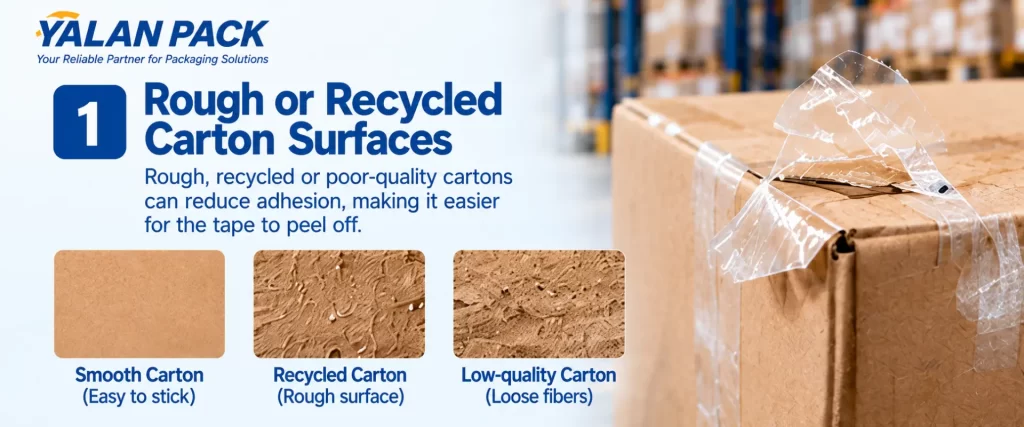
Rough or recycled cardboard surfaces
Start by examining the carton material. Sealing tape adheres more effectively to clean, smooth corrugated cardboard. Cardboard with a high recycled fiber content often has a rough surface, high porosity, and exposed fibers, all of which reduce the effective contact area between the adhesive and the board. This explains why the same roll of tape might stick firmly to some cartons but detach easily from others. If the tape only fails on recycled or rough-surfaced cartons, simply increasing the tape thickness may not solve the problem; the adhesive properties need to match the actual surface conditions of the cardboard. For difficult-to-bond cartons, conduct tests directly on the cartons actually used by the customer; do not judge adhesion quality merely by touching the adhesive surface with your hand or applying it to a smooth test panel.
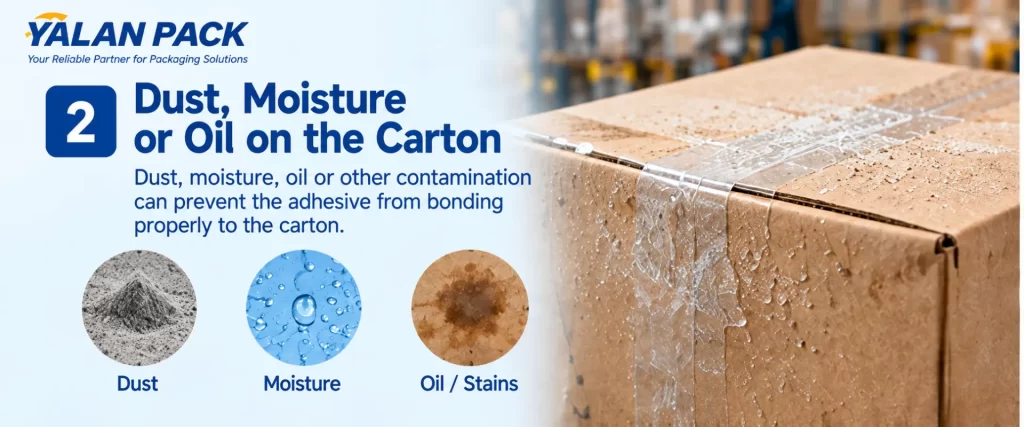
Dust, moisture, or oil/grease on the carton surface
Even with the right tape, adhesion will fail if contaminants are present on the carton surface. Factory and warehouse environments are prone to dust accumulation. When tape is applied to a dusty carton, the adhesive attaches to loose dust particles instead of bonding directly to the cardboard. Moisture, oil, grease, and other contaminants can cause similar issues. Simple troubleshooting method: Take a roll of the same tape and apply it to both a clean, dry carton and a carton experiencing the detachment issue for a comparative test. If there is a significant difference in adhesion, the condition of the carton surface can generally be identified as the source of the problem.
Best practice: Ensure cartons remain clean and dry before sealing, and minimize dust and contaminants in the packaging area. For particularly challenging applications, a tape with stronger adhesion may be used as a supplementary measure, though improving the carton surface condition should remain the priority.
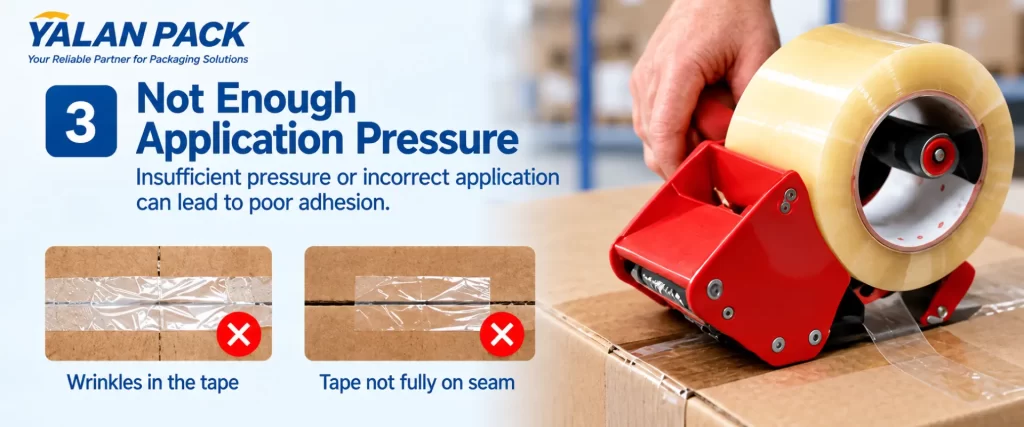
Insufficient Pressure Application
BOPP carton sealing tape is a type of pressure-sensitive tape; it requires full contact with the carton surface to form a reliable bond. If an operator merely places the tape over the carton seam without applying sufficient pressure, parts of the adhesive layer may fail to adhere completely to the cardboard surface. Additionally, issues such as tape wrinkling, uneven application, or insufficient tape overlap at the carton ends can lead to bond failure. When sealing manually, using a compatible tape dispenser helps ensure even pressure application. For automatic sealing equipment, it is necessary to inspect the pressure rollers, tape path, equipment settings, and carton alignment.
A simple rule of thumb: If the same tape performs well for most operators or machines but repeatedly fails at a specific packing station, the problem is likely not the tape itself.
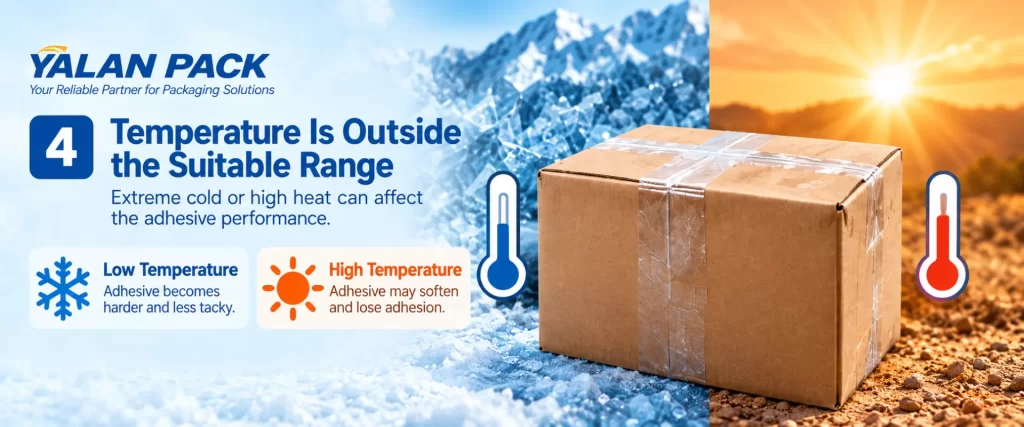
Temperature Outside the Applicable Range
Temperature significantly affects the performance of pressure-sensitive adhesives. When the temperature falls below the recommended application range, the flowability of certain adhesives decreases, making it difficult to form an effective bond with the carton. Conversely, high temperatures can alter adhesive properties, depending on the specific adhesive formulation.
Purchasers should distinguish between two metrics: *Application temperature* (the ambient temperature at the moment the tape is applied) and *Service temperature* (the ambient temperature the carton is exposed to after sealing).
Examples include sealing cartons in a factory at room temperature before storing them in a cold warehouse, or packing goods in a cool environment before shipping them in containers subject to high temperatures during sea transport. Do not assume that all acrylic or hot-melt tapes share the same temperature resistance characteristics. When temperature is a critical factor, always confirm the applicable temperature range for the specific adhesive formulation with the supplier.
Mismatch Between Adhesive Type and Usage Scenario
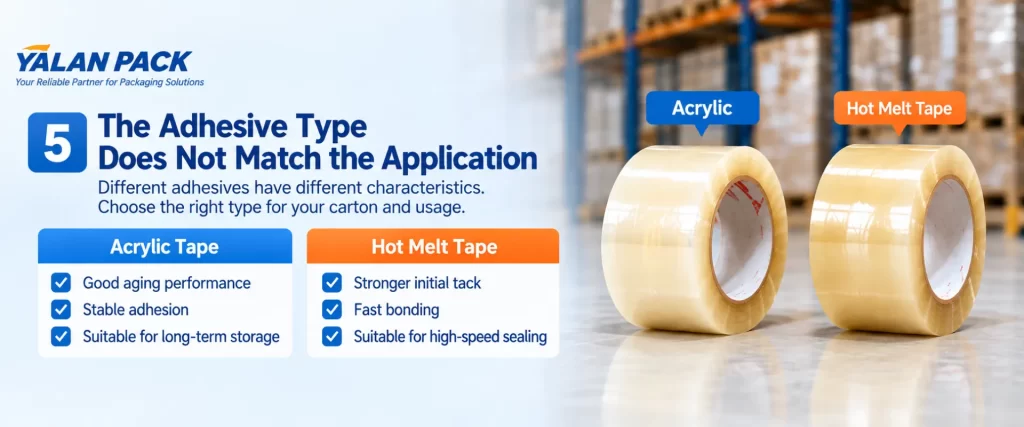
Both acrylic BOPP tape and hot-melt BOPP tape are suitable for carton sealing, yet they exhibit distinct bonding characteristics. Water-based acrylic tape offers versatility, balanced adhesion, and excellent aging resistance, making it widely used for general packaging applications. However, if high initial tack and rapid bonding are required, hot-melt tape is generally the preferred choice.
No single type of adhesive is suitable for every type of carton. Selection should take into account the carton's surface material, packaging speed, storage duration, and environmental conditions. When tape frequently peels off (without the tape itself breaking), switching the adhesive system is often more effective than simply increasing the tape thickness.
Purchasers should distinguish between the two: backing thickness determines mechanical strength, while the adhesive determines bonding performance.
Even with 55-micron-thick tape, an incompatible adhesive can still lead to peeling from the carton; conversely, with the right selection, 45-micron or 50-micron tape can provide a secure seal.
Inconsistent tape quality or adhesive coating weight
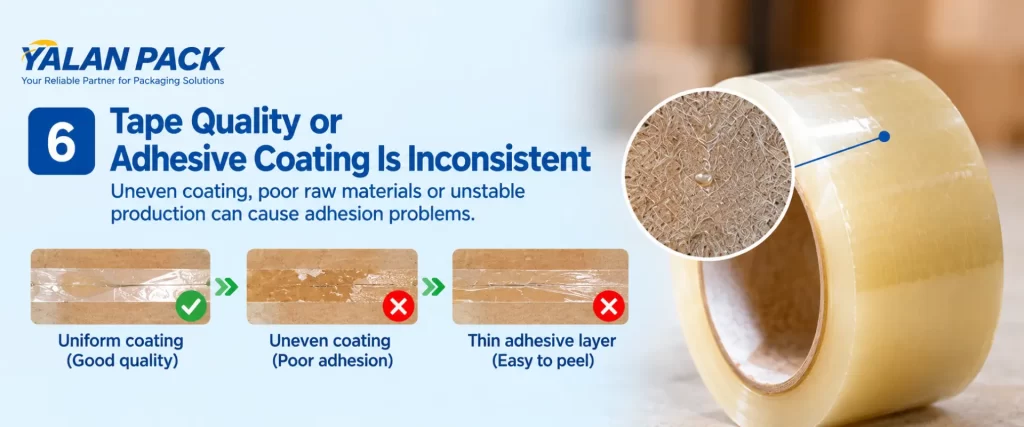
Two BOPP tapes with identical specifications may still differ in performance. For instance, two suppliers might both list dimensions of 48mm x 100m x 50μm, yet there can be variations in the BOPP backing material, adhesive formula, coating weight, and manufacturing process stability.
Uneven adhesive application leads to fluctuations in tackiness—either within a single roll or across different batches. Film quality also affects unwinding performance and actual sealing effectiveness.
When evaluating carton sealing tape, buyers should not rely solely on the price per roll or total thickness (microns). For routine or bulk procurement, key performance indicators include 180° peel strength, initial tack, holding power (cohesion), tensile strength, and elongation at break. Before switching suppliers or placing large orders, it is essential to conduct sample tests on the actual cartons used.
Harsh storage and transportation conditions
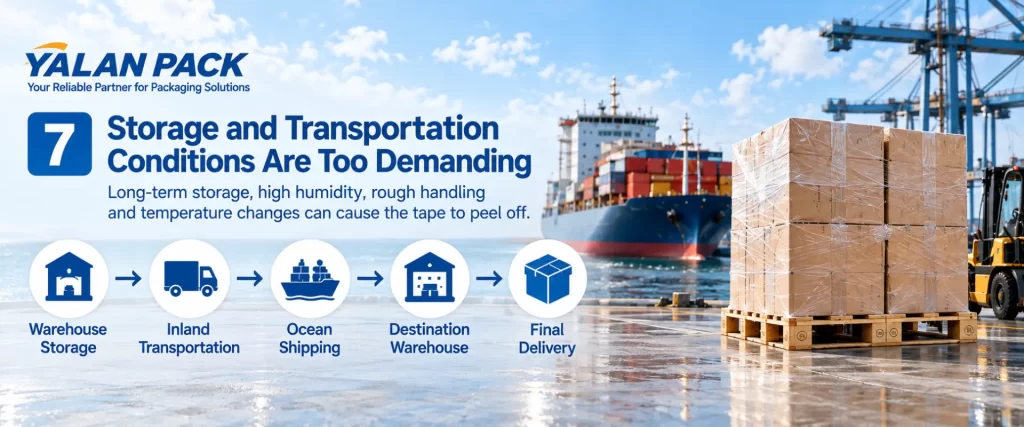
Some cartons appear perfectly sealed initially, yet the tape begins to lift or peel off after days or weeks of storage. In such cases, a comprehensive review of the entire logistics chain is required: Factory → Warehouse → Container → Port → Ocean Freight → Destination Warehouse → Last-mile Delivery.
Temperature fluctuations, humidity changes, prolonged storage, carton deformation, and repeated handling all exert additional stress on both the tape and the carton.
Proper storage management of tape rolls prior to use is equally critical. High temperatures, direct sunlight, humidity, or long-term storage can gradually degrade the performance of packaging materials.
For export carton projects, buyers must verify that the tape maintains its seal throughout the entire storage and transport cycle, rather than checking adhesion only immediately after application. If the tape detaches during transit, do not simply add more layers of tape; instead, prioritize investigating environmental factors and the mechanical stresses the cartons undergo during logistics.
How to prevent carton sealing tape from detaching
The most effective approach: Identify the root cause (failure mode) of the detachment before changing tape specifications. ·Detaches immediately after application: Check the carton surface, contaminants, application pressure, and adhesive compatibility.
·Bonds initially but detaches after storage: Investigate aging, temperature, and storage conditions.
·Strong bond but tape breaks: Focus on tape thickness and backing material strength.
·Detachment occurs only on recycled cartons: Test the compatibility between the adhesive and the specific cardboard.
·Issues limited to specific operators or equipment: Review the carton sealing process.
Yalan Pack supplies water-based acrylic and hot-melt BOPP sealing tapes—including clear, colored, printed, low-noise, and custom options—available in various widths, lengths, and thicknesses.
Recommended troubleshooting sequence: Carton surface → Cleanliness → Application pressure/process → Temperature → Adhesive performance → Tape quality → Storage and transport.
Do not simply request thicker tape; prioritize identifying the root cause of the detachment. Once the problem is pinpointed, selecting the right tape becomes much easier.


Contact Us
In This Article
Related Posts
Yalan Pack at the 140th Canton Fair 2026
Sep 18, 2026
Why Does Packing Tape Peel Off Cartons?
Sep 17, 2026
Pallet Film Wholesale Cost Analysis: Factors That Influence Bulk Stretch Film Pricing
Sep 17, 2026
Industrial Pallet Wrap for Automated Packaging Lines: Film Performance Requirements
Sep 17, 2026


