







Hand Stretch Film vs Machine Stretch Film
By hqt
Jul, 2026
Stretch film is used to unitize cartons, stabilize pallet loads, and protect products during warehouse handling and transportation. When selecting pallet wrapping film, one of the first decisions is whether to use hand stretch film or machine stretch film.
Both products are commonly made from LLDPE and perform the same basic function, but they are designed for very different application methods. Hand film is intended for manual wrapping, while machine film must work with a semi-automatic or automatic stretch wrapper.
Choosing the wrong type can increase film consumption, slow production, cause repeated film breaks, or leave the pallet with insufficient load containment. The correct decision should be based on pallet volume, load characteristics, available equipment, labor requirements, and the total cost of wrapping each pallet.
What Is Hand Stretch Film?
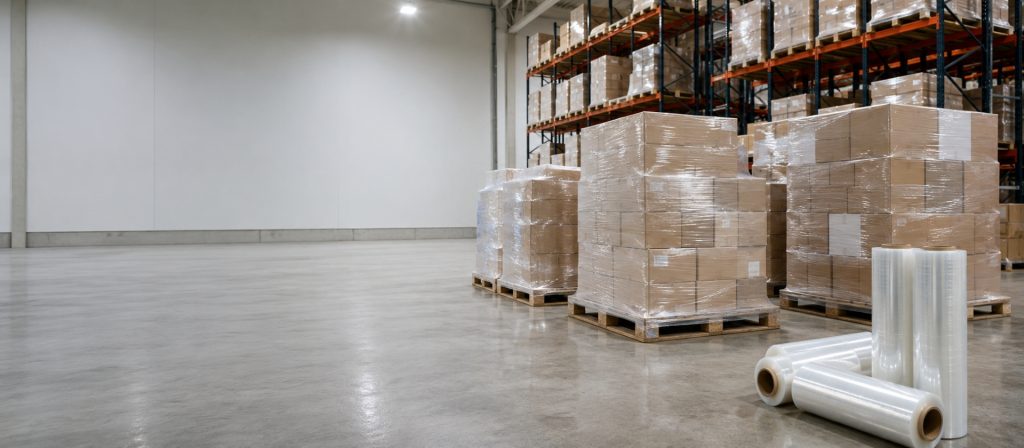
Hand stretch film is applied manually by an operator. The operator usually attaches the film to the pallet, walks around the load, and controls the film tension by pulling the roll or using a handheld dispenser.
Because it requires little equipment, hand wrapping is easy to introduce into a warehouse. It is suitable for businesses that wrap a limited number of pallets, operate from several packing locations, or frequently handle loads with different sizes and shapes.
Hand film is also useful for reinforcing damaged cartons, bundling long products, wrapping furniture, securing small shipments, and adding extra film to selected areas of a pallet.
Yalan Packaging describes its hand stretch film as an LLDPE film designed for manual pallet wrapping, carton securing, warehouse logistics, and transportation protection. Its stretch film range emphasizes stable cling, puncture resistance, load retention, controlled thickness, and reduced material consumption.
What Is Machine Stretch Film?
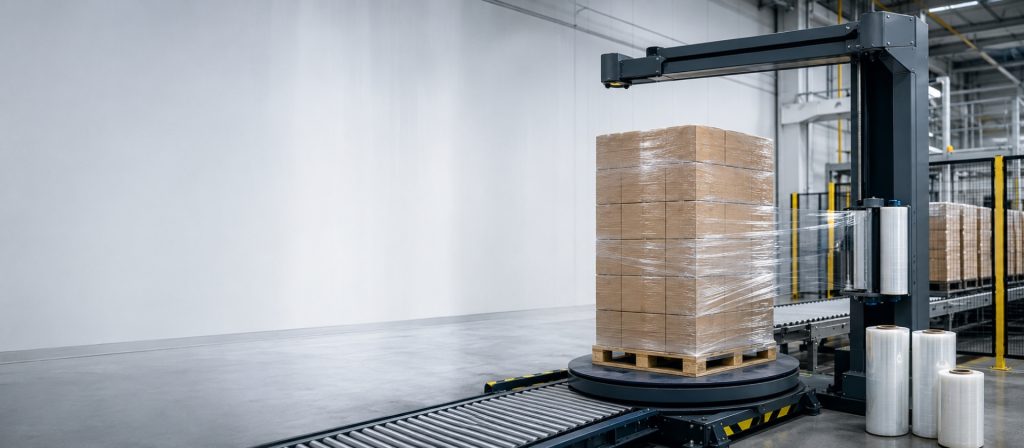
Machine stretch film is designed for use with a pallet wrapping machine. Depending on the equipment, the pallet may rotate on a turntable, or a rotating arm may move around a stationary load.
The film carriage controls how the film is released, stretched, and applied to the pallet. Many machines use a powered pre-stretch system that stretches the film before it reaches the load.
This process allows the machine to apply a repeatable wrapping pattern with controlled film tension, overlap, top wraps, bottom wraps, and wrapping cycles. Machine wrapping is generally selected by manufacturers, distribution centers, beverage plants, food processors, and other facilities with regular pallet output.
Semi-automatic wrappers still require an operator to position the pallet and start the cycle, while automatic systems can be integrated with conveyors and production lines.
Key Differences at a Glance
| Comparison Point | Hand Stretch Film | Machine Stretch Film |
|---|---|---|
| Application | Applied manually | Applied by wrapping equipment |
| Initial Investment | Low | Requires machinery |
| Roll Format | Smaller and easier to carry | Longer, heavier rolls |
| Wrapping Speed | Depends on the operator | Faster and more repeatable |
| Film Tension | Manually controlled | Controlled through machine settings |
| Pre-Stretch | Limited or supplied pre-stretched | Higher controlled pre-stretch available |
| Load Consistency | Can vary between operators | More consistent wrapping pattern |
| Best Use | Low-volume and irregular work | Repeated or high-volume pallet wrapping |
| Flexibility | Easy to move between locations | Limited by machine position and capacity |
| Labor Requirement | Higher per pallet | Lower during the wrapping cycle |
Roll Size and Handling
Hand film rolls are designed to be carried and controlled by an operator. They are therefore shorter and lighter than machine rolls. Common formats include standard hand rolls, extended-core rolls, mini rolls, and pre-stretched hand film.
Machine rolls are longer and heavier because they must support longer production runs without frequent roll changes. Their width, roll diameter, core dimensions, film thickness, and winding quality must match the wrapping machine.
A roll should never be selected only by its total weight. Buyers should compare the net film weight, core weight, width, length, thickness, and usable yield. Two rolls with the same gross weight can contain different amounts of actual film.
Machine-film buyers should also confirm the wrapper model, film-carriage design, recommended roll diameter, target pre-stretch, and machine speed before placing an order. Lantech notes that film gauge, material, and pre-stretch characteristics must be matched to the wrapper rather than assuming that a hand-film grade will perform correctly on a machine.
Pre-Stretch and Film Consumption
Pre-stretch means extending the film before or during application. Stretching the film increases its usable length and helps create the holding force that keeps the pallet together.
With hand wrapping, the amount of stretch depends heavily on the operator, film formulation, roll weight, dispenser, working height, and load shape. Maintaining the same stretch level from the bottom to the top of every pallet is difficult.
A powered machine carriage can stretch the film at a controlled ratio before application. This generally provides more repeatable film usage and makes it easier to establish a standard wrap pattern.
However, a higher stretch ratio does not automatically create a safer pallet. Film performance depends on the relationship between pre-stretch, applied tension, film layers, puncture resistance, load shape, and required containment force. Lantech advises that the correct stretch level depends on the film, machine, product, and packaging objective.
Pre-stretched film is another option. It is stretched during manufacturing and can be supplied for either hand or machine use. Its lighter application force can make manual handling easier, but it still needs to provide adequate load retention for the actual pallet.
Wrapping Consistency
Consistency is one of the biggest differences between manual and machine wrapping.
Two operators may apply different amounts of film to the same pallet. Even one operator may change tension as fatigue increases during a shift. The bottom of the pallet may receive enough film while the middle or top remains under-wrapped.
A machine can repeat a programmed number of bottom wraps, spiral wraps, top wraps, and overlap levels. This does not guarantee a safe load by itself, but it makes the process easier to measure, test, and improve.
Containment force should be adequate at the top, middle, and bottom of the load. It is influenced by both film tension and the number of film layers applied to each area.
Labor and Productivity
Hand wrapping requires an operator to walk around the pallet repeatedly while holding and tensioning the roll. This gives the operator flexibility, but it becomes physically demanding when many pallets must be wrapped during each shift.
Machine wrapping transfers most of the wrapping cycle to the equipment. With a semi-automatic wrapper, the operator still positions the pallet, attaches the film if necessary, starts the machine, and removes the finished load. A fully automatic system can reduce these steps further.
Lantech identifies hand wrapping as a labor-intensive process that makes consistent containment force difficult to maintain. Machine wrapping is better suited to operations that need repeatable output and controlled wrapping cycles.
Cost Per Roll vs Cost Per Pallet
Hand film usually requires little initial investment because the operation may need only a dispenser. Machine wrapping requires equipment, floor space, power, maintenance, and operator training.
For this reason, hand film may be more economical for occasional pallet wrapping. Purchasing a machine for a few irregular loads may not produce a reasonable return.
As pallet volume increases, the calculation changes. Machine wrapping can reduce operator time, improve film utilization, standardize film application, and make wrapping costs more predictable.
Buyers should therefore avoid comparing only the price per roll. A better calculation includes:
- Film used per pallet
- Labor time per pallet
- Number of film breaks
- Damaged or unstable shipments
- Machine investment and maintenance
- Downtime and roll-change frequency
- Total pallets wrapped during each shift
High-performance machine films may also allow a warehouse to use a thinner film while maintaining the required containment performance. The actual result should always be confirmed through pallet testing rather than assumed from the nominal thickness.
Which Film Is Better for Irregular Loads?
Hand film offers useful flexibility for unusual pallets, oversized products, mixed cartons, low-profile loads, and goods that cannot fit safely on a standard turntable.
An operator can add more wraps around sharp corners, reinforce the bottom of the pallet, or change the wrapping direction immediately. Hand wrapping is also practical when pallets must be wrapped in different parts of a warehouse.
Machine wrapping can still handle many irregular loads, but the equipment must be selected carefully. Unstable products may not be suitable for a fast turntable. In these cases, a rotary-arm machine, slower rotation, top platen, or another load-stabilization solution may be required.
The pallet dimensions must also fit the machine. Oversized loads that extend beyond the turntable can create operational and safety problems.
Can Hand Film Be Used on a Machine?
Hand stretch film should not normally be treated as a direct replacement for machine film.
The roll may have the wrong diameter, length, winding tension, core strength, or stretch characteristics for the equipment. It may break during pre-stretching or require frequent roll changes.
Likewise, using a heavy machine roll manually is impractical and may create poor operator control. The film may also be designed to reach its intended performance only through a specific machine pre-stretch system.
Before switching film types, buyers should confirm the film width, thickness, core size, roll diameter, pre-stretch capability, cling orientation, and compatibility with the selected application method.
How to Choose the Right Option
Choose hand stretch film when pallet volume is limited, loads vary frequently, packaging takes place in several locations, or the business is not ready to invest in wrapping equipment.
Choose machine stretch film when pallets are wrapped repeatedly, production speed matters, film consumption must be controlled, or customers require a consistent packaging standard.
Some operations need both. A machine can wrap standard production pallets, while hand film remains available for oversized loads, rework, damaged cartons, warehouse transfers, and emergency packaging.
Before making a final decision, conduct a controlled trial using actual products. Compare film consumption, wrapping time, load movement, corner punctures, operator effort, and pallet condition after transportation.
Working With a Stretch Film Supplier
Yalan Packaging supplies hand stretch film, machine stretch film, and pre-stretched film for logistics, warehousing, manufacturing, and transportation applications. The company also supports customized widths, lengths, roll formats, and OEM packaging for distributors and industrial users.
When requesting a quotation, buyers should provide the wrapping method, pallet dimensions, load weight, daily pallet volume, film thickness, roll requirements, machine model, destination market, and packaging format.
These details help the manufacturer recommend a film based on the actual operation rather than simply offering the lowest-priced roll.
Conclusion
Hand stretch film and machine stretch film are not competing versions of exactly the same product. Each is designed for a different packaging process.
Hand film provides flexibility, low setup cost, and easy use for low-volume or irregular wrapping. Machine film supports faster production, controlled pre-stretch, repeatable application, and more consistent cost per pallet.
The best choice depends on how many pallets are wrapped, how stable the loads are, where wrapping takes place, and what level of consistency the operation requires.
Instead of asking which film is universally better, buyers should ask which system delivers the safest load with the lowest total packaging cost in their own warehouse.
Share on Social:


