







Acrylic vs Hot Melt Packing Tape: What Is the Difference?
By hqt
Sep, 2026Related Posts

Yalan Pack at the 140th Canton Fair 2026
Sep 18, 2026

Why Does Packing Tape Peel Off Cartons?
Sep 17, 2026

Pallet Film Wholesale Cost Analysis: Factors That Influence Bulk Stretch Film Pricing
Sep 17, 2026

Industrial Pallet Wrap for Automated Packaging Lines: Film Performance Requirements
Sep 17, 2026
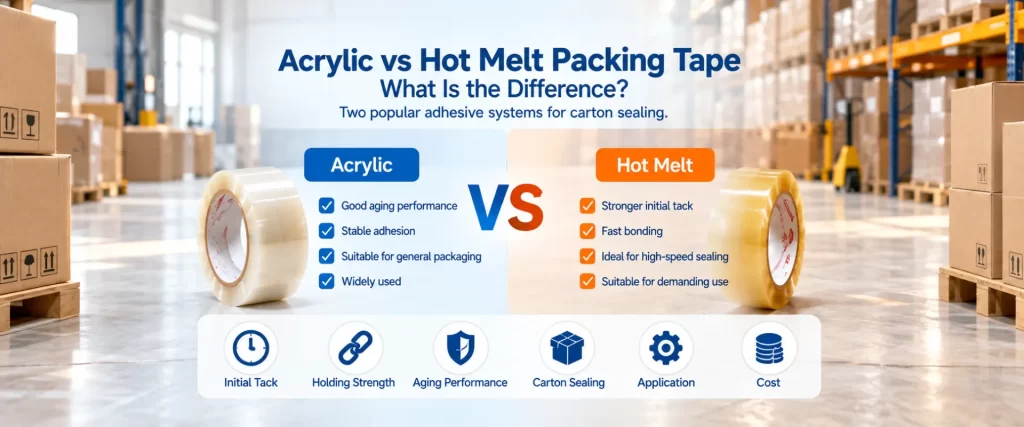
Acrylic adhesive and hot-melt adhesive represent the two mainstream adhesive systems for BOPP sealing tapes. Acrylic tapes are commonly used for general packaging, offering stable adhesion and excellent aging resistance; hot-melt tapes are characterized by rapid initial tack, making them suitable for high-speed sealing applications.
Neither type is inherently superior to the other; selection should be based on a comprehensive assessment of factors such as carton surface conditions, storage environment, sealing efficiency, operating temperatures, and specific bonding requirements.
| Feature | Acrylic Packing Tape | Hot Melt Packing Tape |
| Initial Tack | Moderate to good | Generally higher |
| Aging Performance | Very good | Good |
| General Carton Sealing | Excellent | Excellent |
| Fast Packing Lines | Suitable | Often preferred |
| UV/Aging Resistance | Generally better | Application dependent |
| Typical Positioning | General-purpose / long-term packaging | Fast sealing / strong initial grab |
This table is for general comparison purposes only. Actual performance will vary depending on the adhesive formulation, coating weight, BOPP substrate, and the condition of the carton surface.
Which tape has stronger initial tack?
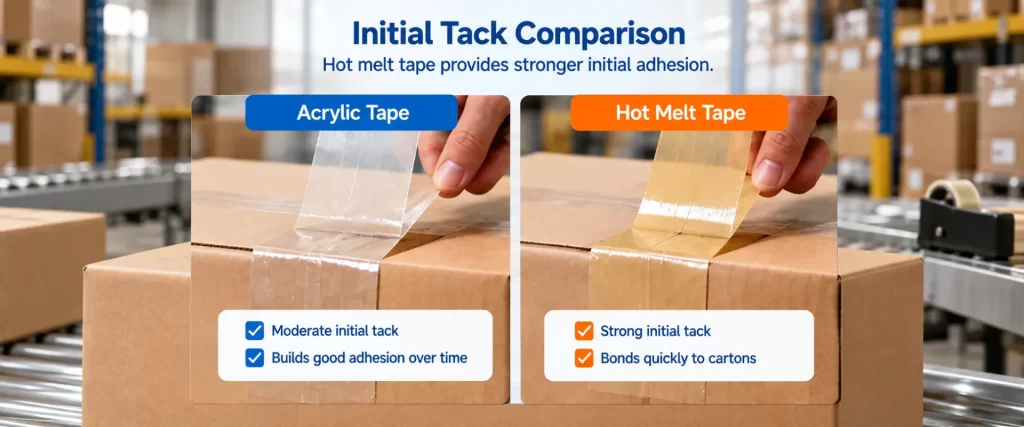
Initial tack is one of the most distinct differences between acrylic tape and hot-melt tape.
A major advantage of hot-melt sealing tape is its excellent initial tack. Upon the application of sufficient pressure, it adheres rapidly to carton surfaces, making it ideal for automated packaging lines that require high-efficiency sealing.
Acrylic tape also provides reliable adhesion in standard sealing scenarios; however, due to formulation differences, the tactile sensation of initial tack differs from that of hot-melt tape.
However, a tackier feel does not necessarily equate to superior sealing performance. Buyers should test adhesion on actual corrugated cartons rather than judging quality solely by touching the adhesive layer.
Hot-melt tape is more suitable for high-speed packaging lines requiring instant adhesion, whereas acrylic tape is a reliable, all-purpose choice for standard warehouse sealing operations.
Which tape is better suited for long-term storage?
When cartons must remain sealed for extended periods, the tape's aging resistance is more critical than its initial tack.
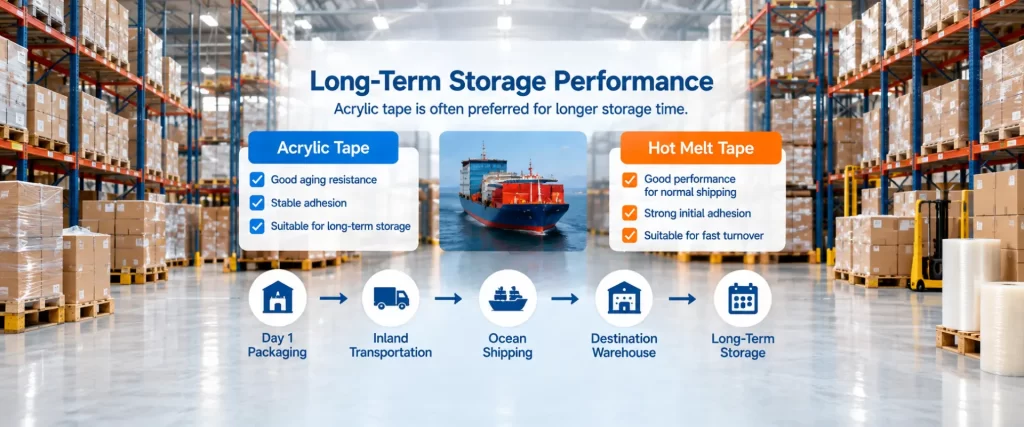
Acrylic BOPP tape is generally the preferred choice for applications requiring long-term stability. High-quality acrylic adhesives maintain their bonding strength over prolonged storage and exhibit excellent aging resistance.
While hot-melt tape performs reliably in many shipping and storage scenarios, its primary strengths are rapid initial tack and sealing efficiency, rather than exceptional long-term storage durability.
This is particularly important for export clients. After being sealed at the factory, cartons may be stored while awaiting container loading, undergo weeks of ocean transit, and remain sealed in a destination warehouse for an extended period.
Selection decisions should account for the entire logistics cycle rather than focusing solely on short-term bond strength.
Acrylic tape is the preferred option when long-term storage is required.
How do temperature and carton surface conditions affect tape selection?
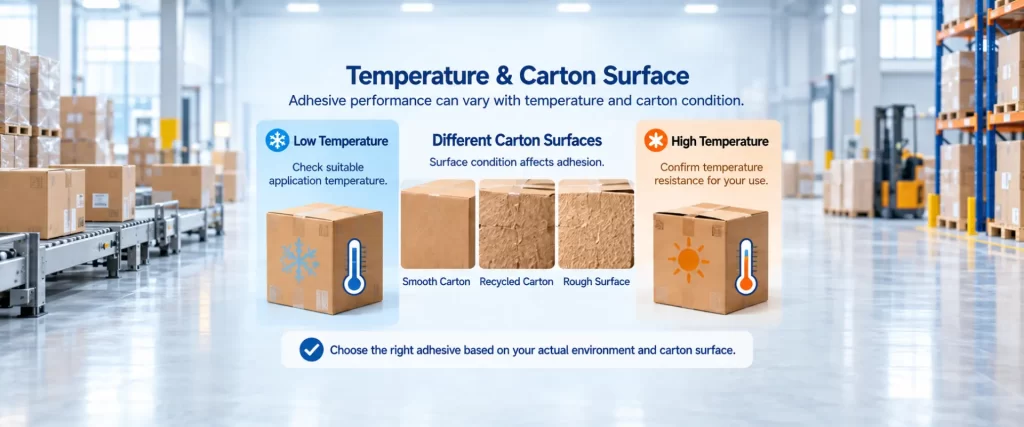
Temperature conditions and the state of the carton surface significantly influence tape adhesion performance. The ideal operating condition involves applying sufficient pressure to adhere the tape to a clean, dry carton surface. Regardless of the adhesive type, factors such as dust, moisture, highly porous recycled cardboard, and extreme operating temperatures can make sealing more difficult.
Particular attention should be paid to corrugated cartons made from high-recycled-content fibers, as their surfaces are rougher and more porous than those made from virgin cardboard.
Hot-melt adhesives offer strong initial tack, making them suitable for certain difficult-to-bond substrates, whereas acrylic tapes are better suited for applications where aging resistance and environmental stability are priorities.
However, buyers should avoid two common misconceptions:
❌ Hot-melt adhesive = automatically suitable for rough cartons
❌ Acrylic tape = automatically resistant to extreme temperatures
Actual temperature resistance depends on the specific adhesive formulation.
If cartons are to be sealed in low-temperature workshops, stored in high-temperature warehouses, or subjected to significant temperature fluctuations during transit, it is essential to verify the recommended operating and service temperature ranges with the supplier.
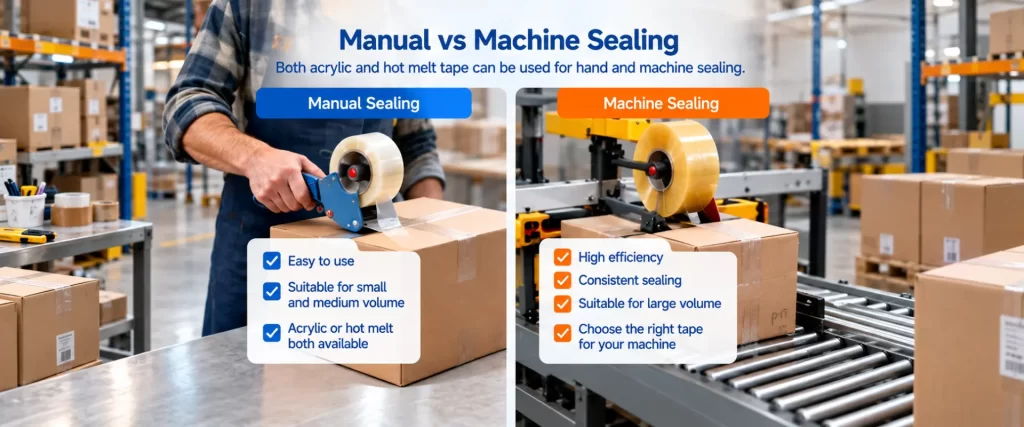
Manual vs. Machine Sealing: Acrylic or Hot-Melt Tape?
Both types of tape can be used for carton sealing, but the choice depends on the packaging process and production speed.
For manual packaging, acrylic BOPP tape is widely used due to its stable overall performance; tapes with appropriate specifications are compatible with standard handheld dispensers available on the market.
Hot-melt tapes are also suitable for manual sealing, though their advantage of high initial tack is particularly evident in high-speed packaging operations.
When selecting tape for automatic sealing machines, in addition to the adhesive type, ensure the tape meets the following requirements:
Smooth and even unwinding → Stable film strength → Uniform adhesive coating → Precise roll specifications → Consistent bonding performance.
If a tape has a low unit price but suffers from frequent breakage or uneven unwinding—leading to the need for carton resealing—it will ultimately drive up total packaging costs.
For high-volume buyers, a more rational approach to comparison is not merely contrasting acrylic and hot-melt adhesives, but actually testing the performance of both tapes on their own packaging production lines.
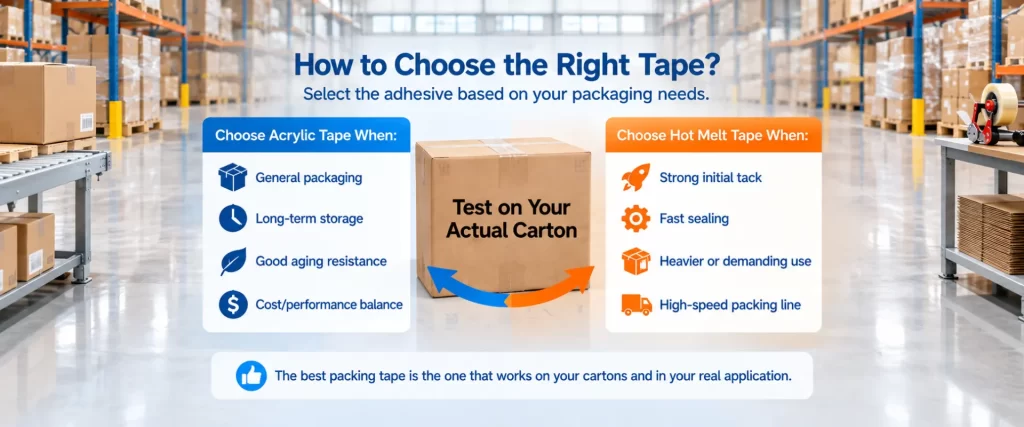
How Should Buyers Choose Between Acrylic Tape and Hot-Melt Tape?
Select tape based on actual packaging requirements rather than drawing conclusions solely from the adhesive type's name.
Acrylic tape is an excellent general-purpose choice for standard carton sealing, routine warehousing, and applications requiring aging resistance.
If high initial tack, rapid bonding, and increased sealing efficiency are the priorities, hot-melt tape is a suitable option.
Confirm the following specifications before placing an order:
Tape width × length × total thickness × adhesive type × carton material × operating temperature × manual vs. machine application.
Example: Comparing acrylic tape and hot-melt tape with identical specifications (e.g., 48mm × 100m × 45 microns) yields far more valuable insights than comparing products with inconsistent specifications.
Yalan Pack supplies water-based acrylic and hot-melt BOPP sealing tapes, including clear, colored, printed, and low-noise varieties, as well as custom-made tapes.
Practical purchasing guidelines:
Select the tape based on carton material and the packaging environment; do not judge adhesive strength solely by feel.
For critical projects or large-scale packaging operations, the most reliable approach is to test both adhesive types on the actual cartons used by the client, then select the product that offers the optimal balance of adhesion, packaging efficiency, and overall cost.


Contact Us
In This Article
Related Posts
Yalan Pack at the 140th Canton Fair 2026
Sep 18, 2026
Why Does Packing Tape Peel Off Cartons?
Sep 17, 2026
Pallet Film Wholesale Cost Analysis: Factors That Influence Bulk Stretch Film Pricing
Sep 17, 2026
Industrial Pallet Wrap for Automated Packaging Lines: Film Performance Requirements
Sep 17, 2026


