







How Should You Wrap a Pallet for International Shipping?
By hqt
Oct, 2026Related Posts
PP Strapping for Cartons: Packaging Challenges in E-Commerce Logistics
Oct 21, 2026

Polypropylene Strapping Under Temperature Changes: Effects on Packaging Performance
Oct 21, 2026
PET Strapping Supplier: Heat-Seal Joint Strength and Sealing Reliability
Oct 21, 2026
PP Strapping Supplier Guide: Smooth vs Embossed Strapping for Automated Packaging
Oct 21, 2026
For international transport, palletized goods must be wrapped into a stable, unified load, rather than simply having as much stretch film as possible wound around them. The process involves selecting a suitable pallet and using a stable stacking pattern, securing cartons, protecting vulnerable corners, anchoring the stretch film to the pallet, wrapping from bottom to top with consistent overlap, reinforcing critical areas, and using strapping bands when extra security is required.
The correct wrapping method depends on the pallet weight, cargo shape, carton strength, transport route, and handling conditions.
1. Ensure stable stacking of the pallet and cargo
Effective pallet wrapping begins before the actual wrapping process starts.
The pallet should be appropriate for the product and the transport process, and cartons or other packages should be stacked as evenly and levelly as possible. If the load is already leaning or unstable, simply adding more stretch film cannot reliably solve the problem.
Whenever possible, avoid having cartons overhang the pallet edges. Overhanging cartons are more susceptible to impact and hinder the creation of a stable, unified load.
The stacking pattern is also crucial. The goal is to create a load unit that can withstand the forces of normal handling and prevents individual cartons from shifting.
Check the following before wrapping:
Pallet condition → Cargo alignment → Carton stability → Weight distribution → Presence of protrusions or sharp edges
Ensuring a stable stack is particularly important for international transport involving forklift operations, warehousing, port handling, and multiple loading/unloading stages.

2. Ensure cartons are securely sealed
Stretch film helps unify the palletized load, but it should not be relied upon to compensate for poorly sealed cartons.
Before wrapping the pallet, verify that the cartons are securely sealed using appropriate BOPP sealing tape or other specified sealing methods.
When selecting tape, consider the carton surface material, weight, storage conditions, and tape adhesion. For example, if tape repeatedly peels off recycled cardboard boxes, simply adding stretch wrap around the perimeter of the pallet does not solve the root problem of insecure carton sealing.
Furthermore, cartons should be kept dry and clean prior to loading. Damaged or severely deformed cartons compromise the structural integrity of the entire palletized load. This highlights a key principle in export packaging:
While the stability of individual packages is related to the overall stability of the pallet, they are distinct issues.
The cartons themselves must remain securely closed, whereas the pallet wrapping system serves to bind the individual packages into a single, cohesive unit.

3. Protecting corners and vulnerable areas before wrapping
During the pallet wrapping process, corners and edges often bear concentrated pressure.
For crush-prone cartons or pallets requiring strapping reinforcement, paper edge protectors can help distribute pressure across the edges of the load.
Edge protectors also provide a more uniform profile for stretch wrapping and minimize localized damage caused by strapping.
Extra care is required for products with sharp features; sharp corners or protrusions can puncture the stretch film when tension is applied.
In such cases, simply opting for thicker film is not the solution. Protecting contact points is often more effective than merely increasing the amount of film used.
Before wrapping, inspect the pallet for the following issues:
Sharp corners, protruding products, fragile carton edges, and irregular load shapes.
Addressing these issues early helps reduce the risk of film tearing and packaging damage during subsequent stages of logistics.

4. Anchoring the stretch film to the pallet base
Establishing a solid starting point is a crucial step.
Begin wrapping at the base of the load and create a secure anchor point for the film, tailored to the specific wrapping method used. The goal is to firmly bond the load to the pallet—meeting the design requirements for a unitized load—rather than simply wrapping around the cartons. When necessary, perform several controlled wraps at the base to ensure stability.
Maintain consistent tension throughout the wrapping process; insufficient tension may result in inadequate restraint, while excessive tension could cause the film to tear or crush fragile cartons.
For manual wrapping, consistency in the operator's movements is particularly important.
For machine wrapping, parameters such as film tension, pre-stretch ratio, carriage speed, and the rotational speed of the turntable or rotating arm should be matched to the specific characteristics of the film and the palletized load.
Optimal parameter settings should be determined through actual load testing rather than simply copying settings used for unrelated pallets.

5. Maintain consistent film overlap while wrapping upwards
After securing the base, continue wrapping upwards along the pallet.
Each layer of film should sufficiently overlap the previous one to create a cohesive, unitized load. A 50% overlap rate is a common starting point, though the specific overlap depends on the film type, cargo characteristics, and wrapping procedure.
Consistency is key.
Uneven wrapping can lead to significant variations in film coverage and load containment force.
Areas subject to high stress may require additional reinforcement. Depending on the cargo, these areas could include the base, the top, or specific unstable sections.
The top of the pallet should also be assessed based on the specific application. Some loads require extra top restraint, while others may need ventilation or a separate top sheet.
More film is not necessarily better.
A well-designed wrapping strategy provides the necessary stability while controlling film usage.

6. Use PP or PET strapping for additional restraint
Stretch wrap and strapping serve different functions.
Stretch wrap is primarily used to unitize and stabilize palletized loads, whereas PP or PET strapping provides additional restraint in the direction of application.
For heavier or more demanding loads, PET strapping may be considered based on required break strength and cargo characteristics.
PP strapping is suitable for lighter-duty bundling and packaging applications.
When using strapping, consider the following factors:
Strap width and thickness, break strength, placement pattern, applied tension, joint performance, and edge protection.
Do not assume that simply adding two straps makes a pallet suitable for international transport.
The load as a whole must remain stable, and individual items may still require separate securing within the container or transport vehicle.
Therefore, pallet strapping is only one part of the packaging system and cannot replace proper cargo securing measures.

7. Check pallet stability before shipment
Necessary inspections should be performed after the wrapping process is complete. Check that the load remains upright, the film coverage is relatively uniform, and the cartons within the wrap do not shift independently.
Inspect for torn film, loose film ends, damaged corners, or instances where strapping comes into contact with sharp edges. For recurring shipments, standardizing the packaging process is beneficial, rather than allowing individual operators to use varying amounts of film.
A simple packaging specification can stipulate:
| Item | What to Confirm |
| Stretch film | Width, thickness and film grade |
| Wrapping method | Hand or machine |
| Bottom reinforcement | Required wrapping pattern |
| Film overlap | Defined according to tested process |
| Critical areas | Additional reinforcement if required |
| Strapping | PP/PET specification and arrangement |
| Edge protection | Position and dimensions |
| Final inspection | Stability and packaging condition |
For critical export shipments, testing should simulate anticipated handling and transport conditions as realistically as possible.
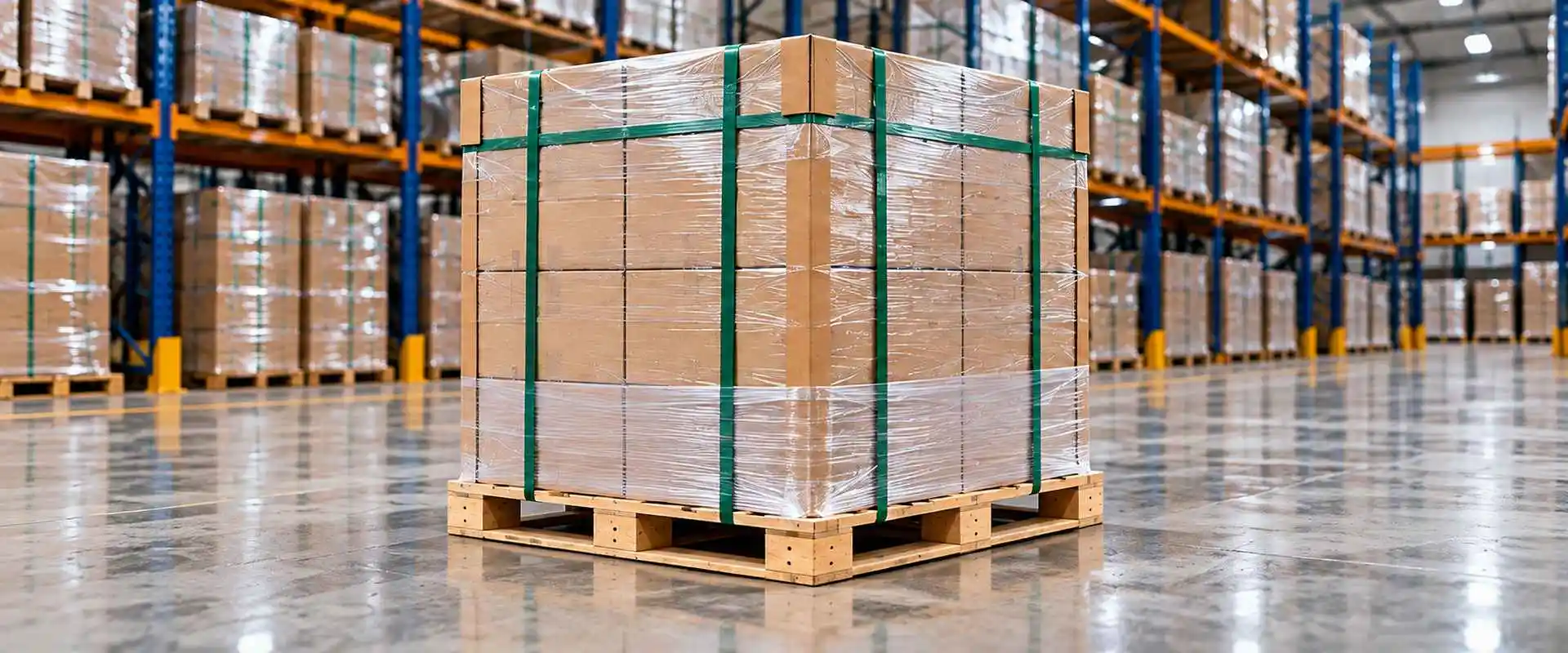
8. What packaging solution is suitable for export pallets?
No single wrapping method suits every type of international shipment.
A practical packaging solution for export pallets may combine the following materials:
BOPP sealing tape — to ensure cartons are securely sealed
Paper edge protectors — to protect and reinforce vulnerable edges
PP/PET strapping — to provide additional load security where needed
Stretch wrap — to unitize the load and maintain stability
Each material serves a specific purpose.
Yalan Pack offers hand-grade and machine-grade stretch wrap, BOPP sealing tape, PP/PET strapping, and paper edge protectors suitable for pallet and export packaging.
For buyers selecting a pallet wrapping solution, the following information is crucial: pallet dimensions, load weight, product type, carton stacking pattern, current stretch wrap specifications, wrapping equipment, and transport conditions.
The core principle is simple:
First, build a stable pallet load; then, use a wrapping system to maintain that stability throughout handling and transport.
For unstable pallets, simply increasing the amount of stretch wrap used is usually not the best solution.


Contact Us
In This Article
Related Posts
PP Strapping for Cartons: Packaging Challenges in E-Commerce Logistics
Oct 21, 2026
Polypropylene Strapping Under Temperature Changes: Effects on Packaging Performance
Oct 21, 2026
PET Strapping Supplier: Heat-Seal Joint Strength and Sealing Reliability
Oct 21, 2026
PP Strapping Supplier Guide: Smooth vs Embossed Strapping for Automated Packaging
Oct 21, 2026


