







6 Specifications Buyers Should Check Before Ordering PET Strapping
By hqt
Sep, 2026Related Posts

Why Do Pallets Collapse During Transportation? 7 Common Packaging Mistakes
Oct 13, 2026

How Many Layers of Stretch Film Should Be Used on a Pallet?
Oct 08, 2026

How Should You Wrap a Pallet for International Shipping?
Oct 07, 2026

6 Specifications Buyers Should Check Before Ordering PET Strapping
Sep 30, 2026
Before ordering PET strapping, buyers should confirm six key specifications: strap width and thickness; breaking strength; elongation and tension retention; coil and core dimensions; equipment compatibility; and packaging and shipping requirements.
Even with identical width and thickness, the performance of two PET straps can differ due to variations in material properties, manufacturing processes, and joint performance. For importers, clearly defined and complete specifications enable suppliers to provide comparable quotes and reduce the risk of ordering unsuitable products.
What width and thickness of PET strapping do you need?
Width and thickness are the primary factors to consider when selecting PET strapping.
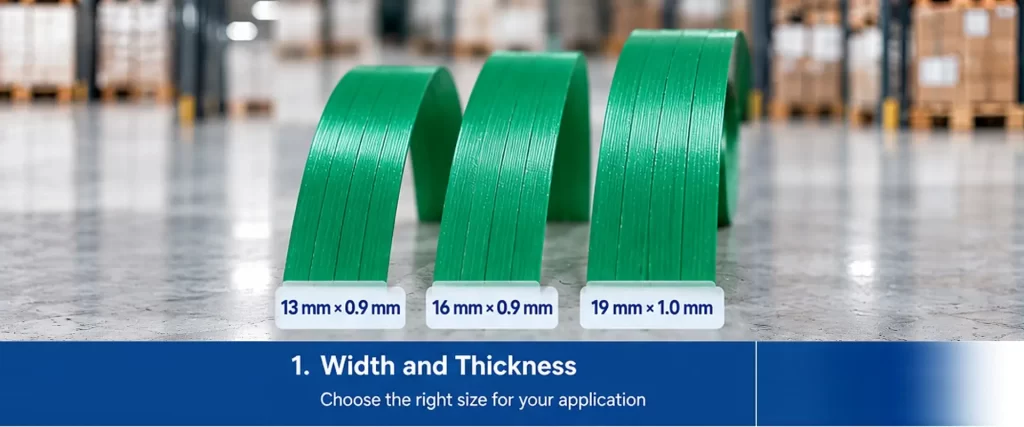
Common widths include 13 mm, 16 mm, and 19 mm, while thickness is determined by the required strength and the specific application.
For example, buyers might encounter the following specifications:
| PET strapping size | Example application considerations |
| 13 mm × 0.9 mm | Compact, stable loads with suitable restraint requirements |
| 16 mm × 0.9 mm | Palletized products requiring greater strap strength |
| 19 mm × 1.0 mm | More demanding industrial load-securing applications |
These are merely examples, not strict recommendations based on specific pallet weights.
Generally, wider or thicker strapping contains more material, but dimensions alone do not determine its breaking strength or suitability for specific loads.
Buyers should also verify dimensional tolerances, especially if the strapping is to be used with automated equipment.
When requesting a quote, please provide the dimensions of your current strapping or describe the products and pallets to be secured.
What breaking strength should PET strapping have?
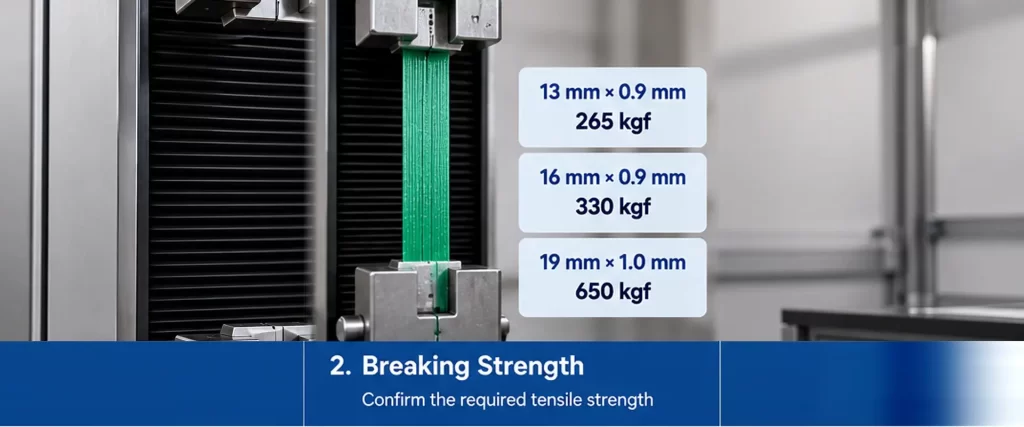
Breaking strength refers to the tensile force required to snap the strapping under specific test conditions.
This metric is typically expressed in kilograms-force (kgf) or Newtons (N).
The following examples of PET strapping specifications are provided for reference:
| Strap size | Example breaking strength | Approximate force |
| 13 mm × 0.9 mm | 265 kgf | 2,599 N |
| 16 mm × 0.9 mm | 330 kgf | 3,236 N |
| 19 mm × 1.0 mm | 650 kgf | 6,374 N |
These figures reflect specific product specifications and do not represent universal ratings for all PET strapping of the same dimensions.
Importantly, a strap with a rated strength of 650 kgf does not mean it can safely secure a palletized load weighing 650 kg on its own.
The required strength depends on load stability, strap configuration, joint efficiency, handling conditions, and the transportation environment.
Buyers should verify whether the stated breaking strength refers to the strength of the strap itself or the strength of the complete strapped loop, including the joint.
For demanding applications, relevant test data should be requested, and the entire strapping system should be evaluated.
Why should buyers pay attention to elongation and tension retention?
Breaking strength is not the only critical mechanical property.
PET strapping must also maintain good performance during load handling, storage, and transportation.
Elongation describes the extent to which the strap stretches under specific conditions.
Tension retention describes how effectively the strapping system maintains tension over time under specified conditions.
These characteristics are crucial because certain loads may settle, compress, or undergo slight dimensional changes after strapping.
PET strapping with appropriate elasticity can accommodate these changes while maintaining effective binding force. However, excessive stretching or loss of tension can compromise load stability.
Buyers should not assume that higher elongation is always better. Optimal performance depends on the product type, pallet stacking method, and transportation requirements.
For critical applications, buyers should request relevant tensile and elongation data from the supplier, including test methods and conditions.
In scenarios requiring extremely high long-term load stability, the complete strapping system should be evaluated under conditions simulating actual storage and transportation.

What coil dimensions and core specifications should be verified?
PET strapping is typically supplied in coils, but coil specifications can vary significantly.
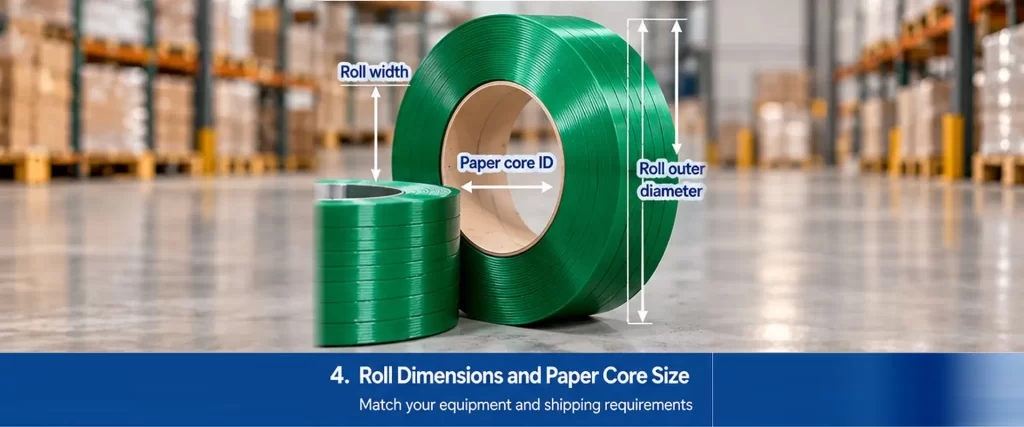
Buyers should verify the coil length or net strap weight, core inner diameter, coil outer diameter, and coil width. These details affect equipment compatibility, warehouse handling operations, and the number of units that can be loaded into a container.
For instance, two rolls of PET strapping might share the same width and thickness yet differ in length or net weight.
If a supplier's quoted weight includes the paper core or other non-usable materials, a heavier roll does not necessarily offer better value.
When comparing quotes, it is important to clarify whether the weight refers to the net weight of the PET strapping or the gross weight of the entire roll. For machine applications, the roll dimensions must also match the equipment's roll holder or dispenser.
If the roll is too large or wide, or if the core specifications are incompatible, it may not fit the existing machinery.
Is the PET strapping compatible with your equipment?
Before ordering, it is essential to verify equipment compatibility, especially for automated packaging operations.
Depending on specifications and the specific application, PET strapping can be used with manual, electric (battery-powered), pneumatic, or fully automatic strapping equipment.
Different machines may have varying requirements regarding strap width, thickness, surface characteristics, tensioning methods, and sealing (joining) techniques.
For example, a buyer might select 19mm PET strapping that meets the required nominal breaking strength, yet their existing strapping machine might only support narrower specifications.
The sealing method is equally critical.
Once the PET strap is applied, the ends are typically joined via friction welding or another suitable fastening method. The performance of the seal depends on the equipment, operational settings, and the properties of the strapping itself.
If the seal strength is insufficient, the entire strap loop may fail, even if the strapping material itself meets tensile strength standards.
Before placing an order, provide the supplier with details such as the equipment brand and model, supported strap dimensions, sealing method, and intended use.
For new product specifications, conducting sample tests on the actual equipment is particularly effective.

What packaging and shipping details should importers verify?
For international buyers, PET strapping specifications represent only one part of the purchasing decision.
Packaging configurations and shipping details impact handling efficiency, freight costs, and the actual number of usable rolls received.
Before confirming an order, verify the number of rolls per pallet, pallet dimensions, gross pallet weight, total shipment volume, and container loading capacity.
Buyers should also confirm whether the goods will be palletized or shipped without pallets.
While palletizing simplifies handling and protects the rolls, it also consumes container space and adds weight.
For full-container orders, the maximum load depends on actual roll dimensions, packaging layout, container limits, and relevant transport restrictions. Importers should also confirm the trade terms, production lead time, payment conditions, and required shipping documents specified in the quotation.
If the packaging configuration results in higher freight or handling charges, the final landed cost may not necessarily be the lowest, even if the unit price (price per kilogram) is lower.
The most effective comparison should be based on the same usable quantity of strapping, equivalent technical specifications, and identical delivery terms.

How should a buyer prepare a Request for Quotation (RFQ) for PET strapping?
A detailed RFQ helps suppliers understand the specific application requirements, enabling them to provide more accurate quotes.
For example:
| Specification | Example requirement |
| Product | PET Strapping |
| Width × thickness | 16 mm × 0.9 mm |
| Breaking strength | 330 kgf |
| Application | Palletized industrial products |
| Equipment | Specify machine brand and model |
| Roll weight or length | Confirm required net strap quantity |
| Core dimensions | Confirm according to equipment |
| Packing | Specify palletized or non-palletized |
| Order quantity | Specify rolls, kilograms or container quantity |
| Trade term | FOB Shenzhen, Incoterms 2020 |
This procurement specification serves as a reference guide only and does not constitute a specific recommendation for a particular load.
For new projects, buyers should also provide details regarding pallet dimensions, load weight, product type, strapping configuration, and anticipated shipping conditions.
Yalan Pack offers PET and PP strapping in a wide range of widths, thicknesses, and strength specifications, suitable for industrial packaging and pallet load securing.
Confirming these six specifications—and conducting sample testing where necessary—prior to bulk purchasing enables buyers to compare similar products and select the strapping best suited to their specific packaging operations.
A key principle in procurement is to compare the full range of specifications for PET strapping, rather than focusing solely on width, thickness, or unit price (price per kilogram).
Share on Social:


Contact Us
In This Article
Related Posts
Why Do Pallets Collapse During Transportation? 7 Common Packaging Mistakes
Oct 13, 2026
How Many Layers of Stretch Film Should Be Used on a Pallet?
Oct 08, 2026
How Should You Wrap a Pallet for International Shipping?
Oct 07, 2026
6 Specifications Buyers Should Check Before Ordering PET Strapping
Sep 30, 2026


