







How Many Layers of Stretch Film Should Be Used on a Pallet?
By hqt
Oct, 2026Related Posts

Why Do Pallets Collapse During Transportation? 7 Common Packaging Mistakes
Oct 13, 2026

How Many Layers of Stretch Film Should Be Used on a Pallet?
Oct 08, 2026

How Should You Wrap a Pallet for International Shipping?
Oct 07, 2026

6 Specifications Buyers Should Check Before Ordering PET Strapping
Sep 30, 2026
The number of stretch film layers required for a pallet depends on the load's weight, stability, film thickness, stretch properties, and the wrapping method used. There is no universal standard for the number of layers that applies to every pallet.
As a starting point for operations, common wrapping practices involve 2–3 overlapping wraps in specific areas, with additional reinforcement at the base or top as needed. However, these are merely initial settings rather than mandatory requirements for ensuring load stability.
The goal is to achieve sufficient load containment without wasting film or damaging the product.
What constitutes "one layer" of stretch film?
Before deciding on the number of wrapping layers, it is crucial to understand how to calculate them.
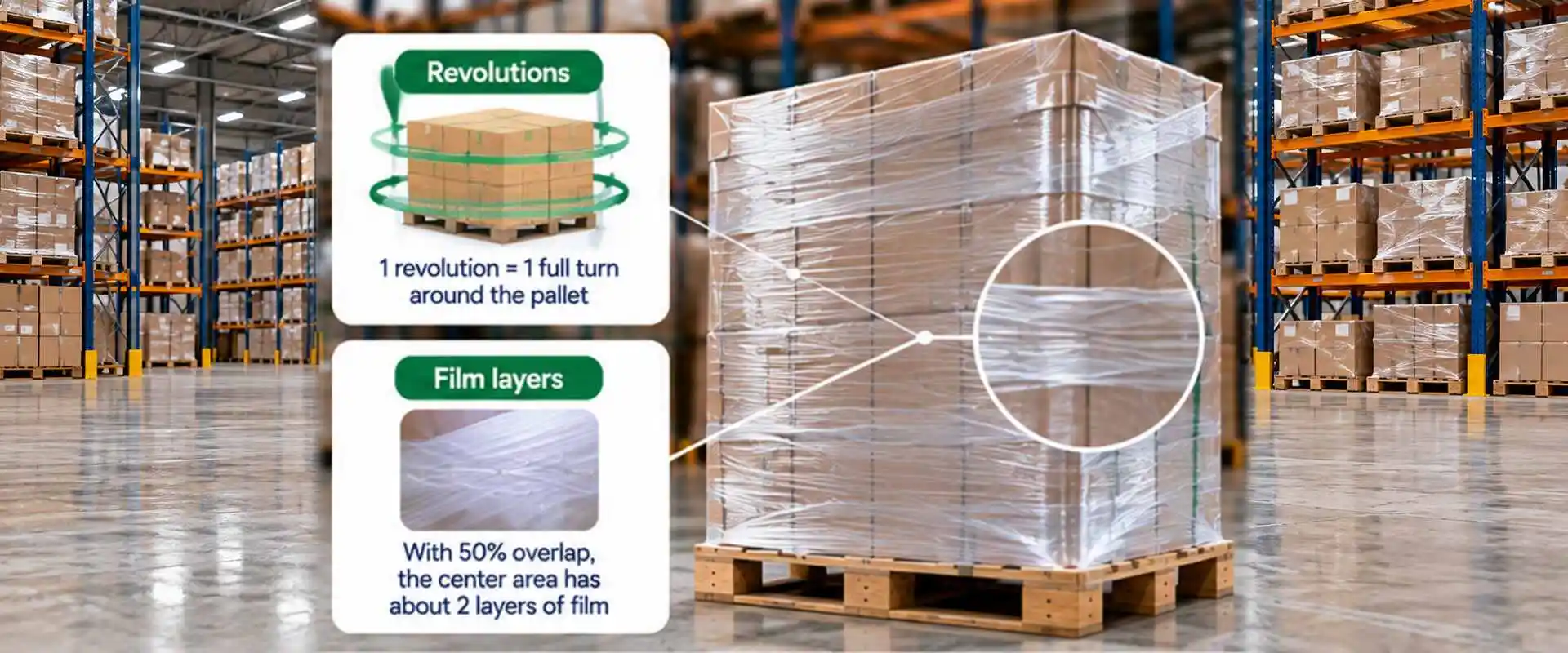
A single wrap or revolution refers to one full rotation around the pallet, whereas the number of film layers refers to the actual coverage of the film at a specific point.
The two are not identical.
For example, when wrapping with an overlap of approximately 50%, each upward pass covers a portion of the previous wrap.
Consequently, after completing one upward spiral pass, the middle section of the pallet may have about two layers of film coverage, while coverage at the top and bottom depends on the specific wrapping pattern.
It is important to distinguish between these concepts when comparing wrapping specifications from different suppliers.
Instead of simply asking how many times a pallet should be wrapped, it is better to clarify the overlap rate, the number of wraps at the base and top, and whether the machine performs a single or multiple up-and-down wrapping cycles.
Do heavy pallets require more layers of stretch film?
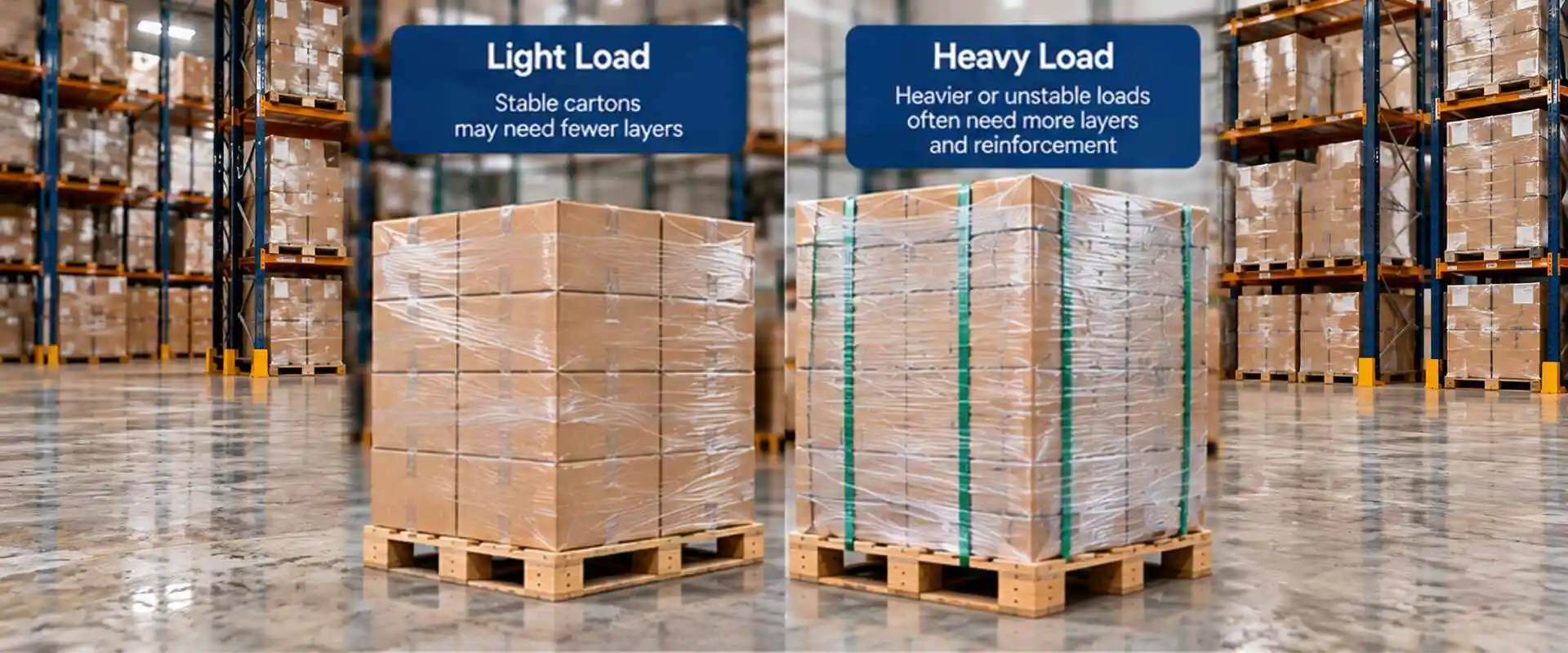
Heavier pallets may require greater containment force, but pallet weight alone does not determine the correct number of film layers.
A pallet of neatly stacked, compact cartons may behave very differently from a pallet loaded with tall, irregularly shaped, or unstable products.
Load height, center of gravity, carton strength, and friction between packages also influence stability. For example, tall pallets loaded with lightweight products may require additional securing due to their geometry, whereas shorter but heavier pallets might actually be more stable.
In certain applications, increasing the number of film layers can improve load stability, but it cannot compensate for improper stacking or excessive carton overhang (extending beyond the pallet edges). Before wrapping, ensure the pallet is stacked correctly and the load is suitable for stretch wrapping.
How does stretch film thickness affect the number of wrapping layers?
Stretch film thickness affects not only material consumption but also mechanical properties.
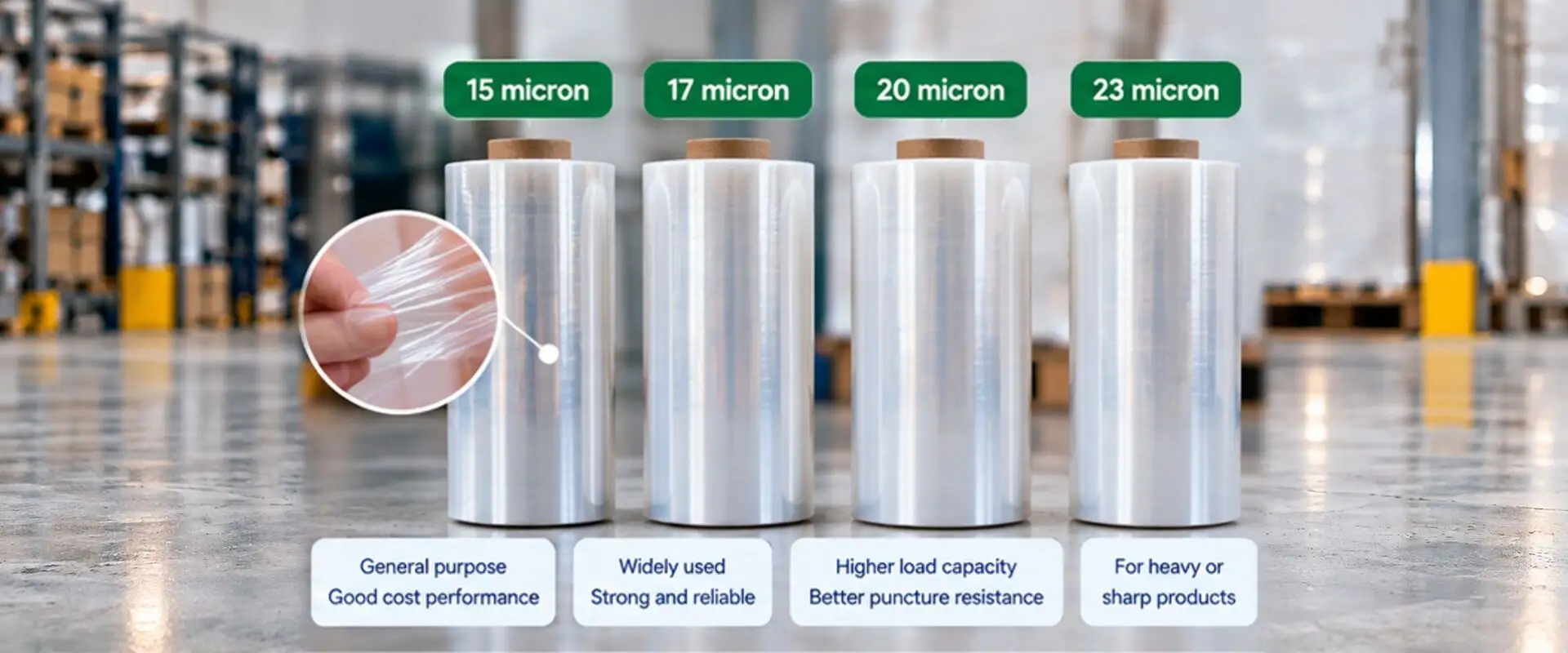
Common specifications for pallet stretch film include thicknesses of 15, 17, 20, and 23 microns (μm).
Assuming other material properties are comparable, thicker films generally offer superior puncture resistance or better load containment.
However, thickness alone does not determine the required number of wrapping layers.
Two films with the same thickness (in microns) may exhibit different performance characteristics due to variations in formulation, stretch properties, and manufacturing consistency.
Similarly, in specific applications, a high-performance film—even if thinner—may provide adequate load containment with less material usage, thereby outperforming a traditional thicker film.
Therefore, buyers should evaluate film performance and actual material consumption per pallet, rather than simply assuming that thicker film requires fewer wrapping layers.
The most valuable criterion for comparison is whether the wrapping method ensures the required load stability while maintaining reasonable film usage.
How does film overlap affect actual coverage?
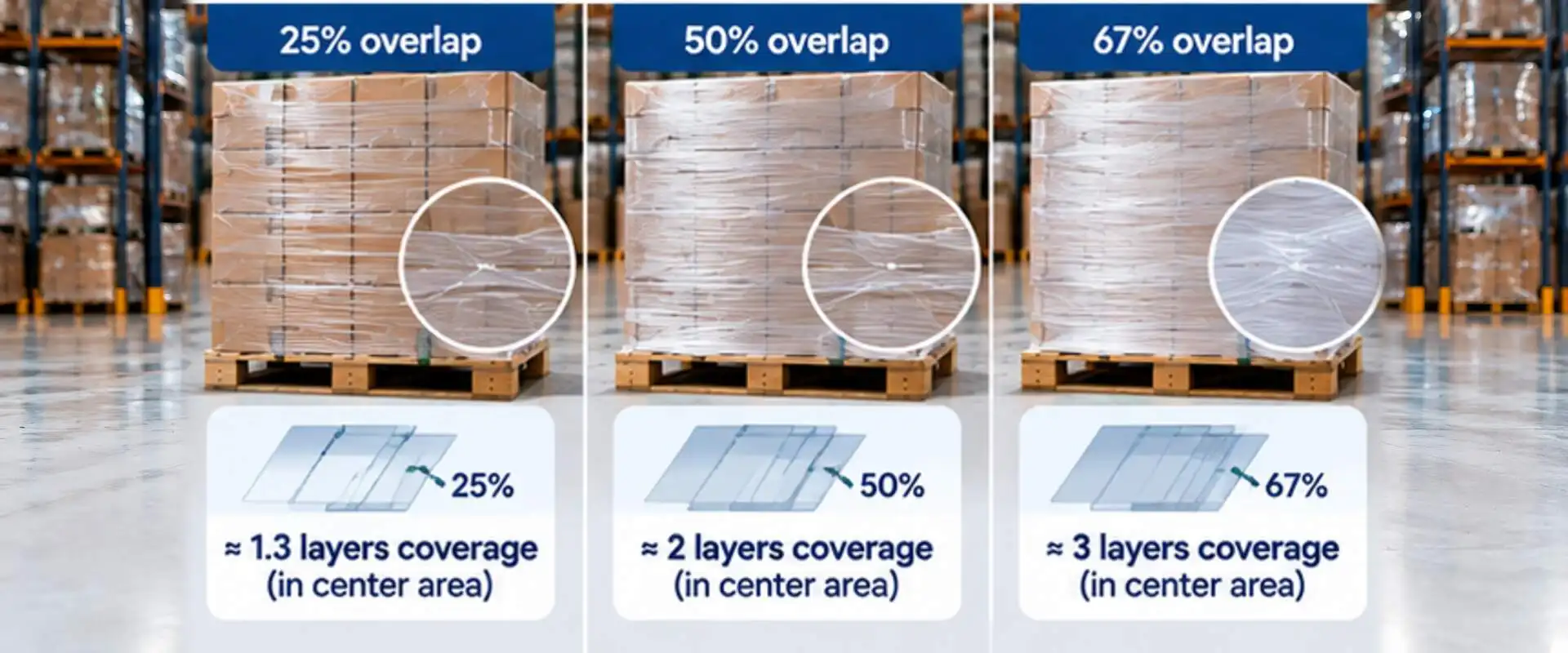
The degree of film overlap directly influences the actual number of layers covering the pallet surface.
As the film carriage moves upward, each subsequent wrap partially overlaps the previous one.
For example:
| Film overlap | Approximate coverage in the central area* |
| 25% | 1.3 layers |
| 50% | 2 layers |
| 67% | 3 layers |
This illustrates the average coverage for a standard spiral wrapping pattern (excluding the top and bottom edge areas). Actual coverage varies depending on the wrap geometry and machine settings.
This explains why two operators, while performing the same number of wraps, might use different amounts of film and achieve varying levels of coverage.
Increasing the overlap increases the amount of film covering a specific area but also raises material consumption.
The appropriate overlap should be selected based on the characteristics of the load and the validated wrapping process.
For many applications, an overlap of approximately 50% serves as a useful starting point for testing, though it is not a mandatory universal requirement.
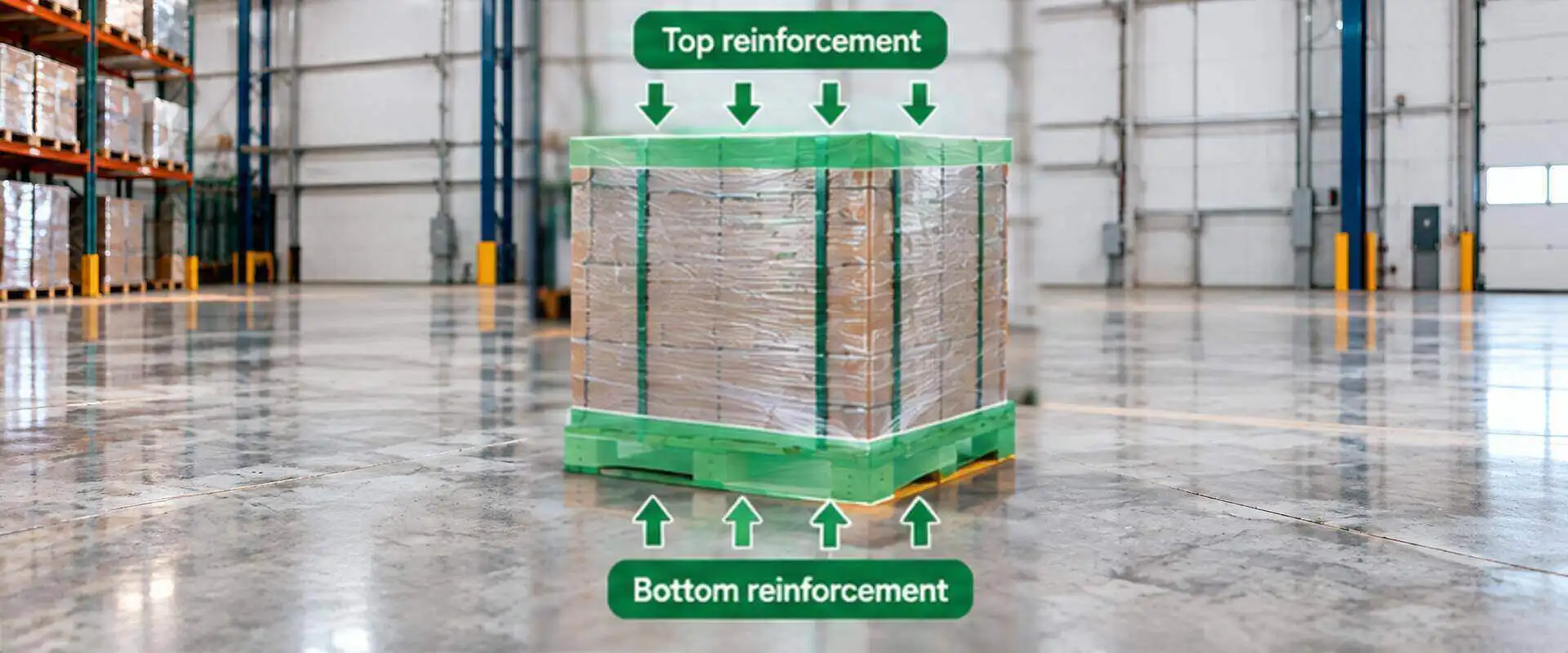
Do the bottom and top of the pallet require extra layers?
The bottom and top of the pallet usually require special attention, as they play distinct roles in load containment.
At the bottom, the wrapping pattern should help maintain the connection between the load and the pallet (depending on the design requirements for the unitized load).
Increasing the number of wraps at the bottom can be beneficial when stronger load containment is required near the pallet base.
The top area may also require reinforcement, particularly if the cartons are relatively loose or the load is tall.
However, applying excessive tension or too many layers to fragile cartons can cause them to deform.
A practical wrapping scheme should clearly define the following:
Bottom reinforcement–spiral overlap–top reinforcement–upward and downward wrapping cycles– film tension or pre-stretch settings.
The correct wrapping pattern should be determined by testing the wrapped pallet under typical handling conditions.
Do manual and machine wrapping require different numbers of layers?
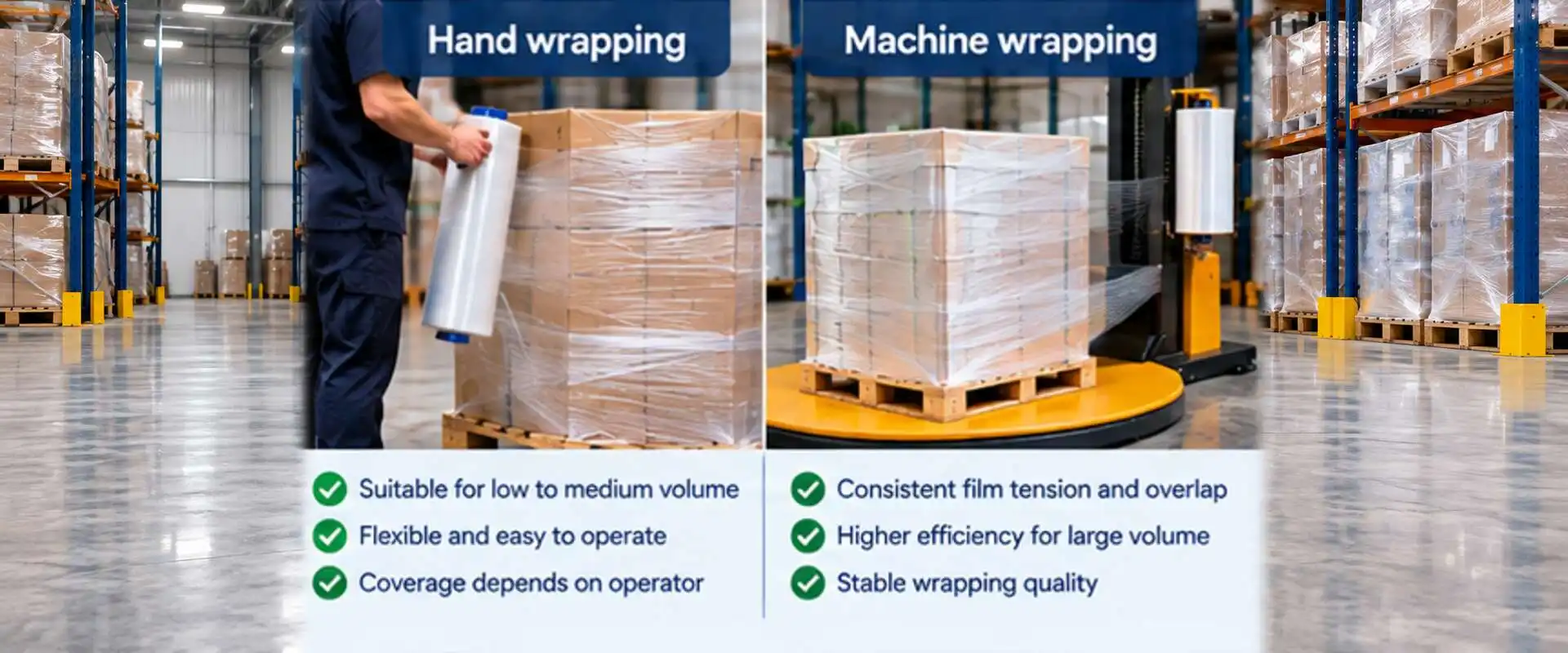
Even when using film of the same nominal thickness, manual and machine wrapping can yield different results.
In manual wrapping, film tension, walking speed, and overlap depend largely on the operator.
Two workers might perform the same number of wraps, yet result in different film consumption and load containment outcomes. With proper equipment configuration, machine wrapping allows for more consistent control over film delivery, carriage movement, pre-stretch levels, and wrapping patterns.
This facilitates the standardization of film usage across large volumes of pallets.
However, machine wrapping does not automatically mean that fewer layers will suffice; actual usage depends on the specific film used, machine settings, and the requirements of the load.
For high-volume operations, buyers should document their wrapping protocols and measure the actual film consumption per pallet.
Yalan Pack offers hand-grade, machine-grade, and pre-stretched films to meet diverse packaging needs.
How can film usage be reduced without compromising pallet stability?
The goal of stretch wrapping should not be to reduce the number of layers at any cost.
Instead, the objective should be to minimize actual film usage while ensuring the stability of the load.
An effective way to compare different wrapping protocols is to measure film consumption per pallet and evaluate the stability of the wrapped load.
For example, let us compare two hypothetical wrapping protocols:
| Item | Wrapping A | Wrapping B |
| Film consumption | 350 g/pallet | 280 g/pallet |
| Film saving | — | 20% |
| Load stability | Must be tested | Must be tested |
While adopting Wrapping Scheme B can reduce film usage by 20%, this is contingent upon the palletized load still meeting necessary stability and transport performance requirements.
Reducing film usage may involve adjusting the overlap, pre-stretch ratio, film tension, or reinforcement methods.
In certain applications, selecting a different grade or specification of film can also enhance efficiency.
However, changing multiple settings simultaneously makes it difficult to determine exactly which adjustment drove performance improvements or caused issues.
Therefore, various wrapping schemes should be compared through controlled tests under similar load and handling conditions.

How many layers of wrap should be used for export pallets?
For international shipping, the appropriate number of stretch film layers should be determined based on the specific characteristics of the palletized load and anticipated transport conditions.
A practical operational approach involves: ensuring stable stacking, properly securing the film's starting end, maintaining consistent overlap, reinforcing critical areas, and testing the finished pallet.
Wrapping specifications should document the film type, thickness, overlap, number of wraps, reinforcement methods, and relevant equipment parameter settings.
For demanding export shipments, conducting load stability tests helps evaluate whether the wrapping scheme provides sufficient load security during handling and transit.
Yalan Pack offers stretch films in various thicknesses, widths, roll lengths, and formulations, suitable for both manual and machine pallet wrapping operations.
For buyers looking to compare stretch film specifications, providing information such as pallet dimensions, load weight, product type, and current wrapping methods facilitates the evaluation and selection of the most suitable film product.
The optimal number of layers is not simply the more, the better; rather, it refers to a wrapping scheme that ensures the stability and security of the palletized load while effectively controlling film usage.


Contact Us
In This Article
Related Posts
Why Do Pallets Collapse During Transportation? 7 Common Packaging Mistakes
Oct 13, 2026
How Many Layers of Stretch Film Should Be Used on a Pallet?
Oct 08, 2026
How Should You Wrap a Pallet for International Shipping?
Oct 07, 2026
6 Specifications Buyers Should Check Before Ordering PET Strapping
Sep 30, 2026


