







PP Strapping for Cartons: Packaging Challenges in E-Commerce Logistics
By hqt
Oct, 2026Related Posts

PP Strapping for Cartons: Packaging Challenges in E-Commerce Logistics
Oct 21, 2026

Polypropylene Strapping Under Temperature Changes: Effects on Packaging Performance
Oct 21, 2026

PET Strapping Supplier: Heat-Seal Joint Strength and Sealing Reliability
Oct 21, 2026
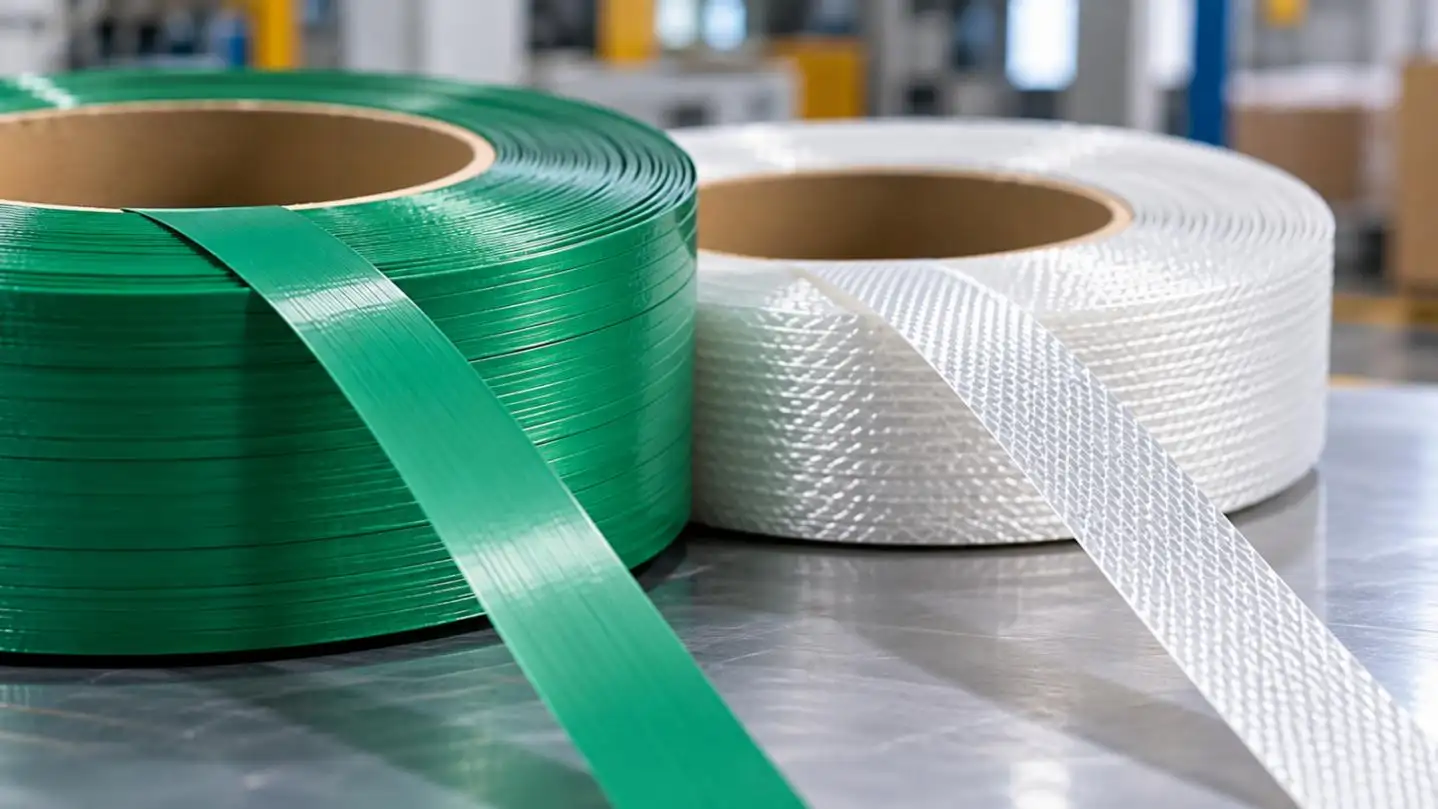
PP Strapping Supplier Guide: Smooth vs Embossed Strapping for Automated Packaging
Oct 21, 2026
PP Strapping for Cartons has to take more than the initial tension in a packing station. During order fulfillment, cartons undergo vibration, changing stacking pressure and multiple conveyor transfers. In addition, straps and carton joints may experience failure before corrugated carton failure occurs.

At Yalan Pack, we consider carton strapping as a complete packaging system. The right polypropylene strap is determined by the carton construction, the method of attachment and the conditions of the real distribution system.
1. Common Packaging Failures in E-Commerce Logistics
The high frequency nature of order fulfillment has put new demands on carton reinforcement.
| Packaging Failure | Underlying Mechanism | Technical Consideration |
| Strap loosening | Relaxation of PP strap and compression of carton | Retained tension |
| Carton edge crushing | Localized compression of carton by straps | Edge and tension protection |
| Joint separation | Inadequate joint strength or buckle slip | Joint efficiency |
| Load displacement | Unsuitable strap layout or not enough restraint | Strapping configuration |
| Sorting interference | Exposed strap ends or loose strap loops | Conveyor compatibility |
PP Strapping for Cartons is also useful for lightweight carton bundles in warehouse transfers. However, loose individual parcels require an evaluation of the constraints and automation sorting compliance of the carrier.
2. PP Strapping for Cartons and Mechanical Stress
Breaking Strength and Working Tension
Breaking strength is the load at which a strap fails. This is different from the load required to secure a carton.
Breaking strength is dependent on the cross-sectional area of the strap. The larger the cross-sectional area, the higher the breaking strength of the strap. This is because polypropylene formulations of similar type and processing conditions, larger cross sections of the strap, support higher breaking loads.
There are several other considerations when determining the appropriate strap thickness. Increasing thickness of the strap also increases the consumption of the strap. While tension is applied to the strap, other cartons may break.
For these reasons, it is best to consider the following three factors to improve strap breaking strength:
•Elongation: refers to the amount of extension of a strap under tensile force, and influences the ability of a strap to accommodate movement of a package.
•Joint Efficiency: is the ratio of the breaking load of a joint to the breaking load of the unjoined strap.
When considering a packaging system, a strong strap with a weak buckle connection is still considered an unreliable system.
Tension Relaxation & Carton Deformation
Polypropylene has viscoelastic behavior. Retained strain may result in loss of internal stress, and consequently, a reduction in tension.
Because of this behavior, it is especially critical in carton systems where:
•Cartons are stored for an extended period in a warehouse.
•Cartons are transported to a destination at an elevated temperature.
•The board loses its stiffness as a result of exposure to high humidity.
•Cartons are subjected to compression and vibration.
Changes in carton dimensions may affect the tightness of a previously-tensioned strap.
Hence, it is necessary to evaluate initial tension of straps, board compression resistance, and retained tension of the PP straps.
3. Comparing PP Strapping to Other Packaging Methods
Packaging materials play different mechanical roles.
| Comparison | PP Strapping | Alternative | Selection Principle |
| PP vs PET | Flexible; works for lighter loads. | PET provides stronger restraint for heavier loads. | Match load and tension-retention needs. |
| PP vs Packing Tape | External carton bundling. | Tape is used to close carton flaps. | Reinforcement vs. closure. |
| Single vs Cross-Strapping | One-direction restraint. | Cross-strapping restrains in two-directions. | Package geometry and movement. |
| Manual vs Machine | Adapts to carton size variation. | Repeatable for standard production. | Volume, tooling and labor. |
At Yalan Pack, our PP hand strapping is used for manual packaging of cartons and parcels of light weight goods.
Variable sized e-commerce orders can be manually packed using PP hand strapping, without special dedicated strapping equipment. High volume orders should consider equipment investment, throughput and first-part machine compatibility.
4. Selecting PP Strapping for Cartons: Dimensions and Manufacturing Consistency
The mechanical properties of different kinds of strapping materials determine the specific strapping specification for a given application.
Strapping Specifications
Information about the width and thickness of our PP/PET strapping as well as the dimensions of the core of the coil are as follows. The grade specific tolerance limits should be verified for a given case.
| Parameter | Range | Engineering Relevance |
| Strap Width | 5–32 mm | Load distribution and strength selection |
| Strap Thickness | 0.4–1.2 mm | Cross sectional area and material consumption |
| Coil Core Diameter | 200/406 mm | Dispenser and equipment compatibility |
| Breaking Strength | Grade dependent | Required restraint capacity |
| Other Options | As above | Supply and Logistic Preferences |
The ranges described above are for the PP/PET strappings and the tolerances for a specific grade must be confirmed.

Importance of Precision in Manufacturing
The mechanisms for the dimensional and property uniformity for the different lots produced are the same.
During a technical purchase evaluation it is suggested that the variability of:
•Width: Impact on position of the strap and tool/tongue compatibility.
•Thickness: Impact cross sectional area and local strength.
•Breaking load: Differences in production samples and batches.
•Winding Quality of the Coil: Impact on uniform unwinding and applicability of strap.
Nominal dimensions are not manufacturing tolerances. It is suggested that buyers request grade specific tolerance limits and measured inspection results as opposed to assuming a fixed ±mm.
Matching Strap Layout to Carton Strength
In the case of small bundles that permit considerable movement, single-band strapping may not be adequate. With large movement in one direction, for example, use a second strap in the opposite direction. Parallel bands distribute the restraint over a larger area.
Where corner strap contact produces creases or damages carton corners, edge protectors may be used to distribute the applied strain.
The best design should be determined by trials with representative cartons (i.e. not by the weight of the cartons alone).
5. Testing PP Strapping for Cartons before Procurement
Packaging validation should include testing of the strapping material and the packaged product.
Two related technical references are:
•ASTM D3950-23: Specification covering non-metallic strapping and joining methods, and mechanical performance requirements.
•ISTA 3A: Transport simulation for individual eligible parcels not exceeding 70 kg. (150 lb.)
Both references cover different verification needs. Neither ensures that a specific delivery network is serviced.
Each of the references covers different verification needs. Neither specifically verifies that a particular delivery network is serviced.
Recommended Procurement Verification
For bulk purchase of PP Strapping for Cartons, verification should include:
- Tests for the nominal thickness, breaking load, and elongation.
- Joint tests to evaluate connection strength using the intended fastening tool.
- Tension tests to evaluate strap retention after exposure to various environmental conditions and storage.
- Transit tests to evaluate the package and carton integrity after various drops, shock and vibration tests.
- Test a representative sample of each lot to verify batch consistency, and compare the sample to previously approved samples, and documented specification.
The above are to be conducted for other variables, including internal carton cushioning, construction of cartons, strap end management, and carrier handling requirements, for consistency.
6. Minimizing Cost while Maintaining Package Protection
Not considering all costs associated with packaging, e.g. equipment, labor, and the expected costs associated with damaged and reworked packages, may result in a suboptimal packaging solution.
The total cost of a package = Strapping + Fastening materials + Equipment allocation + Labor + Expected damage and rework costs
For companies using PP Strapping for Cartons, strain can be reduced through the optimization of strapping pattern and strap width, while package security is not compromised.
At Yalan Pack, we offer PP Hand Strapping according to customers' requirements for carton bundling. For us to provide you with a solution, kindly provide us with your specifications and the conditions under which your packages will be handled and fastened.
FAQs
Q1. What is Yalan Pack's PP Hand Strapping used for?
Yalan Pack's PP Hand Strapping is designed for bundling cartons, parcels, and lightweight goods in warehousing, distribution, and general packaging operations.
Q2. Is Yalan Pack's PP Strapping suitable for e-commerce packaging?
Yes. Our PP hand strapping is suitable for lightweight carton bundling and warehouse order fulfillment, subject to package strength and handling requirements.
Q3. Can Yalan Pack customize PP strapping width and thickness?
Yes. We offer customizable widths, thicknesses, lengths, and colors. Available dimensions and tolerances should be confirmed for each product grade.
Q4. Is Yalan Pack's PP Hand Strapping compatible with manual tools?
Yes. Our PP hand strapping is designed for manual packaging. Tool, tensioner, and buckle compatibility should be checked before use.
Q5. How does Yalan Pack help prevent carton damage during strapping?
We recommend selecting suitable strap dimensions and tension levels, considering carton compression strength, and using edge protectors when necessary.
Share on Social:


Contact Us
In This Article
Related Posts
PP Strapping for Cartons: Packaging Challenges in E-Commerce Logistics
Oct 21, 2026
Polypropylene Strapping Under Temperature Changes: Effects on Packaging Performance
Oct 21, 2026
PET Strapping Supplier: Heat-Seal Joint Strength and Sealing Reliability
Oct 21, 2026
PP Strapping Supplier Guide: Smooth vs Embossed Strapping for Automated Packaging
Oct 21, 2026


