







Wholesale Stretch Film Rolls: Downgauging Without Losing Load Stability
By hqt
Oct, 2026Related Posts
PP Strapping for Cartons: Packaging Challenges in E-Commerce Logistics
Oct 21, 2026

Polypropylene Strapping Under Temperature Changes: Effects on Packaging Performance
Oct 21, 2026
PET Strapping Supplier: Heat-Seal Joint Strength and Sealing Reliability
Oct 21, 2026
PP Strapping Supplier Guide: Smooth vs Embossed Strapping for Automated Packaging
Oct 21, 2026
Theoretically, decreasing pallet stretch film from 20 to 17 microns reduces the film mass by 15%. However, using thinner film increases the risk of film breakage, requiring additional layers of film, and possible weakening of pallet containment.
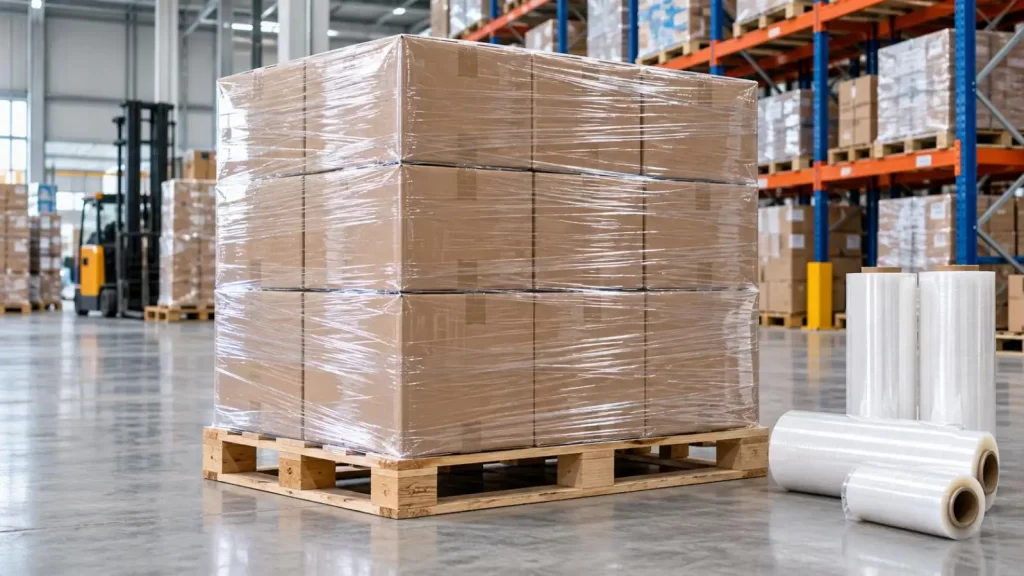
Achieving downgauging of Wholesale Stretch Film Rolls necessitates balancing the thinnest possible film gauge with the structure of the film and elastic recovery and wrapping process, in order to achieve load stability.
What is Downgauging in Wholesale Stretch Film Rolls?
Downgauging is the process of using a thinner film that still satisfies the same requirements of a package.
Film thickness effects the amount of material used, but load containment is also affected by the behavior of the material, the tension it is being stretched with, how it adheres to the load, and the wrapping process.
Consider a theoretical conversion:
| Parameter | Conventional Film | Downgauged Film |
| Nominal thickness | 20 μm | 17 μm |
| Relative film mass | 100% | 85% |
| Theoretical material reduction | Baseline | 15% |
| Performance requirement | Existing containment | Equivalent verified containment |
The 15% reduction is based on equal film width, unwound length and density. Actual savings depend on many factors, including neck-down, wrapping cycles and how many wraps are rejected.
Because of this, gauges need to be considered along with how much film is actually used.
How Can Thinner Stretch Film Maintain Load Stability?
LLDPE Structure and Manufacturing Precision
In stretch film, LLDPE provides the balance for film properties, including toughness, elastic recovery and cling.
For downgauging, the following three properties are critical:
• Puncture resistance: to avoid local failure in the film around carton corners and edge-out products.
• Elastic recovery: to provide the force to restrain the load.
• Thickness uniformity: to avoid weak film sections that could initiate failure.
Yalan Pack's manufacturing equipment and controls for raw materials, film thickness, mechanical performance, and finished product inspection, along with highly developed process controls and verification, enable us to achieve the same benefits in our multilayer stretch film.
Our published product information indicates certain products can achieve elongation up to 350%. This is not a guaranteed product setting. This is a product performance capability.
Why Elongation is Not the Same as Containment Force
Elongation at break measures how far a film stretches before failure. Containment force describes the restraining force applied to a wrapped load.
Film elongation is not a definitive indicator of containment force. A film with high elongation can still demonstrate excessive stress relaxation or insufficient holding force.
In addition to elongation, buyers should evaluate:
• Pre-stretch and wrapping tension
• Elastic recovery and retained stress
• Film-to-film cling and overlap
• Containment force after wrapping and storage
These provide a basis for determining if a film can provide load restraint.
Which Wholesale Stretch Film Rolls Are Suitable for Downgauging?
Selection of thickness must consider pallet geometry, weight distribution and handling conditions, as well as the capability of the equipment being used.
| Film Option | Potential Application | Main Verification Point |
| 15–17 μm | Uniform, relatively stable carton loads | Containment and tear resistance |
| 18–20 μm | General warehouse pallets | Material consumption versus stability |
| 23 μm and above | Challenging or sharp-edged loads | Puncture resistance and load movement |
| High-performance thin film | Validated downgauging applications | Retained containment at lower film mass |
| Pre-stretched film | Compatible manual or low-tension applications | Applied tension and wrap integrity |
These are selection starting points, not guaranteed load ratings.
Pre-Stretch Ratio and Machine Compatibility
Machine stretch film must operate within the wrapping equipment's practical stretch range.
Too much pre-stretch can cause neck-down, thin spots, and ruptures. Applying too much tension can cause the cartons to deform. Using too little tension, or bottom wrapping, can allow pallet loads to separate.
When using machine film, the wrapping process is more controlled than with hand film, but the equipment still needs to be verified.
Prior use of pre-stretch film may require less effort than traditional hand film, but may give less containment than hand film.
Will Downgauging Lower My Total Packaging Costs?
Roll thickness and prices do not always correlate to lower packaging costs.
A good benchmark is the film cost per pallet, calculated as:
Film Cost per Pallet = Mass of Film Consumed per Pallet × Cost per kg of Film
Other operating costs include loss in productivity due to machine downtime, increase in workforce due to additional rewrapping, and damage to the load.
For example, if an 15% downgauging provides a more economical price, and savings are realized, it will only be so if additional wrapping cycles offset the savings.
Purchasing teams should evaluate cost per successfully wrapped pallet rather than cost per roll.
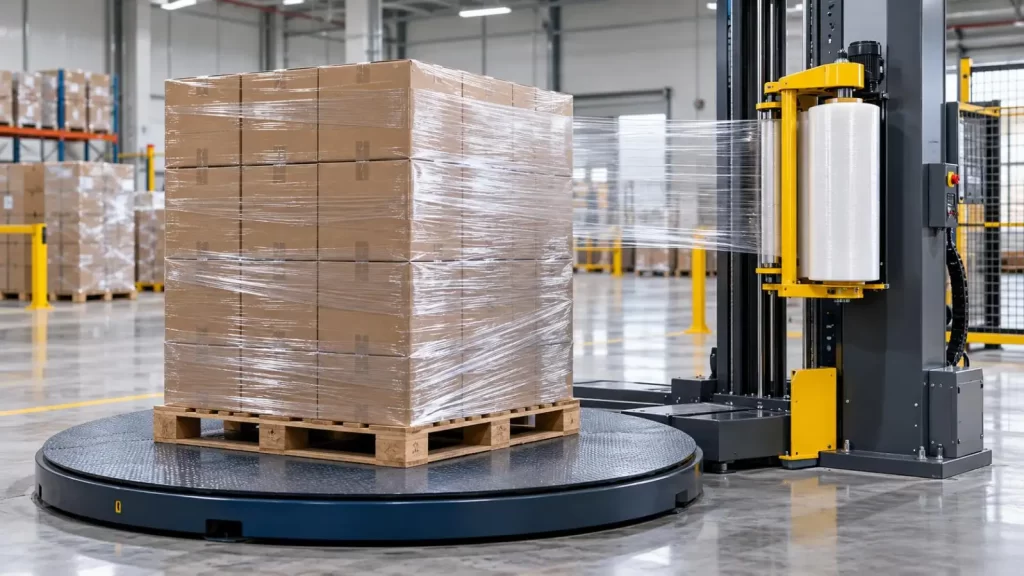
Evaluating a Wholesale Stretch Film Distributor
Thin film requires consistent manufacturing.
At full capacity, our manufacturing facilities can produce over 2,000 tons per month with the aid of multi-layer production equipment, IQC, and OQC.
Buyers should not assume nominal specifications represent guaranteed tolerances. Requests for measurements should be made instead.
Essential purchase requirements:
• Nominal width and thickness with measured tolerance limits
• Cross web thickness variation and batch inspection records
• Roll length, net film weight and paper-core weight
• Tensile, puncture, cling and recovery test results
• Machine compatibility and approved wrapping parameters
• OEM specifications, sampling and lot traceability requirements.
For a nominal 500 mm x 17 μm film, the actual dimensional tolerance and acceptance criteria should be established by an agreed technical specification.
We provide different levels of hand, machine, and pre-stretched versions of stretch films to help meet varied customer requirements.
Any customer who wishes to buy stretch film in a roll in a bulk shall first assess the required containment performance and then check the proposed gauge against actual pallet loads.
At Yalan Pack, we work with customers to define film requirements, adjustments and assess sample packages for their shipment needs. Please approach us to verify the technical feasibility of downgauging.
FAQs
Q1: What types of wholesale stretch film rolls does Yalan Pack supply?
Yalan Pack supplies hand stretch film, machine stretch film, pre-stretched film, jumbo rolls, and customized stretch film for industrial packaging.
Q2: Can Yalan Pack support stretch film downgauging?
Yes. We offer different film thicknesses and specifications. Buyers should verify thinner films through sample testing and pallet load stability evaluations.
Q3: Does switching from 20μm to 17μm film guarantee cost savings?
No. Although the theoretical film mass reduction is 15%, actual savings depend on wrapping layers, pre-stretch settings, film consumption, and load stability.
Q4: What is the maximum stretch performance of Yalan Pack's stretch film?
Our product offers elongation up to 350% for suitable products. Actual operating pre-stretch depends on the film grade and wrapping equipment.
Q5: How does Yalan Pack control stretch film manufacturing quality?
We use multilayer film production equipment, incoming quality control (IQC), in-process monitoring, and outgoing quality control (OQC).


Contact Us
In This Article
Related Posts
PP Strapping for Cartons: Packaging Challenges in E-Commerce Logistics
Oct 21, 2026
Polypropylene Strapping Under Temperature Changes: Effects on Packaging Performance
Oct 21, 2026
PET Strapping Supplier: Heat-Seal Joint Strength and Sealing Reliability
Oct 21, 2026
PP Strapping Supplier Guide: Smooth vs Embossed Strapping for Automated Packaging
Oct 21, 2026


