







What Is the Difference Between Net Weight and Gross Weight of Stretch Film?
By hqt
Sep, 2026Related Posts


Stretch Film Net Weight vs Gross Weight is a distinction when comparing pallet wrap rolls and supplier quotes. Net weight refers to the film itself, while gross weight includes the cardboard core and other packaging components. Understanding this difference helps buyers assess usable film quantity, evaluate roll length claims, and compare costs fairly. This guide explains how to calculate both weights, why core weight matters, and what specifications to confirm before ordering stretch film for warehouse or industrial packaging needs.
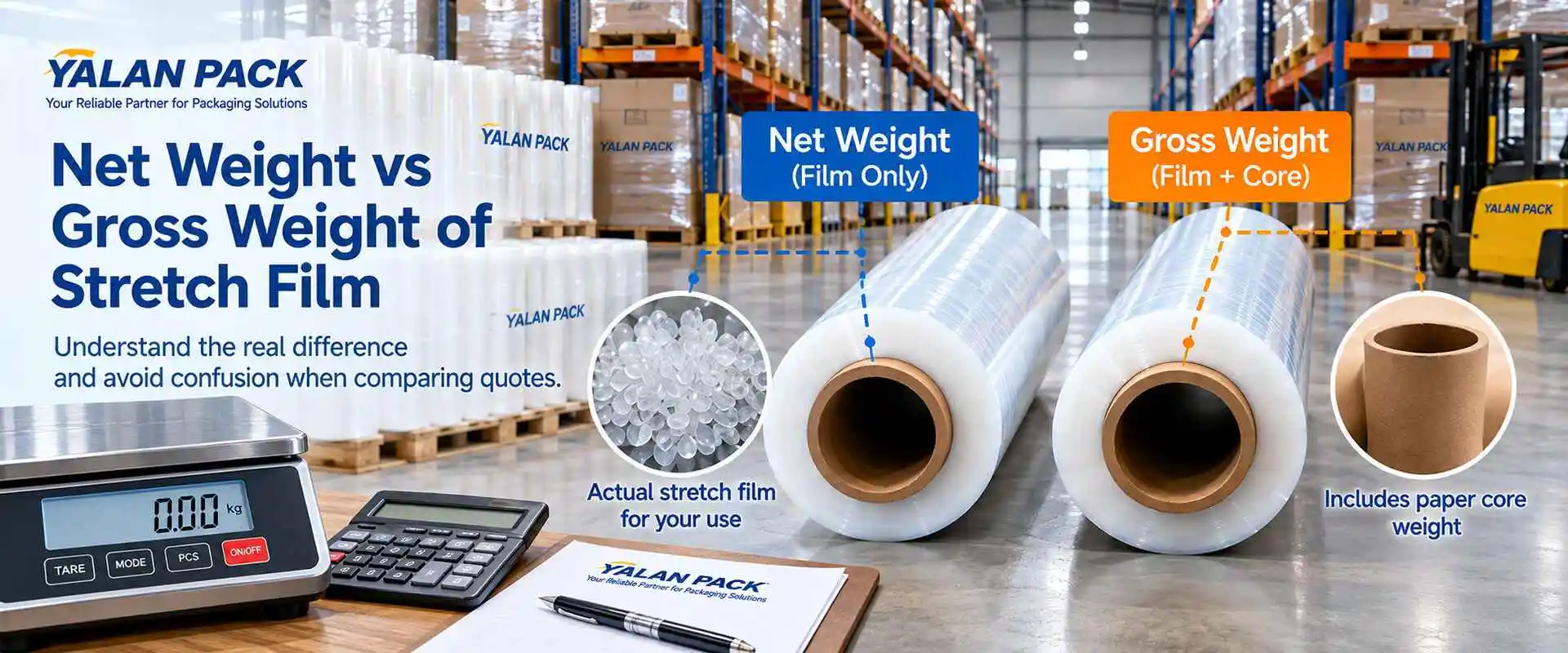
What is the net weight of stretch film?
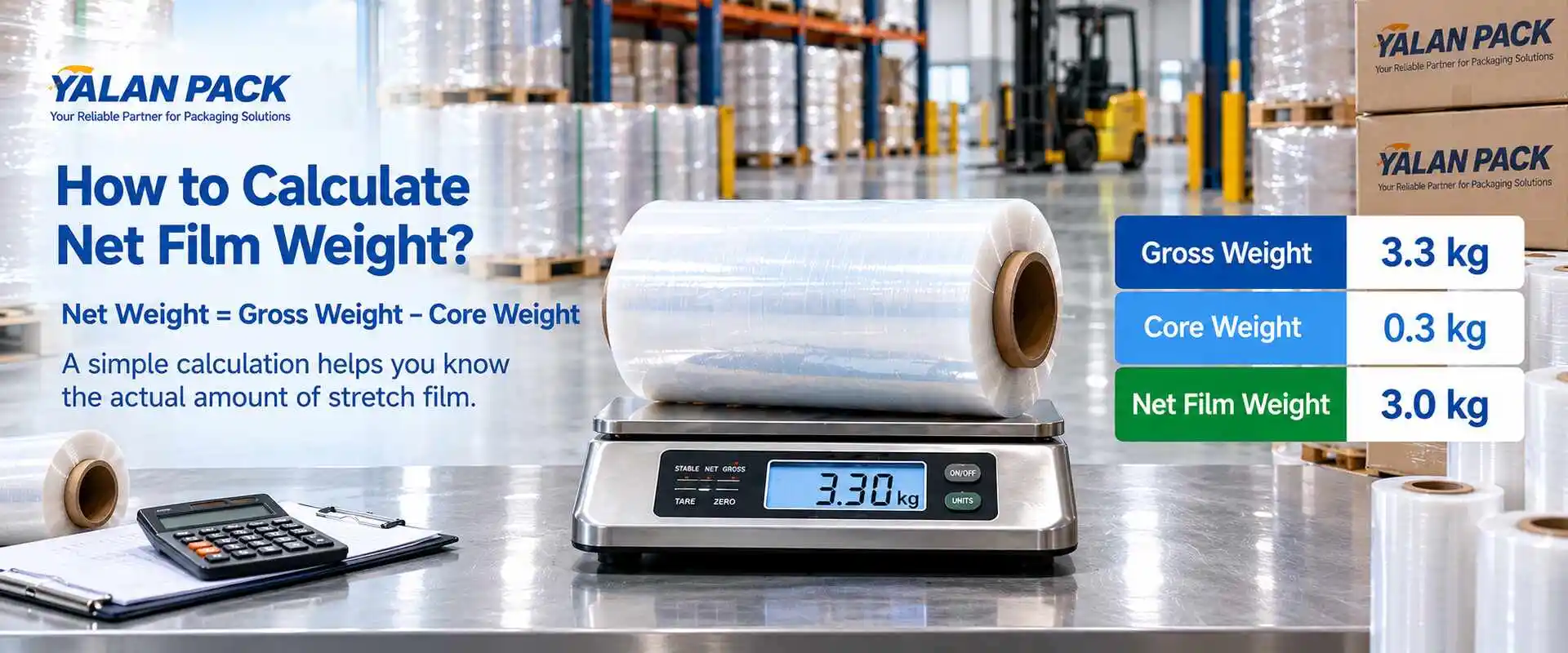
Net weight is the weight of the usable stretch film itself, excluding the paper core. If a product specification lists "500 mm × 20 microns × 3 kg net weight," it means the roll received by the buyer contains approximately 3 kg of stretch film; the weight of the paper core is calculated separately. If the paper core weighs 0.3 kg, the total gross weight of the roll is: 3.0 kg film + 0.3 kg paper core = 3.3 kg gross weight.
When comparing actual film consumption during procurement, net weight is a more meaningful reference; the paper core serves merely as a support carrier and is not part of the usable stretch film material.
What is the gross weight of a stretch film roll?
Gross weight includes the weight of both the stretch film and the paper core.
Example: Roll gross weight: 3.0 kg; Paper core weight: 0.3 kg; Stretch film net weight: 2.7 kg.
In this scenario, out of the 3.0 kg total roll weight, only 2.7 kg consists of stretch film. Specifying weight based on gross weight is not inherently incorrect; in many regions and among many buyers, it is common practice to purchase based on the total roll weight. Key point: Price quotations must clearly indicate whether the weight listed is net weight (NET) or gross weight (GROSS).
Why is paper core weight critical when comparing stretch film quotes?
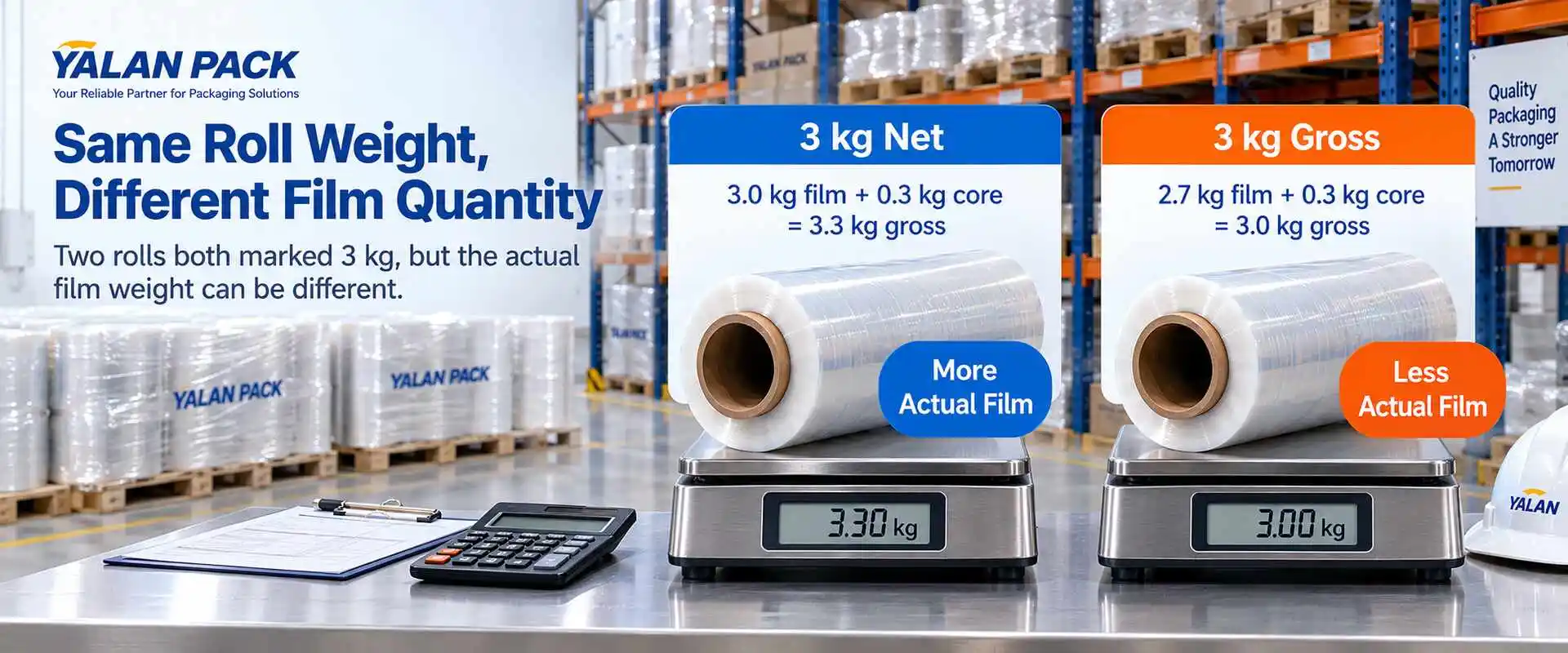
When comparing prices, the weight of the paper core can result in significant differences in quantity. Consider the two products below:
Table
| Specification | Supplier A | Supplier B |
| Stated Roll Weight | 3.0 kg | 3.0 kg |
| Weight Type | Net | Gross |
| Core Weight | 0.3 kg | 0.3 kg |
| Actual Film Weight | 3.0 kg | 2.7 kg |
| Approx. Total Roll Weight | 3.3 kg | 3.0 kg |
At first glance, both products appear to be "3 kg stretch film"; however, Supplier A actually provides 3.0 kg of film, while Supplier B provides only 2.7 kg. This results in a difference of 0.3 kg per roll. For an order of 5,000 rolls, the total discrepancy would be: 0.3 kg × 5,000 = 1,500 kg.
Therefore, when comparing prices, professional buyers must verify whether the quoted weight refers to net weight or gross weight.
Does a heavier paper core mean there is more film?
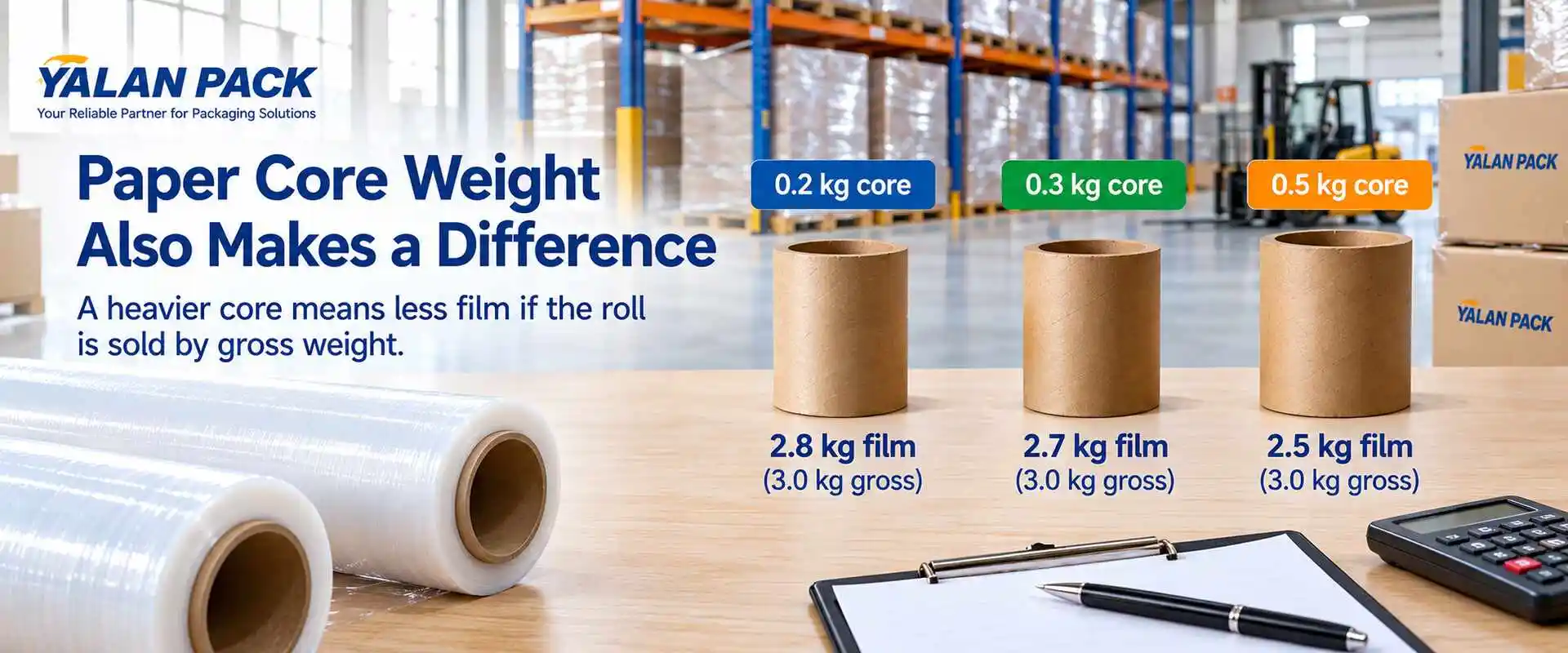
Not necessarily. There is no direct correlation between the weight of the paper core and the amount of film. If the product is sold based on gross weight—meaning the total weight of the roll is fixed—a heavier paper core actually results in less actual film weight.
Table
Gross Weight Paper Core Weight Actual Film Weight
| Gross Weight | Core Weight | Actual Film Weight |
| 3.0 kg | 0.2 kg | 2.8 kg |
| 3.0 kg | 0.3 kg | 2.7 kg |
| 3.0 kg | 0.5 kg | 2.5 kg |
This is why stretch film quotations should also specify the paper core specifications. However, a lighter paper core is not always better. Machine-grade stretch film or heavy rolls require higher-strength paper cores to provide adequate support during handling and wrapping operations. Paper core specifications must match the actual usage scenario.
How do you calculate the net weight of stretch film?
If the total weight of the roll and the weight of the paper core are known, the calculation is straightforward: Net film weight = Total roll weight − Paper core weight.
Example: Total roll weight = 3.5 kg; Paper core weight = 0.4 kg; Net film weight = 3.5 − 0.4 = 3.1 kg.
For bulk purchases, the buyer can also estimate the total net weight of all the film: Total net film weight = Net weight per roll × Total number of rolls.
Example: Purchasing 4,000 rolls of stretch film with a net weight of 3 kg per roll: 3 kg × 4,000 = 12,000 kg of film. This calculation method facilitates the comparison of price quotes from different suppliers.
Is net weight more important than roll length?
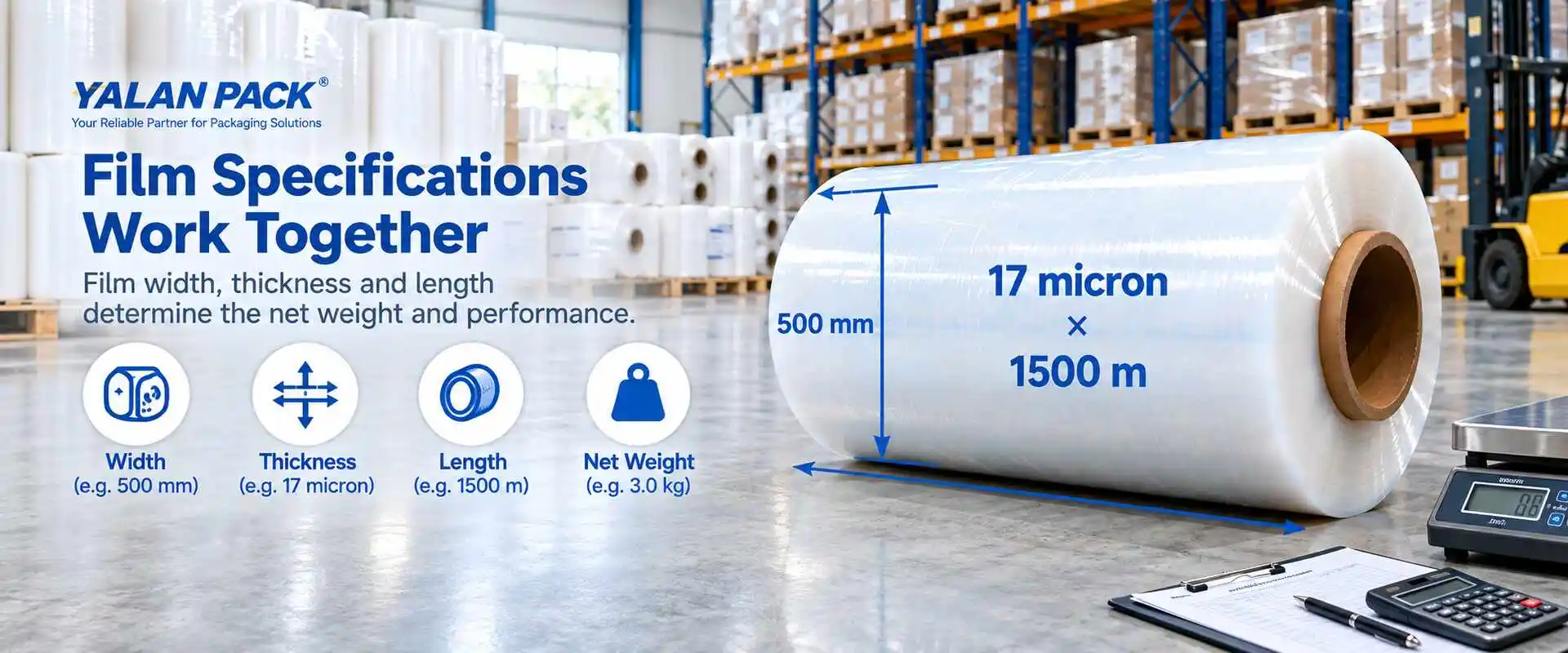
These two specifications cannot be viewed in isolation. Net weight represents the actual total amount of plastic film being purchased, whereas roll length refers to the theoretical length of the film wound around the paper core. Given a fixed material density, the formula for calculating film weight is: Film width × Thickness × Length × Density.
Suppose a supplier provides the following specifications: 500 mm × 17 microns × 1,500 meters. The corresponding theoretical film weight should align with these dimensions and the material density. If the stated length, thickness, and net weight data are contradictory, the buyer needs to verify how the specifications were measured. When comparing prices, it is advisable to look at the complete set of parameters rather than focusing on a single figure.
Can I directly compare the price per roll when purchasing stretch wrap?
Relying solely on the price per roll for comparison can easily lead to misjudgment.
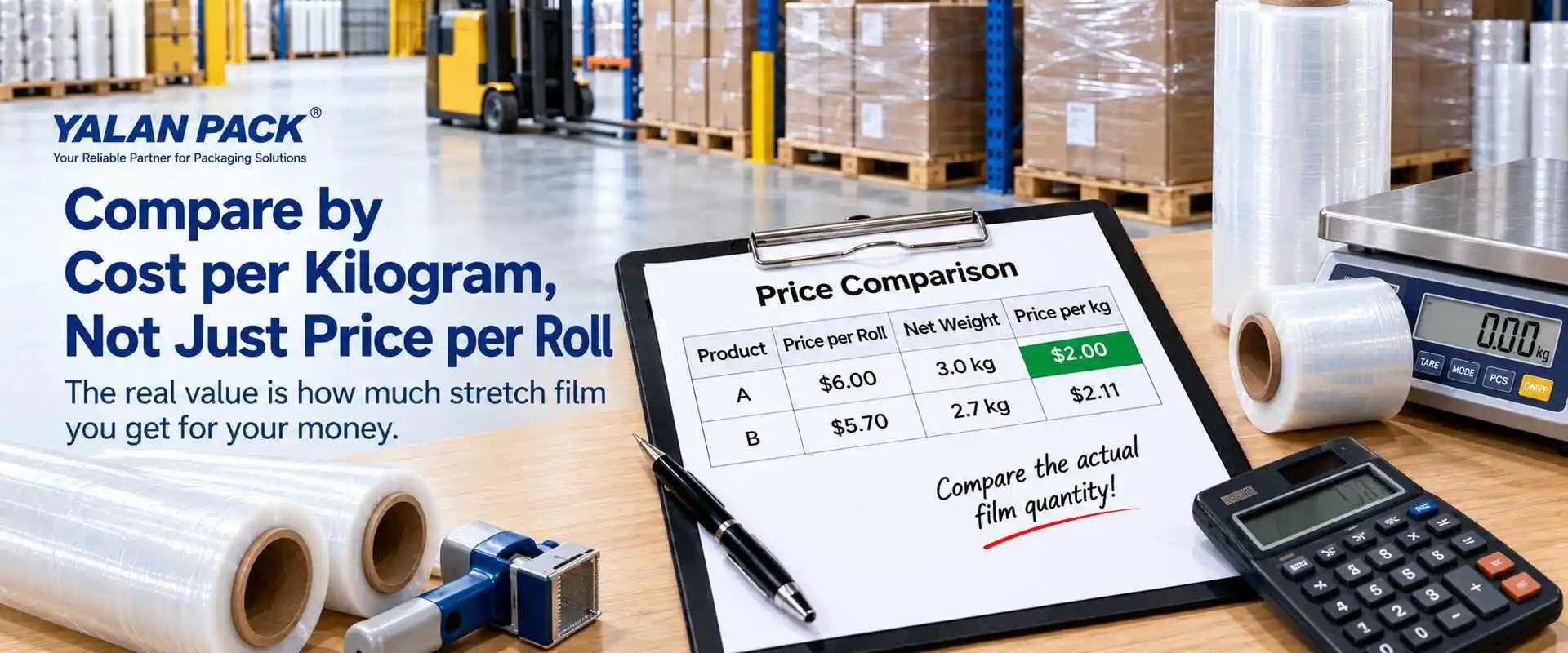
Comparison example: Film A: $6.00/roll, net weight 3.0 kg; Film B: $5.70/roll, net weight 2.7 kg.
Film B appears to be $0.30 cheaper per roll. Cost per kilogram calculation: Film A: $6.00 ÷ 3.0 = $2.00/kg; Film B: $5.70 ÷ 2.7 = $2.11/kg.
This demonstrates that Film B, despite having a lower price per roll, actually has a higher cost per unit of weight. When comparing prices, buyers should consider a range of factors: price per roll, net film weight, specifications, and actual performance. For pallet wrapping operations, the optimal metric for evaluation is typically the cost per pallet to achieve a secure wrap.
What information should a stretch wrap quotation include?
To avoid misunderstandings, buyers should require suppliers to clearly list the following details:
·Film width
·Film thickness
·Roll length (if applicable)
·Net film weight
·Gross roll weight
·Paper core weight
·Paper core inner diameter
·Application type: Hand-wrap or machine-wrap
·Number of rolls per carton/pallet
·Gross weight of carton/pallet
·Shipment quantity per order
For example, simply labeling it as "Stretch film: 500mm × 20μm × 3kg" is not recommended.
A clearer, standardized description would be: 500mm × 20μm × 3.0kg net weight + 0.3kg paper core; total gross roll weight: 3.3kg.
Such clear labeling helps prevent significant calculation errors when comparing quotes from multiple suppliers.
What is the best way to compare stretch film quotes?
The prerequisite for comparing stretch film quotes is establishing a unified standard for comparison. First, confirm whether the stated 3kg refers to net weight or gross weight, then verify the paper core weight, film thickness (microns), film width, roll length (if applicable), application type (hand vs. machine), and packaging quantities. Based on this, evaluate the film's actual performance and consumption per pallet. Yalan Pack supplies hand-grade stretch film, machine-grade stretch film, pre-stretched film, and custom LLDPE stretch film, offering a wide range of specifications for width, thickness, net/gross weight, and core size.
Buyers should keep one key principle in mind: instead of simply asking, How much does the roll weigh?, ask, How much actual stretch film is on the roll? This approach ensures greater price transparency and helps buyers accurately determine the amount of usable material.
FAQ
1. What is the difference between net weight and gross weight of stretch film?
Net weight refers to the actual weight of the stretch film material, excluding the cardboard core and packaging components. Gross weight includes the film, core, and any included packaging materials. Understanding this difference helps buyers compare usable film quantities and evaluate supplier quotations more accurately.
2. How do you calculate the net weight of a stretch film roll?
To calculate net weight, subtract the weight of the cardboard core and any included packaging from the gross roll weight. For example, if a roll weighs 3 kg and the core weighs 0.5 kg, the net film weight is 2.5 kg. Accurate measurements help buyers determine how much usable film they are purchasing.
3. Why does cardboard core weight matter when buying stretch film?
Cardboard core weight affects the total roll weight without increasing the amount of usable stretch film. Two rolls with identical gross weights may contain different quantities of film if their cores have different weights. Checking core weight helps buyers compare products fairly and avoid paying for unnecessary packaging weight.
4. Is net weight more important than roll length when comparing stretch film?
Both measurements are important. Net weight indicates the quantity of film material, while roll length shows how much film is available for wrapping. Film thickness and width also affect the relationship between weight and length. Buyers should compare these specifications together to assess actual packaging value and efficiency.
5. How can buyers compare stretch film costs accurately?
Compare suppliers using the actual net film weight, roll length, film width, thickness, and unit price. Calculating the cost per kilogram of usable film or per meter of comparable film can help identify better value. Buyers should also consider film performance, pre-stretch capability, and consumption per pallet rather than focusing only on the price per roll.
Share on Social:


