







Steel Strapping vs PET Strapping: When Can PET Replace Steel?
By hqt
Sep, 2026Related Posts
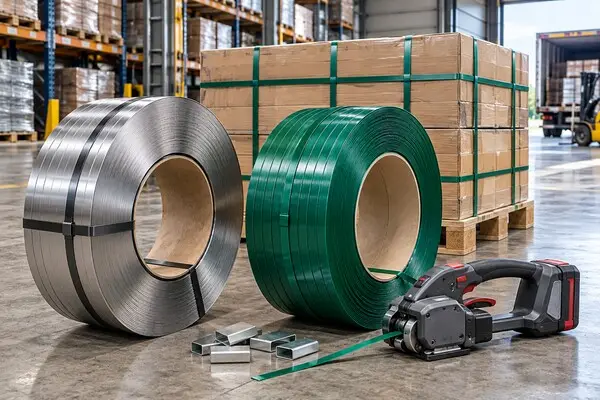
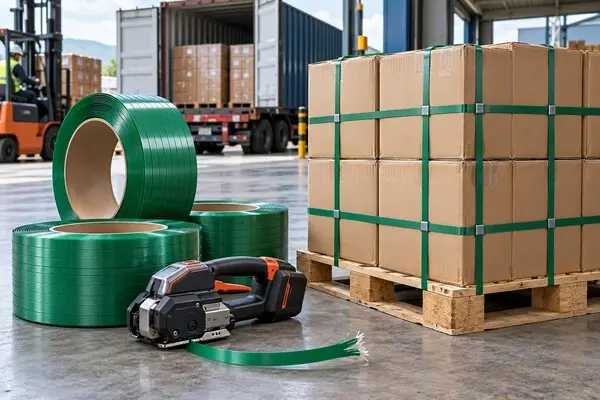
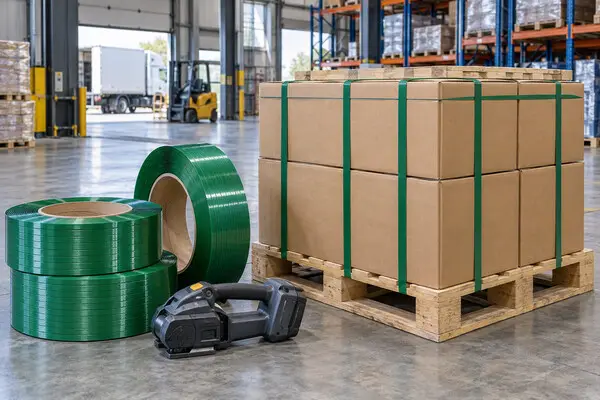
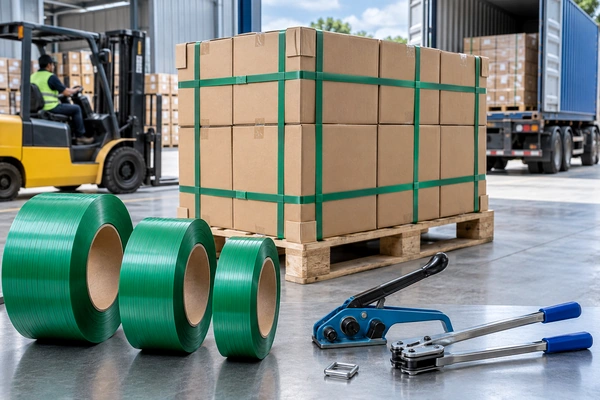
In certain pallet packaging applications, PET strapping can replace steel strapping if the chosen PET strap and its associated strapping system provide sufficient strength, load retention, and resistance to anticipated handling conditions.
PET strapping is generally suitable for stable, unitized loads—such as certain construction materials, wood products, and palletized cartons. However, steel strapping may still be the necessary choice for loads that are extremely heavy, highly rigid, have sharp edges, or are exposed to high temperatures.
The correct choice depends on the specific product, required strap tension, strapping configuration, joint strength, equipment, and transport conditions—rather than simply comparing the nominal breaking strength of PET versus steel.
What is the difference between steel strapping and PET strapping?
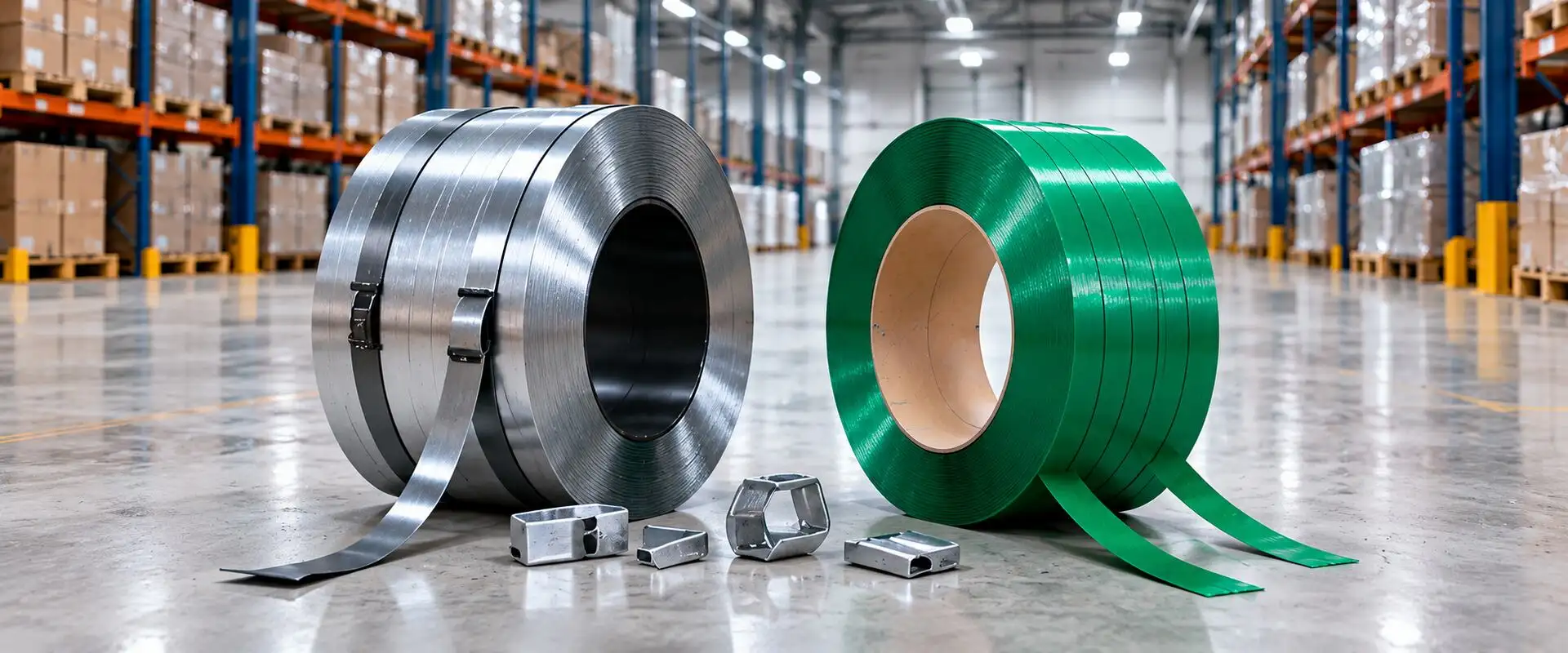
Both steel and PET strapping are used to secure industrial products, yet they possess distinct material properties.
Steel strapping is made of metal and is typically characterized by high tensile strength, high rigidity, and low elongation.
PET strapping is made of polyethylene terephthalate (a type of polyester); it offers a combination of tensile strength and elasticity that surpasses that of steel.
These differences determine how the materials behave when the load settles, expands, contracts, or shifts during transport.
| Property | Steel Strapping | PET Strapping |
| Material | Steel | Polyester (PET) |
| Elongation | Relatively low | Generally higher |
| Elastic recovery | Limited | Greater flexibility and recovery |
| Corrosion | May rust without suitable protection | Does not rust |
| Sharp-edge resistance | Application-dependent; generally more resistant to cutting | Requires particular attention to sharp edges |
| High-temperature exposure | May be suitable for applications beyond PET's temperature capability | Limited by the specific PET grade and exposure conditions |
| Handling | Sharp edges may present handling hazards | Generally easier to handle, but tensioned straps still present hazards |
| Typical applications | Rigid, sharp-edged or demanding industrial loads | Palletized products and suitable industrial loads |
There is no absolute superiority or inferiority between these two materials; their suitability depends on the required packaging performance.
When can PET strapping replace steel strapping?
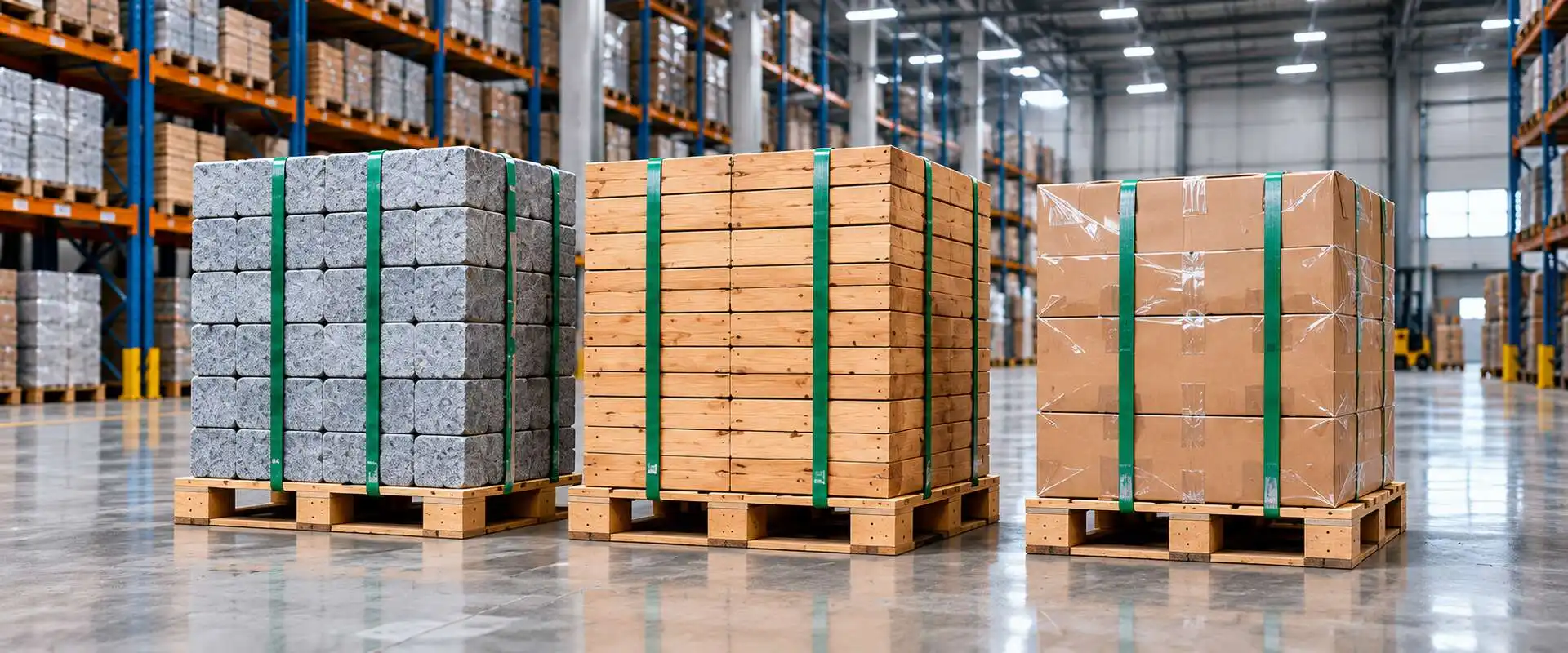
If a load can be securely fastened without the specific high rigidity or high-temperature resistance offered by steel strapping, PET strapping may be considered as an alternative.
Potential applications include palletized bricks, certain wood products, construction materials, and heavy-duty cartons.
For instance, manufacturers currently using steel strapping to secure neatly stacked construction materials could evaluate the feasibility of switching to PET strapping.
However, the decision to switch should not be based solely on the product category.
Even two pallets loaded with the same type of material may have different packaging requirements due to variations in weight, dimensions, center of gravity, edge profiles, and transport conditions.
Before switching materials, the purchaser should verify that the selected PET strapping provides adequate performance within the overall packaging system.
This includes factors such as breaking strength, joint strength, applied tension, and the number and layout of the straps.
A successful substitution strategy should be validated through practical application testing rather than relying solely on comparisons of nominal strength ratings.
Can PET strapping provide the same breaking strength as steel strapping?
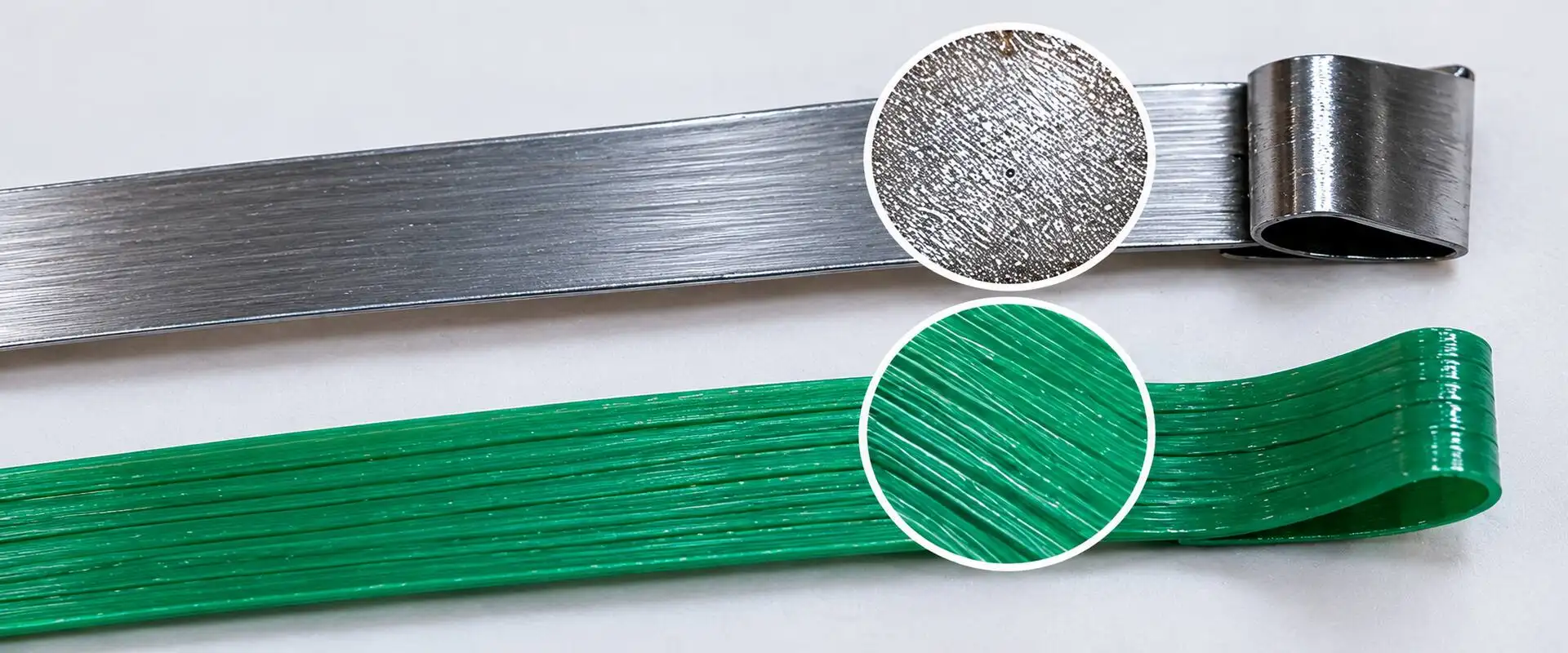
PET strapping is available in a range of strength specifications, and certain PET products offer tensile strength that fully meets the demands of applications previously served by steel strapping.
For example, the PET strapping specifications offered by Yalan Pack include:
| PET strapping size | Example breaking strength |
| 13 mm × 0.9 mm | 265 kgf |
| 16 mm × 0.9 mm | 330 kgf |
| 19 mm × 1.0 mm | 650 kgf |
These figures are examples specific to certain PET strapping specifications and do not represent universal ratings applicable to all straps of the same dimensions.
When comparing PET strapping with steel strapping, buyers should evaluate the actual tested break strength of both products.
PET strapping and steel strapping with similar nominal break strengths are not necessarily interchangeable.
They may differ in terms of rigidity, elongation, tension retention, joint efficiency, and performance under dynamic loads.
The break strength of a formed strap loop may be lower than that of a single strap, as the joint often serves as a point of weakness.
Therefore, comparable nominal break strength does not equate to equivalent cargo-securing performance.
Why is the elasticity of PET strapping important?
A key difference between PET strapping and steel strapping lies in how they respond to load variations.
During transport, certain loads may undergo settling, compression, or slight dimensional changes.
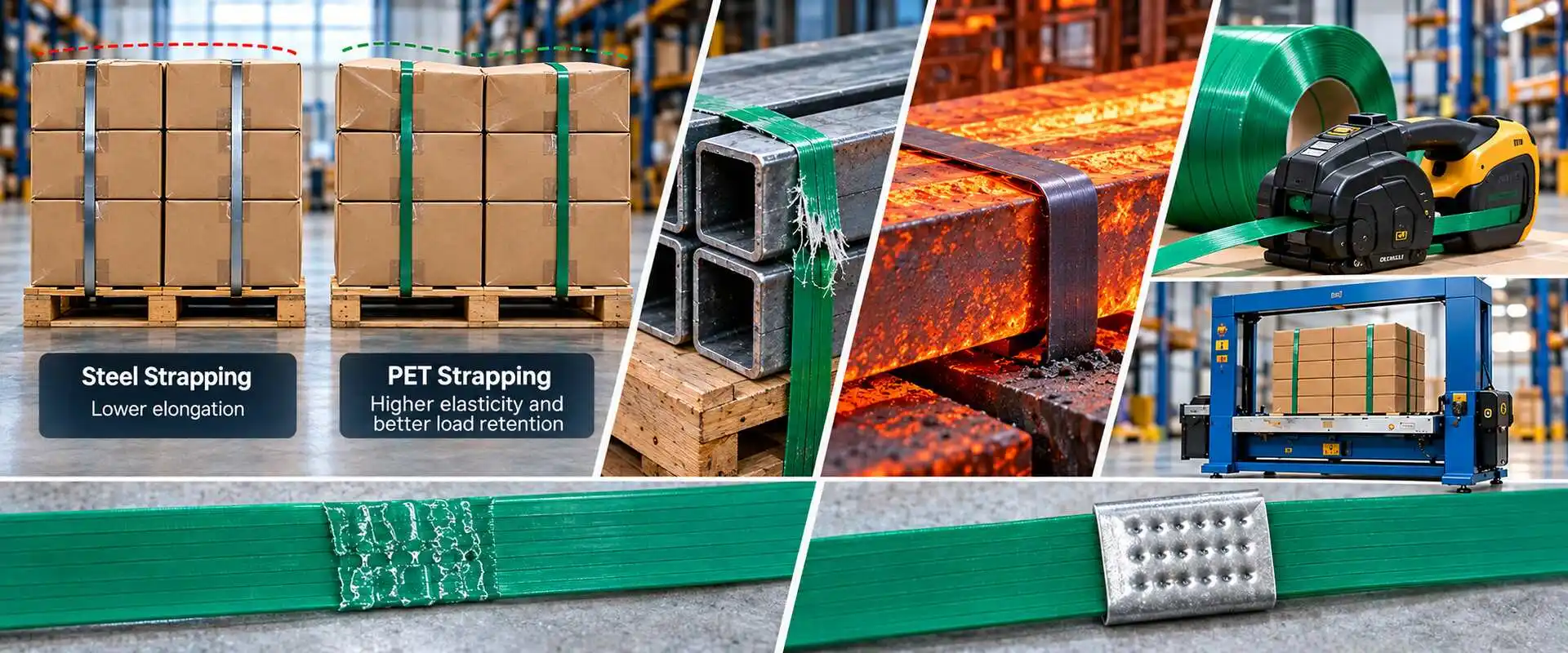
Because PET strapping possesses greater elasticity than steel strapping, a well-designed PET strapping system can maintain effective tension while accommodating some dimensional changes.
This characteristic is particularly advantageous for palletized loads prone to settling or vibration.
Steel strapping, with its lower elongation and higher rigidity, offers advantages when securing rigid loads that require minimal displacement.
However, the flexibility of PET strapping does not mean it can prevent all types of load displacement.
Excessive load shifting, improper pallet stacking, or unsuitable strapping configurations can still lead to packaging system failure.
The correct choice depends on the interaction between the material's mechanical properties and the specific characteristics of the load.
When should steel strapping still be considered?
Not all applications currently using steel strapping are suitable for a switch to PET strapping.
Steel strapping may remain the necessary choice when the packaging process involves extreme mechanical stress, sharp contact points, or environments that exceed the validated operating temperature range of PET strapping. Examples requiring special assessment include certain steel products, metal components with sharp edges, rigid industrial strapping applications, and high-temperature products.
Sharp edges can damage PET strapping by cutting it or creating concentrated contact stresses.
Although the use of appropriate edge protectors can mitigate this risk in some applications, the presence of edge protectors does not automatically make PET strapping suitable for all loads with sharp edges.
Temperature is another critical factor.
PET strapping should not be used directly on high-temperature products, nor should it be used in environments exceeding the material's validated temperature resistance range. Buyers should also consider whether existing steel strapping is part of a certified packaging or load-securing process.
In such cases, switching to PET strapping requires appropriate engineering assessment and testing, rather than a simple material substitution.

How do equipment and joint strength affect the substitution process?
Switching from steel strapping to PET strapping may require adjustments to the strapping equipment.
Steel and PET strapping have different requirements regarding tensioning, strap feeding, and joint formation.
Depending on the strap specifications and the specific application, suitable manual, electric (battery-powered), pneumatic, or automatic equipment can be used for PET strapping.
Before switching materials, buyers should verify whether existing equipment supports PET strapping and is compatible with the intended strap width and thickness.
Joint performance is critical.
A PET strap with a nominal breaking strength of 650 kgf may not necessarily retain that full strength after the joint is formed.
Actual joint strength depends on the sealing method, equipment settings, strap characteristics, and application conditions.
For demanding applications, the complete PET strapping system—including the intended equipment and joining method—should be tested.
Additionally, the alternative solution should be evaluated for performance regarding tension stability, packaging efficiency, and operator safety.

Can PET strapping reduce packaging and transportation costs?
In suitable applications, PET strapping may offer economic advantages, but the entire packaging process should be considered when making comparisons.
Compared to equivalent steel strapping products, PET strapping is generally lighter and does not require anti-corrosion treatment.
Depending on the specific application, PET may also offer advantages in handling, equipment operation, and material consumption.
However, buyers should not simply compare prices per kilogram.
Steel and PET strapping differ in density, dimensions, and mechanical properties. Equal weights (one kilogram) of the two materials do not necessarily yield the same usable length or load-securing performance. A more meaningful comparison should encompass the following aspects:
Cost of strapping per pallet + cost of sealing materials + equipment and labor costs + packaging efficiency + costs associated with transit damage + waste disposal or recycling arrangements.
For instance, if a PET strapping system requires a change in the number of straps or the addition of edge protectors, these costs should also be factored into the comparison.
Likewise, a reduction in packaging costs is only truly significant if the new system maintains the required load stability and product protection.

How should buyers evaluate the switch from steel strapping to PET strapping?
Before switching from steel strapping, buyers should gather current packaging specifications and clearly define performance requirements.
A practical comparison should include: existing steel strap dimensions and break strength, proposed PET specifications, load weight and dimensions, strapping pattern, equipment, sealing method, and transport conditions. Subsequently, the PET strapping solution should be tested on the actual product.
For export packaging, testing should account for anticipated handling and transport environments, including load settling, vibration, abrasion, and potential changes in strap tension.
Yalan Pack offers PET and PP strapping in a variety of widths, thicknesses, and strengths, suitable for industrial packaging and pallet load securing.
For customers considering switching from steel to PET strapping, providing photos of current packaging, existing strap specifications, and load details helps identify the appropriate PET product solution for evaluation.
In certain applications, PET can replace steel strapping; however, decisions should be based on the proven performance of the complete strapping system, rather than solely on material type or break strength.
Share on Social:


-
PREV:
Why Does PET Strapping Break During Packaging or Transportation?
- NEXT: Null


