







Popular Stretch Film Sizes in Southeast Asia
By hqt
Jul, 2026Related Posts
Meet YALAN Packaging in Korea: Connecting with Global Packaging Partners at K-PRINT 2026
Aug 10, 2026

When Should a Warehouse Automate End-of-Line Packaging?
Jul 29, 2026
Total Packaging Cost: How to Cut Waste Without More Damage
Jul 29, 2026

Packaging Industry Trends 2026: What Buyers Should Watch
Jul 29, 2026
Stretch film is widely used throughout Southeast Asia for pallet wrapping, warehouse storage, export shipping, manufacturing, furniture protection, and e-commerce fulfillment. However, distributors entering this market should not assume that one specification will suit every customer.
A small warehouse wrapping mixed cartons by hand has different requirements from a beverage factory using an automatic pallet wrapper. Climate, load weight, local handling practices, pallet height, wrapping equipment, and customer price expectations can all influence the final specification.
Despite these differences, several stretch film sizes appear repeatedly across Malaysia, Singapore, Vietnam, and the Philippines. Understanding these common formats can help distributors build a practical product range without carrying too many slow-moving specifications.

The 500 mm Width Is the Regional Mainstream
The most widely available pallet stretch film width in Southeast Asia is approximately 500 mm, or 50 cm.
Regional suppliers in Singapore, Malaysia, Vietnam, and the Philippines commonly list 500 mm hand and machine rolls. This width is practical because it covers a useful area of the pallet during each wrapping cycle while remaining manageable for manual operators. It is also compatible with many commonly used pallet-wrapping machines.
Some buyers may request 450 mm film, especially when they are familiar with international export specifications or use specific dispensers. Narrower mini rolls are also used for bundling pipes, profiles, cables, furniture parts, and small cartons. However, a distributor building a general industrial inventory will usually find that 500 mm film covers the largest range of warehouse and logistics applications.
Common Hand Stretch Film Specifications
Hand stretch film is still important across Southeast Asia because many small and medium-sized warehouses do not operate automatic wrapping lines. It is also useful for irregular pallets, lower daily volumes, mobile packing areas, and loads that need additional wrapping after inspection.
Common regional hand-roll formats include:
| Width | Thickness | Typical Length or Weight | Common Application |
|---|---|---|---|
| 500 mm | 15–17 microns | 300–500 m | Light and regular cartons |
| 500 mm | 18–20 microns | 217–500 m or 2.4–3 kg | General pallet wrapping |
| 500 mm | 23 microns | Around 200–500 m or 2.5–3 kg | Heavier or irregular loads |
| 100–250 mm | Varies | Short mini rolls | Bundling small products |
Vietnamese manufacturers list 500 mm hand rolls in thicknesses ranging from 15 to 30 microns, with 300 m being a common length. Malaysian listings include 500 mm × 300 m film in 15- and 20-micron versions. Singapore suppliers frequently sell 500 mm rolls by gross weight, including 2.4 kg, 2.7 kg, and 3 kg formats.
For distributors, 500 mm × 20 microns is a useful general-purpose starting point. It is familiar to many warehouse buyers and can serve a broad range of ordinary carton and pallet loads. A lighter 15- or 17-micron option can target cost-sensitive, high-volume users with stable loads, while a 23-micron product can cover more demanding applications.
Length-Based and Weight-Based Purchasing
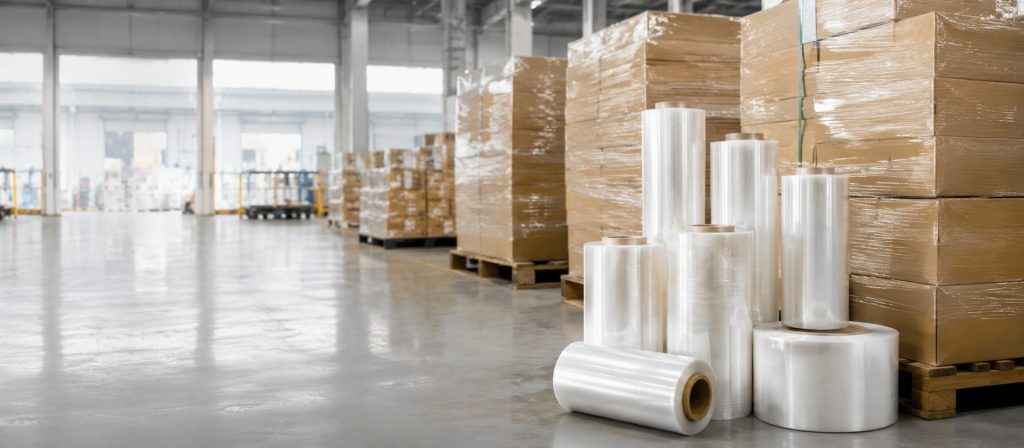
Stretch film specifications are not always presented in the same way.
Some Southeast Asian customers purchase by width, thickness, and length, such as 500 mm × 300 m × 20 microns. Others are more familiar with width, thickness, and gross roll weight, such as 500 mm × 2.4 kg × 20 microns.
These two descriptions should not be treated as interchangeable without checking the paper core. A heavy core can make a roll appear more economical even though it contains less usable film.
For example, one Singapore supplier identifies a 500 mm × 200 m × 23-micron roll with a gross weight of 2.4 kg, a 0.4 kg core, and approximately 2.1 kg of film. Other regional listings also separate net film weight from gross roll weight.
Distributors should therefore confirm the net film weight, gross weight, core weight, actual roll length, and thickness tolerance before comparing quotations. Cost per kilogram of usable film or cost per wrapped pallet is more meaningful than the headline roll price.
Popular Machine Stretch Film Sizes
Machine stretch film is generally used by manufacturers, large distribution centers, beverage plants, food-processing facilities, and warehouses with consistent pallet volumes.
The 500 mm width remains common, but machine rolls are much longer and heavier than hand rolls. Regional examples include 500 mm × 1,000 m × 20 microns, 500 mm × 1,500 m in 20- or 23-micron thicknesses, and 500 mm machine rolls weighing approximately 15 kg.
A Singapore industrial supplier also lists a 500 mm × 1,402 m × 20-micron machine roll. These examples show why machine film should be specified according to the actual equipment rather than ordered as a generic heavy roll.
The supplier should know the wrapper type, pre-stretch ratio, carriage system, tension setting, wrapping speed, pallet height, and load profile. Film that performs well on one machine may break or stretch inconsistently on another.
Choosing the Right Thickness
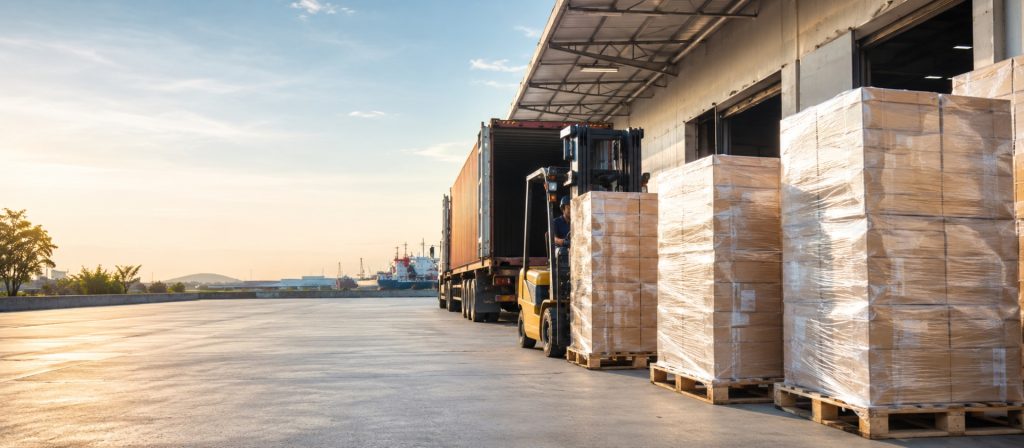
Thickness is important, but thicker film is not automatically the better choice.
Light, uniform cartons may be secured with 15- or 17-micron film when the film has consistent thickness and good holding force. General warehouse pallets commonly use 18- or 20-micron film. Loads with sharp edges, heavy products, unstable stacking, or repeated handling may require 23 microns or more.
A distributor should also consider puncture resistance, tear propagation, cling, stretchability, and load retention. Two films with the same nominal thickness may perform differently because of resin quality, layer structure, production control, and stretch characteristics.
Yalan Packaging describes its stretch film as using cast-film and co-extrusion technology to support stable cling, puncture resistance, load retention, reduced film consumption, and consistent thickness. The company offers hand, machine, and pre-stretched options for warehouse, logistics, industrial packaging, and transportation applications.
Clear, Black, and Colored Stretch Film
Clear film is the standard choice for most Southeast Asian warehouses. It allows employees to see carton labels, inspect goods, count products, and scan barcodes without removing the wrap.
Black stretch film is commonly selected when customers want to conceal valuable goods, reduce casual product identification, or separate specific inventory. Clear and black 500 mm rolls are both offered by suppliers in Singapore and the Philippines.
Colored film may be useful for warehouse zoning, export-order identification, customer classification, or internal stock management. However, distributors should avoid carrying too many colors unless they already have regular demand. Clear film, black film, and one or two customer-specific colors usually provide a more manageable starting range.
Packaging Formats for Distributors
Carton quantity matters because it affects warehouse storage, local delivery, container loading, and resale convenience.
Hand stretch film is frequently packed in four or six rolls per carton, while large machine rolls may be packed individually. Vietnamese suppliers list hand rolls in four- or six-roll cartons and machine rolls as one roll per carton. Several Singapore suppliers also use six rolls per carton for 500 mm hand stretch film.
Before ordering, distributors should confirm carton dimensions, carton weight, rolls per carton, cartons per pallet, pallet height, container quantity, label language, and whether neutral or private-label packaging is required.
Match the Product Range to Local Customers
A practical Southeast Asian stretch film range may begin with three core products: a light hand roll, a general-purpose 20-micron hand roll, and a 20- or 23-micron machine roll. Black film and mini rolls can then be added according to local demand.
Samples should be tested with actual pallets before a bulk order. Record the number of wraps, film breaks, material used per pallet, load movement, corner punctures, operator comfort, and condition after transportation.
Yalan Packaging positions its Southeast Asian supply service around cost-effective products for wholesalers, distributors, industrial users, and growing e-commerce packaging businesses. It also supports customized width, length, packaging, and OEM production, allowing buyers to develop specifications for their local customer base rather than relying only on standard export rolls.
Conclusion
The most popular stretch film specification in Southeast Asia is generally based on a 500 mm width, with hand-film thicknesses commonly ranging from 15 to 23 microns. Hand rolls are often sold in 300- or 500-meter lengths or in gross weights between approximately 2.4 and 3 kg. Machine rolls commonly use the same 500 mm width but provide longer lengths of around 1,000 to 1,500 meters or heavier roll formats.
These figures are useful starting points, not fixed regional standards. Distributors should choose their inventory according to local wrapping methods, customer industries, pallet conditions, and equipment.
The right product is not simply the thickest or cheapest roll. It is the film that provides stable wrapping performance, predictable usable weight, efficient material consumption, and reliable repeat-order quality.
Share on Social:


Contact Us
In This Article
Related Posts
Meet YALAN Packaging in Korea: Connecting with Global Packaging Partners at K-PRINT 2026
Aug 10, 2026
When Should a Warehouse Automate End-of-Line Packaging?
Jul 29, 2026
Total Packaging Cost: How to Cut Waste Without More Damage
Jul 29, 2026
Packaging Industry Trends 2026: What Buyers Should Watch
Jul 29, 2026


