







How Pallet Wrapping Film Prevents Load Shifting in Transit
By hqt
Oct, 2026Related Posts
PP Strapping for Cartons: Packaging Challenges in E-Commerce Logistics
Oct 21, 2026

Polypropylene Strapping Under Temperature Changes: Effects on Packaging Performance
Oct 21, 2026
PET Strapping Supplier: Heat-Seal Joint Strength and Sealing Reliability
Oct 21, 2026
PP Strapping Supplier Guide: Smooth vs Embossed Strapping for Automated Packaging
Oct 21, 2026
A pallet can look tightly wrapped at dispatch and still arrive with displaced cartons. The problem is rarely solved by adding more Pallet Wrapping Film indiscriminately. During braking, cornering, and vibration, individual packages move when lateral forces exceed the resistance provided by film restraint, interlayer friction, and the pallet-to-load connection.
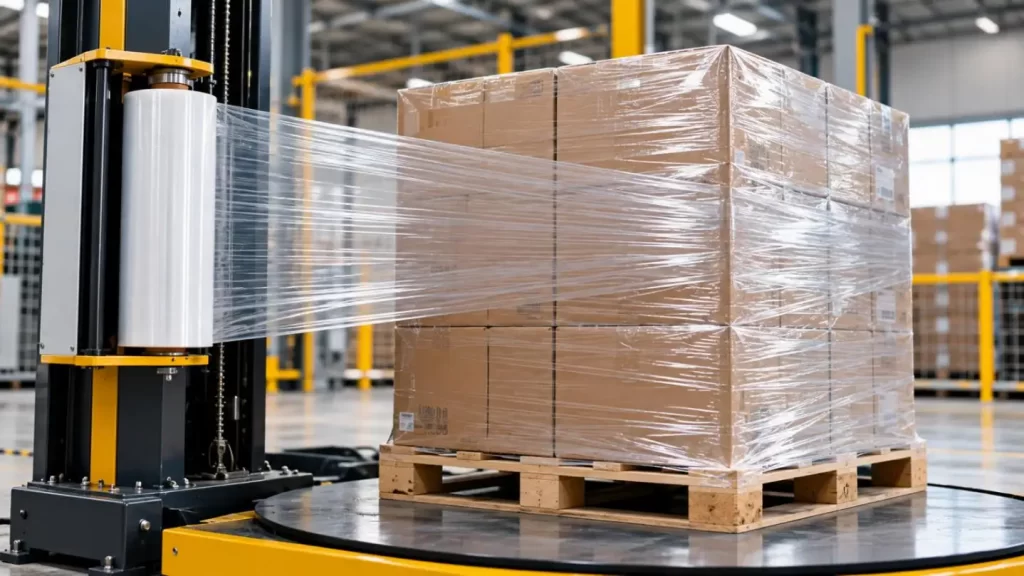
At Yalan Pack, we assess containment force alongside film properties, wrapping settings, and actual transportation conditions.
Why Loads Shift Even When the Film Does Not Break
Three failure mechanisms deserve separate attention:
•Internal movement: Cartons slide against one another because friction or lateral restraint is insufficient.
•Unit-load deformation: A tall or uneven stack leans under acceleration, redistributing film tension.
•Pallet separation: Poor bottom anchoring allows goods to move relative to the pallet.
Film cannot correct weak stacking, excessive overhang, or a high center of gravity on its own. Heavy or irregular loads may also need corner protection, strapping, or changes to the stacking pattern.
How Pallet Wrapping Film Creates and Retains Containment Force
Wrap Force vs. Containment Force
Wrap force is the tension applied to an individual film layer. Containment force is the combined restraining effect measured at a specified point on the wrapped load.
Increasing the effective number of layers can raise containment force, but the force is not necessarily uniform across pallet height.
Stretched LLDPE film recovers some of its shape, creating restraint. There are several factors that affect how long it takes film to relax, including temperature, history of stretching, and the film's formulation.
Because of this, maximum elongation should not be used to set a holding-force specification. Film must retain enough restraint after handling and storage to hold the load sufficiently when it is first wrapped.
Pre-Stretch Is Not Applied Tension
Applying a pre-stretch of 250% means that 1 meter of film can extend to 3.5 meters. This setting does not control the force on the pallet.
Applying excess pre-stretch can lead to insufficient deformation for sharp corners and/or movement, and excess applied tension can crush weak cartons.
It is recommended to control pre-stretch, carriage force, film overlap, and reinforcement wraps as one configuration when wrapping a pallet.
Which Pallet Wrapping Film Properties Matter Most?
| Property | Technical Influence | Selection Risk |
| Elastic Recovery | Retained Restraint after Stretching | Initial Tension May Decay |
| Gauge and Uniformity | Film Cross-Section and Weak-Point Distribution | Nominally Thick Rolls Can Contain Thin Spots |
| Puncture Resistance | Strength at Corners and Projections | Local Rupture Releases Restraint |
| Film Cling | Layer Cohesion and Tail Retention | High Cling Does Not Always Mean High Containment |
| Wrap Pattern | Force Distribution Across Pallet Height | Poor Anchoring Is a Failure Point |
Manufacturing Precision and Material Consistency at Yalan Pack
At Yalan Pack, we have Pallet Wrapping Films in the thicknesses of 15, 17, 20, and 23 μm, offered as Hand, Machine and/or Pre-stretched Films.
At Yalan Pack, we have Pallet Wrapping Films available with elongation up to 350%, dependent on the film grade and formulation. However, we understand that maximum elongation does not define the optimum operative pre-stretch ratio or containment force. Therefore, we suggest testing each Film grade under a given set of wrapping conditions to accomplish load stability.
Our manufacturing philosophy is to:
•Balance the multilayer film structure for puncture resistance and surface adhesion.
•Inspect incoming materials for consistency of the resin.
•Control film thickness during the manufacturing process.
•Inspect the finished product for conformance to the roll specification.
How Should Pallet Wrapping Film Containment Force Be Tested?
A repeatable test should always be preferred over a test that depends on a human making a subjective judgment.
•Report the load: Specify weight, dimensions, geometry, pallet type, and stacking arrangement.
•Report the wrapping: Report film gauge, pre-stretch, application tension, overlap, and revolutions (top & bottom).
•Determine the containment force: Test the top, middle and bottom, of a given load using the same measurement instrument, and test method.
•Check force retention: Conduct a measurement after the film has been stored for a specified period of time.
•Stabilize transport: Evaluate the pallet under anticipated conditions of transport and shipping.
There are no universally applicable target containment forces. Acceptance limits should be determined by the load testing and by the experience of shippers.
Packaging Standards
| Standard | Application |
| ASTM D4649-20(2025) | Guidance on the selection, specification, and application of stretch film |
| ISTA 3E:2026 | Simulation of comparable unit loads within full truckloads for the purpose of transport |
| EUMOS 40509:2020 | Evaluation of the rigidity of unit loads under defined accelerations |
Rigidity and static measurement of containment force do not ensure adequate performance.

Pallet Wrapping Film Selection for Various Services
| Load Condition | Main Priority | Recommended Approach |
| Puncture sensitive product | Puncture resistance | Film toughness and edge protection |
| Lateral movement of product | Lateral displacement | secure connection to pallet |
| Compression of product | Excessive bulging | Controlled application tension |
| Automation | Film meters, thickness, and uniformity | Elastomeric and stretch properties, and uniformity |
| Shipment distance | Containment force | Dwell time and dynamic testing |
Hand-wrapping is appropriate for some operations where shipment volume and variability are low; however, this can increase variation.
Machine wrapping allows consistent and repeatable tension and wrap patterns. It also allows for better control of patterns and pitch. However, this is only the case if the equipment is in proper working condition and the film matches the machine.
Savings on Pallet Wrapping Film Without Compromising Stability
A lower unit cost for film does not always mean a lower total cost for film.
When comparing different grades of film it is helpful to evaluate:
•Mass of film consumed per pallet and number of wraps removed
•Distribution of containment-force and force retained after storage
•Frequency of film breaks and level of compression on cartons
•Number of pallets damaged during transport and consistency of film wrap
•Thickness and variation of mechanical properties
Film Material Cost per Pallet = Consumed Film Mass × Unit Film Price
The total cost of the package also includes man-hours, equipment downtime and damage to the product.
Buyers should ask for:
•Manufacturing tolerance and range of thickness
•Tensile strength and elongation
•Cling to pallet and puncture resistance
•Roll dimension and batch traceability
•Sample shipment under actual use conditions
Economic down gauging only results in cost savings if the film is of sufficient thickness and provide adequate containment.
Yalan Pack provides reliable pallet protection.
At Yalan Pack, we view Pallet Wrapping Film as one component of a larger integrated system of load security.
Because of our multilayer film capability and processes, we can manufacture custom roll dimensions.
We can assist in pallet wrapping film trials based on your shipping needs.
For more information, contact us!
FAQs
Q1. What types of Pallet Wrapping Film does Yalan Pack manufacture?
Yalan Pack manufactures hand stretch film, machine stretch film, pre-stretch film, and jumbo roll stretch film for industrial pallet packaging.
Q2. How does Yalan Pack help prevent pallet load shifting?
We provide Pallet Wrapping Film options with suitable stretchability, puncture resistance, and cling properties. Actual load stability depends on film selection, wrapping settings, and transportation conditions.
Q3. Can Yalan Pack customize Pallet Wrapping Film specifications?
Yes. We offer customized film thickness, width, roll length, core specifications, and packaging formats to meet different industrial requirements.
Q4. What Pallet Wrapping Film thicknesses does Yalan Pack offer?
Our common film thickness options include 15, 17, 20, and 23 microns. Additional specifications can be discussed according to packaging requirements.
Q5. Does Yalan Pack supply Pallet Wrapping Film for automatic wrapping machines?
Yes. We supply machine-grade stretch film for automated and semi-automated pallet wrapping systems. Film compatibility should be checked against the equipment's pre-stretch and tension settings.
Share on Social:


Contact Us
In This Article
Related Posts
PP Strapping for Cartons: Packaging Challenges in E-Commerce Logistics
Oct 21, 2026
Polypropylene Strapping Under Temperature Changes: Effects on Packaging Performance
Oct 21, 2026
PET Strapping Supplier: Heat-Seal Joint Strength and Sealing Reliability
Oct 21, 2026
PP Strapping Supplier Guide: Smooth vs Embossed Strapping for Automated Packaging
Oct 21, 2026


