







7 Things Buyers Must Know Before Purchasing Packaging Tape
By hqt
Aug, 2026Related Posts
What Packaging Materials Are Commonly Used in North American Warehouses?
Oct 23, 2026
PP Strapping for Cartons: Packaging Challenges in E-Commerce Logistics
Oct 21, 2026
Polypropylene Strapping Under Temperature Changes: Effects on Packaging Performance
Oct 21, 2026
PET Strapping Supplier: Heat-Seal Joint Strength and Sealing Reliability
Oct 21, 2026
Packaging tape is one of the most commonly used industrial packaging materials in logistics, warehousing, and manufacturing. The vast majority of cartons on the market require packaging tape to seal them securely before shipment.
When selecting packaging tape, many buyers focus only on basic specifications such as price, width, and length. In reality, the performance of packaging tape is determined by several key factors, including the adhesive type, film thickness, carton material, storage environment, and application method.
Choosing the right packaging tape can effectively improve packaging efficiency, reduce issues like carton damage and bursting during transit, and minimize waste and additional costs associated with packaging consumables.
Before purchasing packaging tape, buyers are advised to familiarize themselves with the following seven key selection criteria to ensure the product precisely meets their sealing needs.
Industrial packaging tape consists of three core components: the BOPP film backing, the adhesive layer, and the paper core.
1. Understand the overall structure of the packaging tape
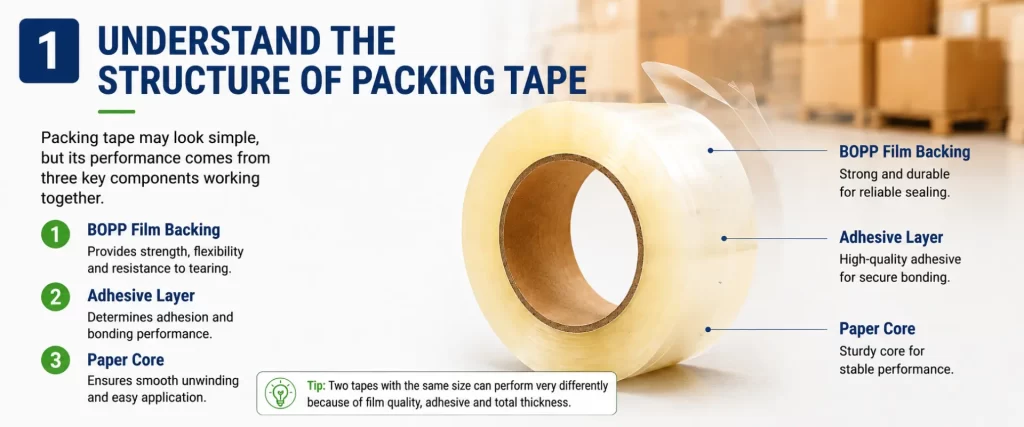
The Biaxially Oriented Polypropylene (BOPP) film determines the tape's overall strength, flexibility, and tear resistance, while the adhesive layer directly affects how well the tape bonds to various carton surfaces. Even if two tapes share the same width and length specifications, differences in film quality, adhesive formulation, and coating thickness can lead to significant disparities in actual performance.
For example, standard sealing tape suitable for lightweight cartons may suffer from insufficient adhesion and seal failure when used on heavy-duty export cartons made of recycled paper. Therefore, when purchasing packaging tape, one should not rely solely on external specifications but must prioritize understanding the tape's overall structural composition.
2. Select the appropriate adhesive type based on the application scenario
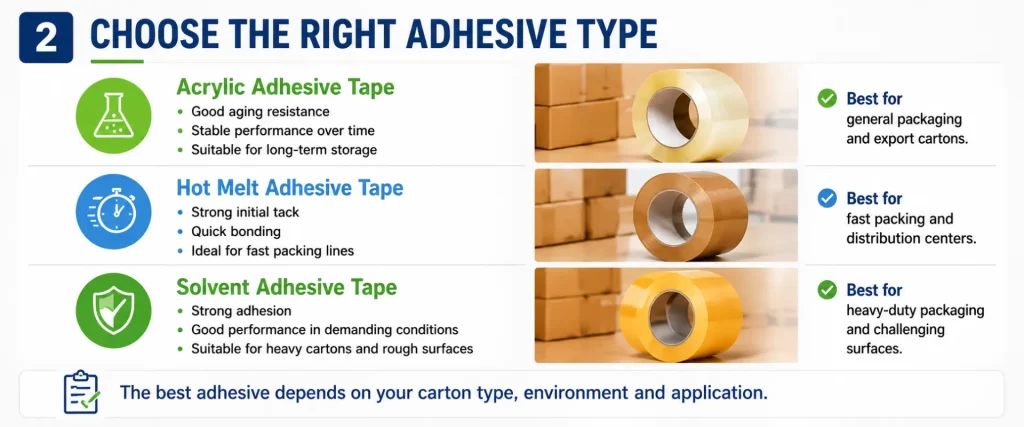
The type of adhesive is a critical factor in purchasing packaging tape, as it directly determines sealing stability and suitability for specific applications. The main types of carton sealing tapes are acrylic, hot-melt, and solvent-based.
Acrylic Tape
Acrylic packaging tape is a general-purpose sealing tape suitable for most standard carton sealing applications. It features excellent aging resistance, stable performance, high transparency, and a long shelf life, making it widely suitable for warehouse storage, general export packaging, and standard industrial packaging.
Hot-Melt Adhesive Tape
Hot-melt packaging tape offers exceptional initial tack and rapid bonding capabilities, making it ideal for high-efficiency carton sealing. It is commonly used in automated packaging lines, distribution centers, and e-commerce fulfillment operations where fast sealing and high initial adhesion are required.
Solvent-Based Adhesive Tape
Solvent-based tape provides strong adhesion and maintains stable performance even in complex or harsh environments. It is well-suited for heavy-duty cartons, rough or hard-to-bond carton surfaces, and packaging applications involving extreme temperatures.
When selecting adhesive tape, there is no need to blindly pursue the highest level of tack; the most sensible approach is to choose the adhesive type that best matches your specific packaging environment.
3. Tape thickness is not just a number; select based on specific needs
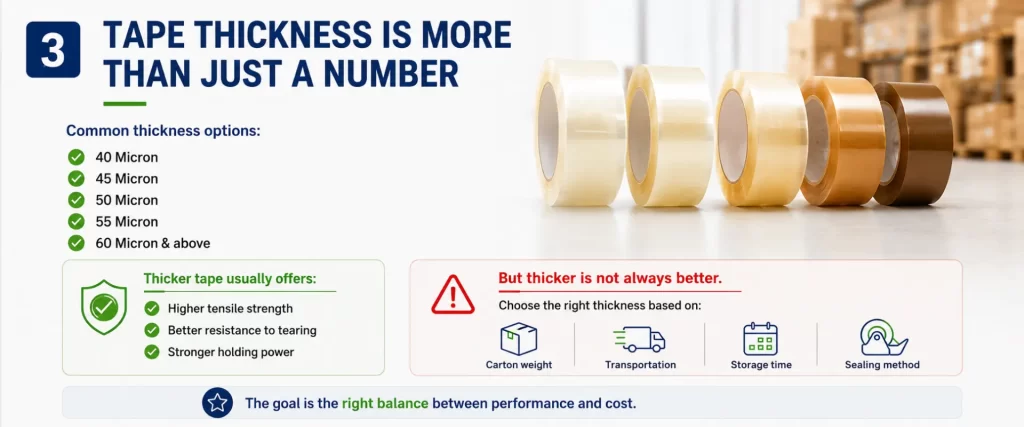
Many buyers compare packaging tape thickness using micron values, with common specifications including 40, 45, 50, and 55 microns. However, total thickness does not fully represent overall performance; greater thickness does not necessarily equate to better results.
Thicker tapes generally offer higher tensile strength, better tear resistance, and stronger holding power. However, using excessively thick tape for lightweight cartons or short-distance transport merely increases packaging costs without providing tangible performance benefits.
Professional selection requires a comprehensive assessment of carton weight, transport conditions, storage duration, stacking requirements, and sealing methods (manual vs. automatic) to strike the optimal balance between tape performance and packaging costs.
4. Confirm carton material before selecting packaging tape
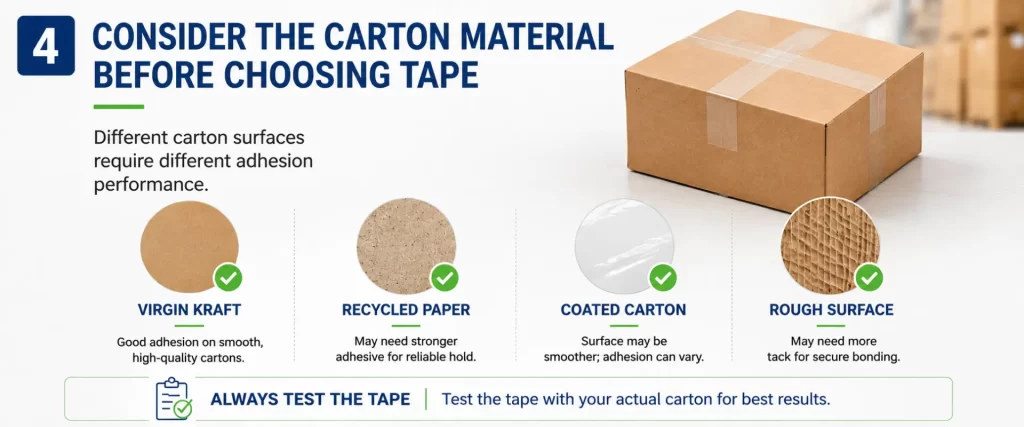
Carton material directly affects the adhesion performance of packaging tape. Traditional kraft paper cartons offer good surface adhesion and are compatible with most standard tapes. However, many businesses now use recycled cardboard, coated cartons, or cartons made with special processes; these materials place higher demands on tape adhesiveness and compatibility.
Before selecting a tape, consider four key factors: whether the carton is made of virgin or recycled paper, whether the surface is smooth or rough, whether the storage environment is humid, and whether long-distance transport or ocean export is required.
A tape suitable for standard cartons may not be suitable for heavy-duty recycled cartons. When sourcing for export packaging, it is advisable to test tape performance using actual carton samples to prevent issues such as seal failure or the tape peeling off during transit.
5. Select appropriate tape width and length specifications
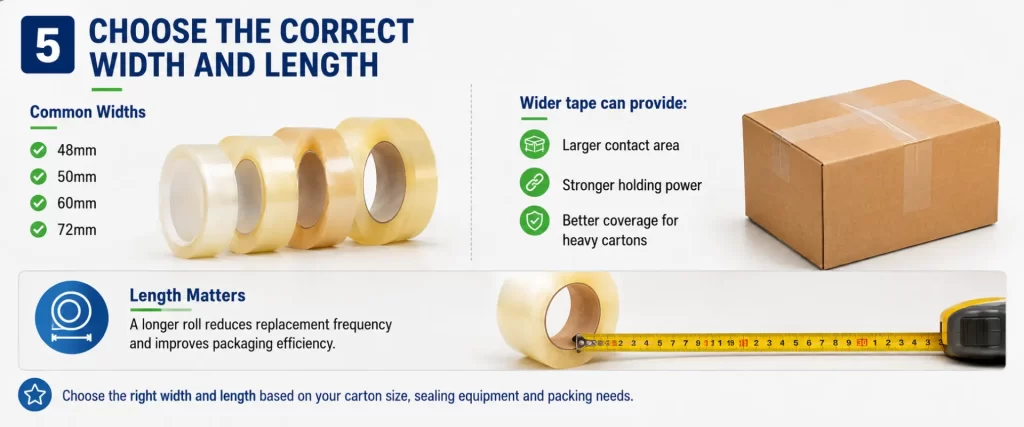
Packaging tape comes in various widths and lengths to suit different sealing scenarios. Common widths on the market include 48mm, 50mm, 60mm, and 72mm.
Standard 48mm tape is suitable for sealing conventional cartons and is the most versatile specification. Wider tapes (60mm and 72mm) offer a larger bonding area, stronger holding power, and better coverage, making them ideal for heavy-duty cartons and large-scale industrial packaging.
The length of the tape roll affects the frequency of roll changes and overall packaging efficiency. In high-volume packaging scenarios, buyers should focus on the sealing cost per carton rather than the price of a single roll of tape.
6. Printed packaging tape enhances brand visibility and packaging security
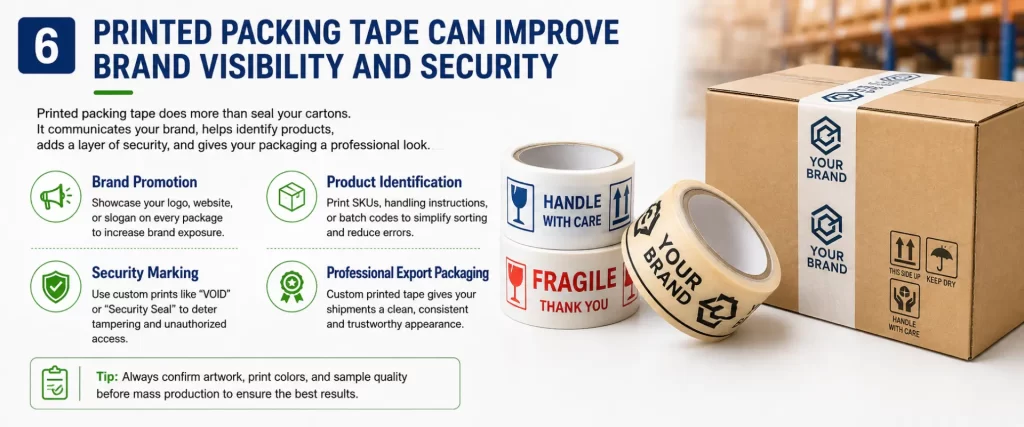
Printed packaging tape has become a popular choice for corporate branding and secure packaging. Custom-printed tape serves various purposes, including brand promotion, product differentiation, safety warnings, and specialized export packaging.
Companies can customize elements such as logos, slogans, warning text, and contact information. This lends a professional appearance to cartons during transport and distribution while providing tamper-evidence, theft deterrence, and traceability.
Print quality depends on tape material, printing techniques, and color schemes. Before bulk purchasing, it is essential to verify design proofs, color codes, and sample results to ensure consistent quality across the entire batch.
7. Compare total packaging costs, not just the unit price of the tape
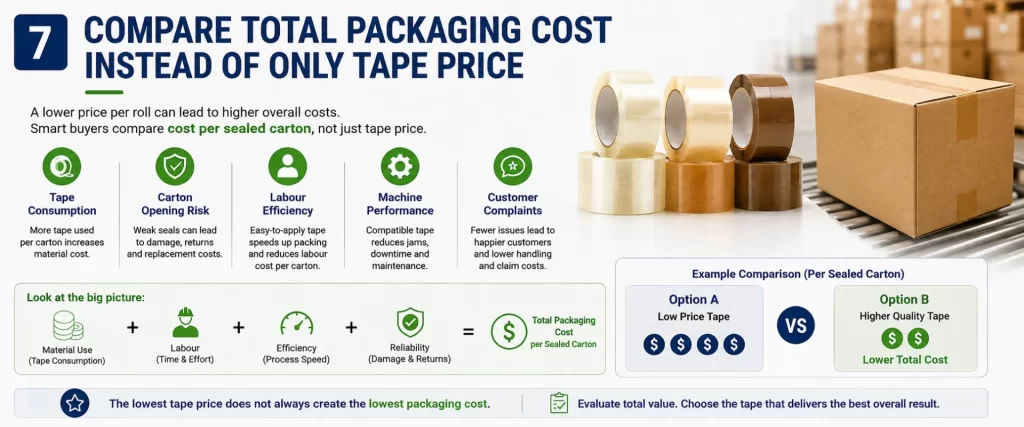
While purchase price is a key factor, it should not be the sole criterion for selection. Opting solely for low-priced tape can lead to hidden costs, such as cartons bursting during transit, increased tape consumption, production line downtime, and customer complaints.
A more scientific approach is to calculate the comprehensive cost of sealing a single carton, factoring in tape consumption, tape strength, labor efficiency, equipment compatibility, and packaging stability.
Upgrading to high-quality packaging tape can reduce material usage per carton, lower rework rates, and enhance packaging reliability. The lowest purchase price does not equate to the lowest overall packaging cost.
What information is required when purchasing packaging tape?
To obtain a precise, suitable, and cost-effective tape solution, buyers should provide the following specifications: tape width, roll length, thickness requirements, adhesive type, carton dimensions and weight, sealing method (manual or machine), purchase quantity, printing requirements, and target markets.
Providing comprehensive operational details enables suppliers to match the right customized product to your needs, rather than simply supplying generic, standard tape.
Can packaging tape be customized?
Professional packaging tape manufacturers offer comprehensive customization services. Options include varying widths, thicknesses, colors, and printed patterns, as well as a choice of three adhesive systems—acrylic, hot-melt, and solvent-based—to meet the diverse needs of standard, heavy-duty, and export packaging.
Customized tape integrates seamlessly with corporate standardized packaging systems, unifies brand image, and adapts to the specific transport and storage environments of different regions. Packaging tape may appear simple, yet it is a crucial consumable for ensuring the safety of products during storage and transport. The right tape must balance reliable sealing performance, efficient application, and cost-effectiveness.
When purchasing, buyers should look beyond price and instead select the appropriate product based on factors such as carton type, product weight, storage and transport duration, and sealing method to find a tailored packaging solution.
Yalan Packing specializes in the R&D and customization of BOPP packaging tapes, offering a comprehensive range of products—including acrylic, hot-melt, and solvent-based options. We provide customized dimensions, thicknesses, colors, and printed designs to meet specific operational needs, delivering professional, reliable, and cost-effective sealing and packaging solutions for businesses.


Contact Us
In This Article
Related Posts
What Packaging Materials Are Commonly Used in North American Warehouses?
Oct 23, 2026
PP Strapping for Cartons: Packaging Challenges in E-Commerce Logistics
Oct 21, 2026
Polypropylene Strapping Under Temperature Changes: Effects on Packaging Performance
Oct 21, 2026
PET Strapping Supplier: Heat-Seal Joint Strength and Sealing Reliability
Oct 21, 2026


