







How to Choose Stretch Film: 7 Key Points for Buyers
By hqt
Aug, 2026Related Posts


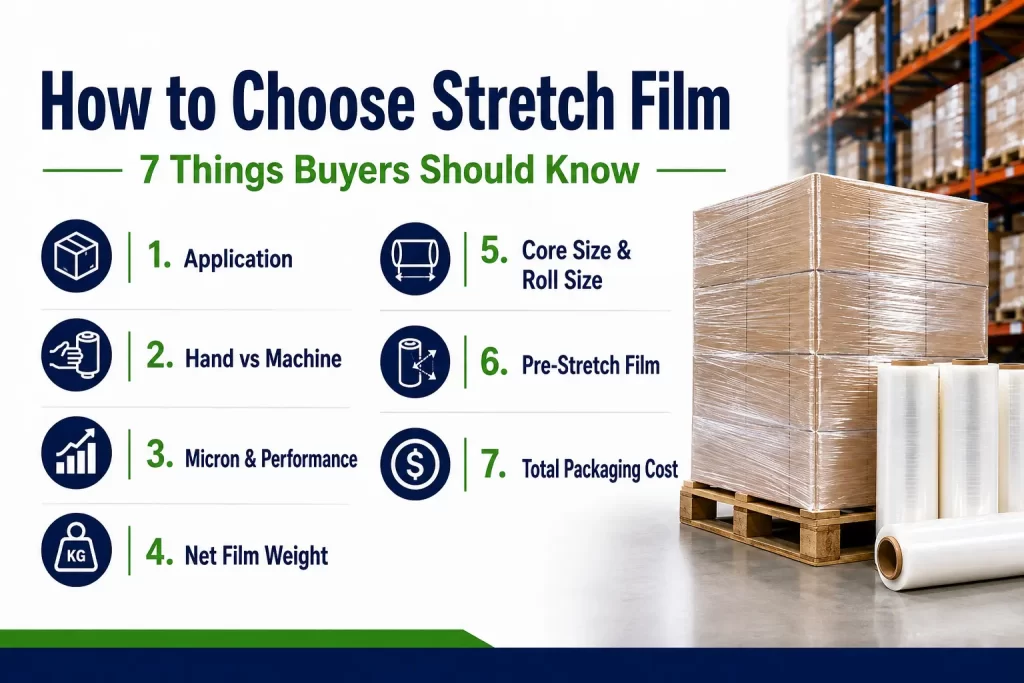
Stretch film may seem simple, but selecting the right product involves more than just comparing width, thickness, and price.
For instance, two rolls of stretch film that look nearly identical can perform very differently when wrapping a pallet. One might stretch smoothly and secure the load firmly, while the other could break frequently or require more layers to achieve the same level of stability.
For buyers, this means the lowest-priced film isn't necessarily the most cost-effective choice.
Before purchasing stretch film for warehouse, logistics, or industrial packaging applications, consider these seven practical points.
1. Focus on application needs, not just thickness
Thickness is often one of the first specifications buyers ask about.
Stretch film comes in a wide range of thicknesses—from light-duty packaging films to heavy-duty industrial grades—but thickness alone does not determine actual performance.
The nature of the load affects the choice.
Thinner film may suffice for light pallets stacked with standard cartons, whereas heavy or irregularly shaped loads may require a film with superior puncture resistance and holding force.
Before purchasing, consider the following factors:
-Pallet weight
-Product shape
-Presence of sharp edges or corners
-Shipping distance
-Storage conditions
-Manual vs. machine wrapping
Greater thickness does not guarantee better quality, nor does thinner film necessarily mean better cost-efficiency.
The goal is to use the right amount of film to ensure load stability while avoiding material waste.
2. Differences between hand stretch film and machine stretch film
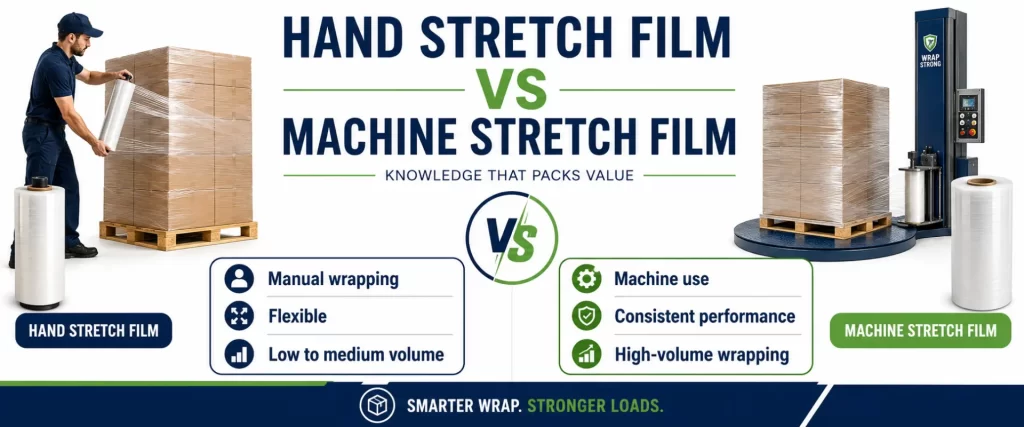
Hand stretch film and machine stretch film are products designed for different packaging methods.
Hand stretch film is primarily designed for manual pallet wrapping and is commonly used in warehouses, small production lines, and operations with lower packaging volumes. While the standard width is 500mm, other widths and roll weights are also available.
Machine stretch film, on the other hand, is specifically designed for use with pallet wrapping machines. Machine-grade stretch film is subjected to stretching during high-speed operations, requiring superior film stability.
It must be compatible with the wrapping machine's pre-stretch mechanism and specific packaging parameters.
Using an unsuitable film type can lead to film breakage, insecure wrapping, and material waste.
For high-volume packaging operations, machine-grade stretch film ensures consistent packaging quality while reducing labor requirements.
3. While film thickness is certainly important, overall performance is the more critical consideration.
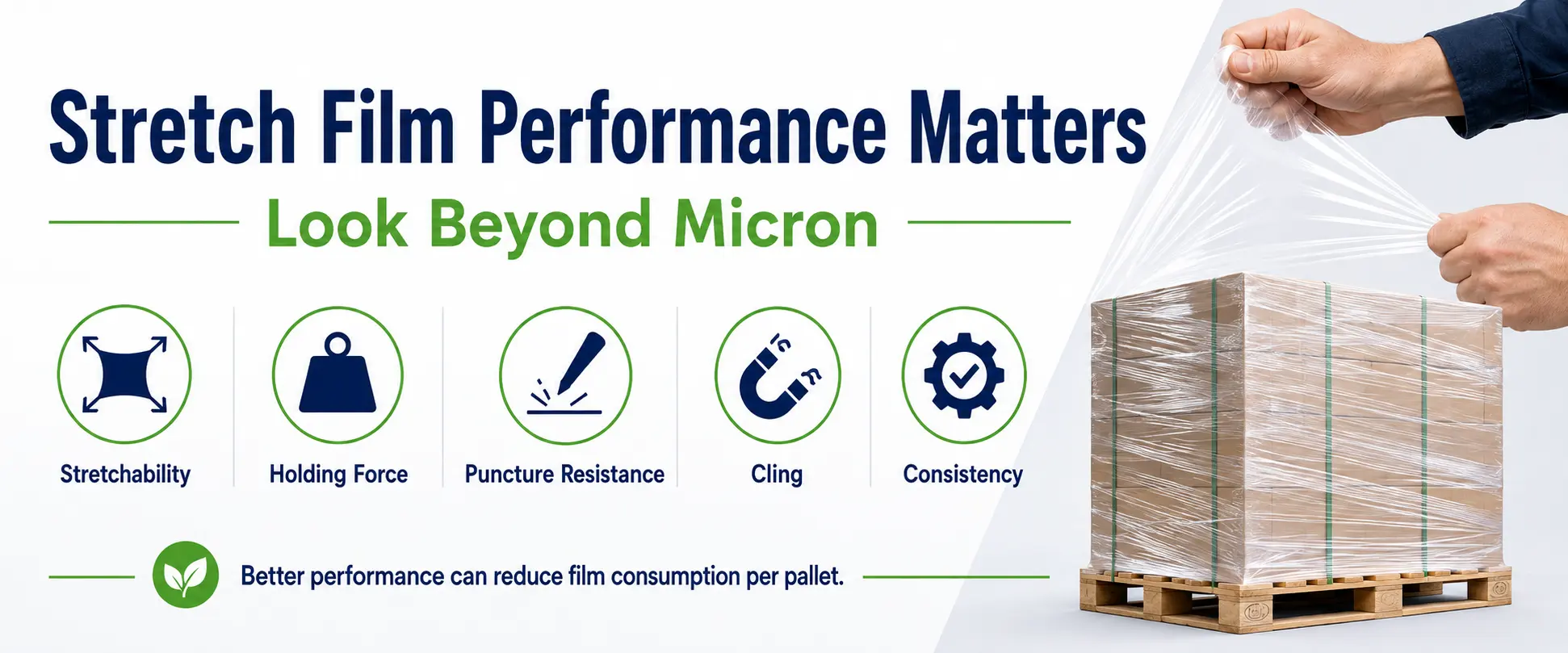
When selecting stretch film, buyers often focus heavily on thickness—specifically the micron (μm) rating—frequently comparing specifications such as 12μm, 17μm, 20μm, and 23μm.
While thickness comparisons offer some reference value, they should not be the sole criterion for evaluating a product.
A high-quality stretch film must balance multiple key performance indicators:
‑ Tensile strength
‑ Load retention force
‑ Puncture resistance
‑ Tear resistance
‑ Cling (self-adhesion)
‑ Consistency of performance across the entire roll
Some high-performance films can replace traditional thicker films despite having a lower gauge, thereby reducing material consumption.
However, when selecting down-gauged products, it is essential to conduct on-site testing under actual operating conditions.
If a thinner film requires more wrapping revolutions or breaks frequently during application, the actual cost savings will be significantly diminished.
Therefore, professional buyers do not evaluate products based on thickness alone; they also calculate the actual amount of film consumed per pallet.
4. Focus on the net weight of the film rather than just the gross weight of the roll.
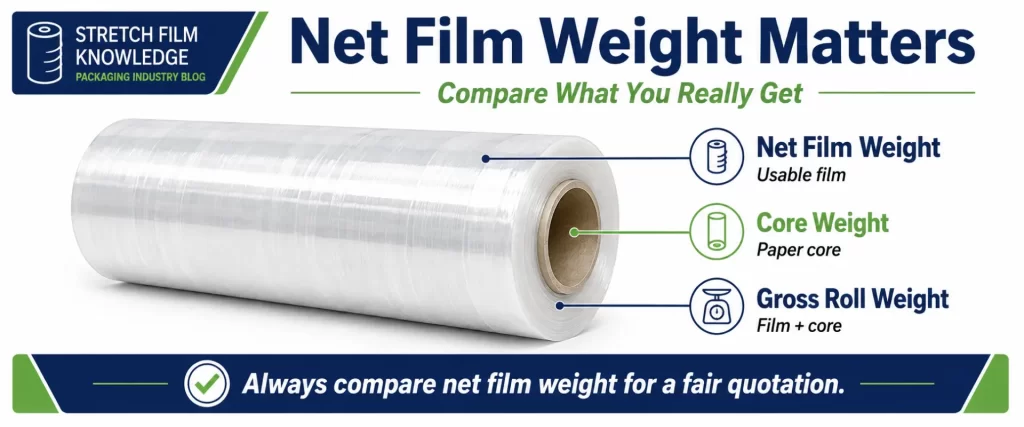
This is a crucial detail when comparing price quotes for stretch film.
A roll of stretch film consists of two parts: the film itself and the paper core.
For example, if two suppliers offer rolls with the same gross weight of 3 kg, but one has a heavier paper core, the actual net content of the film will be lower.
To ensure a fair price comparison, buyers should request the following specifications from suppliers:
‑ Net film weight
‑ Paper core weight
‑ Gross roll weight
The same logic applies to comparing roll lengths.
Ideally, quotes should list the film weight and paper core weight separately to clearly show the actual usable material being purchased.
This is particularly important for bulk importers, distributors, and industrial end-users.
5. Paper core and roll specifications must suit actual operating conditions
Stretch film films are available with various paper core specifications.
Common inner diameters include 1 inch, 1.5 inches, 2 inches, and 3 inches; the choice depends on the product type and wrapping method.
Hand stretch films typically use smaller cores, whereas machine stretch films generally utilize 3-inch cores.
The structural strength of the paper core is also a critical factor.
In machine-wrapping scenarios, if the core lacks sufficient strength, it may deform during transport or loading, preventing the roll from being properly mounted on the wrapping equipment.
Roll weight also directly impacts the user experience.
Although heavy hand-wrap rolls contain more film, excessive weight reduces operator comfort and lowers efficiency during prolonged manual wrapping tasks.
Selection should balance material utilization rates with actual on-site operating conditions.
6. Pre-stretched film is suitable for specific packaging scenarios
Pre-stretched film is another option for pallet wrapping.
Unlike standard stretch film, pre-stretched film undergoes stretching during production, requiring less physical effort to apply manually.
It is an ideal choice for companies looking to simplify workflows and control film consumption.
Key advantages include:
‑ Less effort required for manual application
‑ Reduced physical exertion for operators
‑ Consistent and uniform wrapping results
‑ Potential for reduced film consumption in suitable applications
However, pre-stretched film is not suitable for every pallet packaging scenario.
For heavy loads, irregularly shaped items, or goods with special packaging requirements, alternative film types or adjusted wrapping techniques may be necessary.
As with standard stretch film, conducting on-site pallet wrapping tests is the best way to verify whether pre-stretched film is suitable for your specific operations.
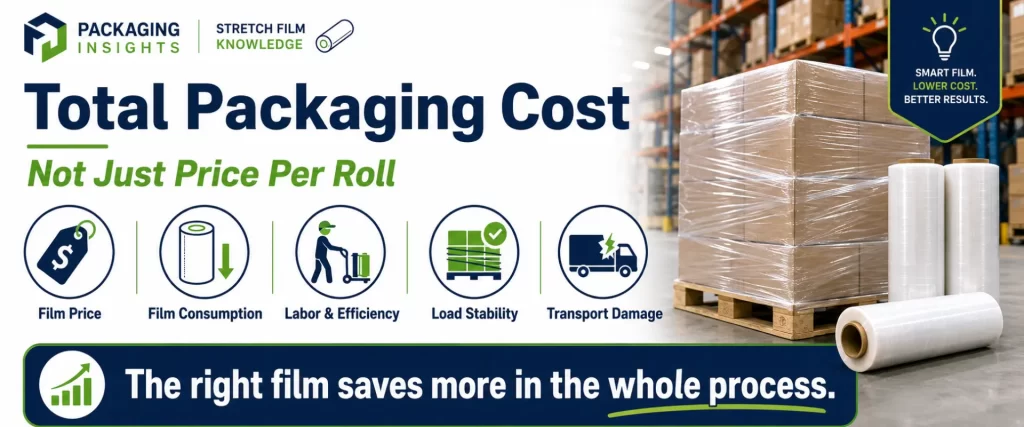
7. Compare total packaging costs rather than just the price per roll
This is arguably the most critical point.
When purchasing stretch film, buyers often ask first: How much does a roll cost?
However, the core question that offers more value is: What is the actual cost to securely wrap a single pallet?
Total packaging cost is influenced by multiple factors:
‑ Unit price of the film
‑ Film consumption per pallet
‑ Actual number of wraps applied
‑ Film waste/loss
‑ Labor costs
‑ Equipment operating efficiency
‑ Load stability
‑ Damage losses during transit
A film with a lower unit price does not necessarily save money if it requires more material to stabilize the pallet.
Conversely, a film with superior overall performance can reduce material consumption while providing better load protection.
Therefore, it is best for buyers to test and verify the film under actual operating conditions.
What information should be provided to the stretch film supplier?
Clearly defining actual usage conditions allows the supplier to provide precise product recommendations.
Before requesting a quote, please prepare the following information:
‑ Film width
‑ Film thickness
‑ Required roll length or net film weight
‑ Application method: manual wrapping vs. machine wrapping
‑ Paper core inner diameter
‑ Purchase quantity
‑ Film color
‑ Outer packaging format
‑ Specific details of the pallet and load
‑ Destination country or port
If specific specifications cannot be determined immediately, you can provide parameters of the film currently in use and details of on-site operations for reference.
For machine wrapping scenarios, providing the wrapping machine model and the equipment's pre-stretch ratio helps the supplier propose an optimal solution.
Can stretch film be customized?
Yes. We offer customized production based on your specific packaging requirements, covering the following parameters:
‑ Width
‑ Thickness
‑ Roll length
‑ Net weight
‑ Core size
‑ Film color
‑ Outer packaging method
Our standard product range includes clear, black, and colored stretch films, as well as hand-grade, machine-grade, pre-stretched, and mini stretch films.
For distributors and importers, we can also discuss customized options for carton styles, product labeling, and other external packaging requirements.
Selecting the right stretch film requires a balanced assessment.
No single universal specification meets every customer's needs.
The ideal stretch film must align with the nature of the goods, the packaging method, performance metrics, and specific procurement priorities.
Some customers prioritize material reduction, while others value superior puncture resistance, smooth machine runnability, or specific roll dimensions.
Selection should be based on the complete usage scenario rather than focusing on a single metric from a specification sheet.
If you are sourcing stretch film but haven't yet determined the right specifications, Yalan Packing can assess your needs and provide hand-grade, machine-grade, pre-stretched, and mini films, along with various customized solutions.
When requesting a quote, please provide details regarding your current specifications, actual application scenarios, and order volume. We will deliver a tailored selection
Share on Social:


