







PP Strapping Supplier Guide: Smooth vs Embossed Strapping for Automated Packaging
By hqt
Oct, 2026Related Posts
PP Strapping for Cartons: Packaging Challenges in E-Commerce Logistics
Oct 21, 2026

Polypropylene Strapping Under Temperature Changes: Effects on Packaging Performance
Oct 21, 2026
PET Strapping Supplier: Heat-Seal Joint Strength and Sealing Reliability
Oct 21, 2026
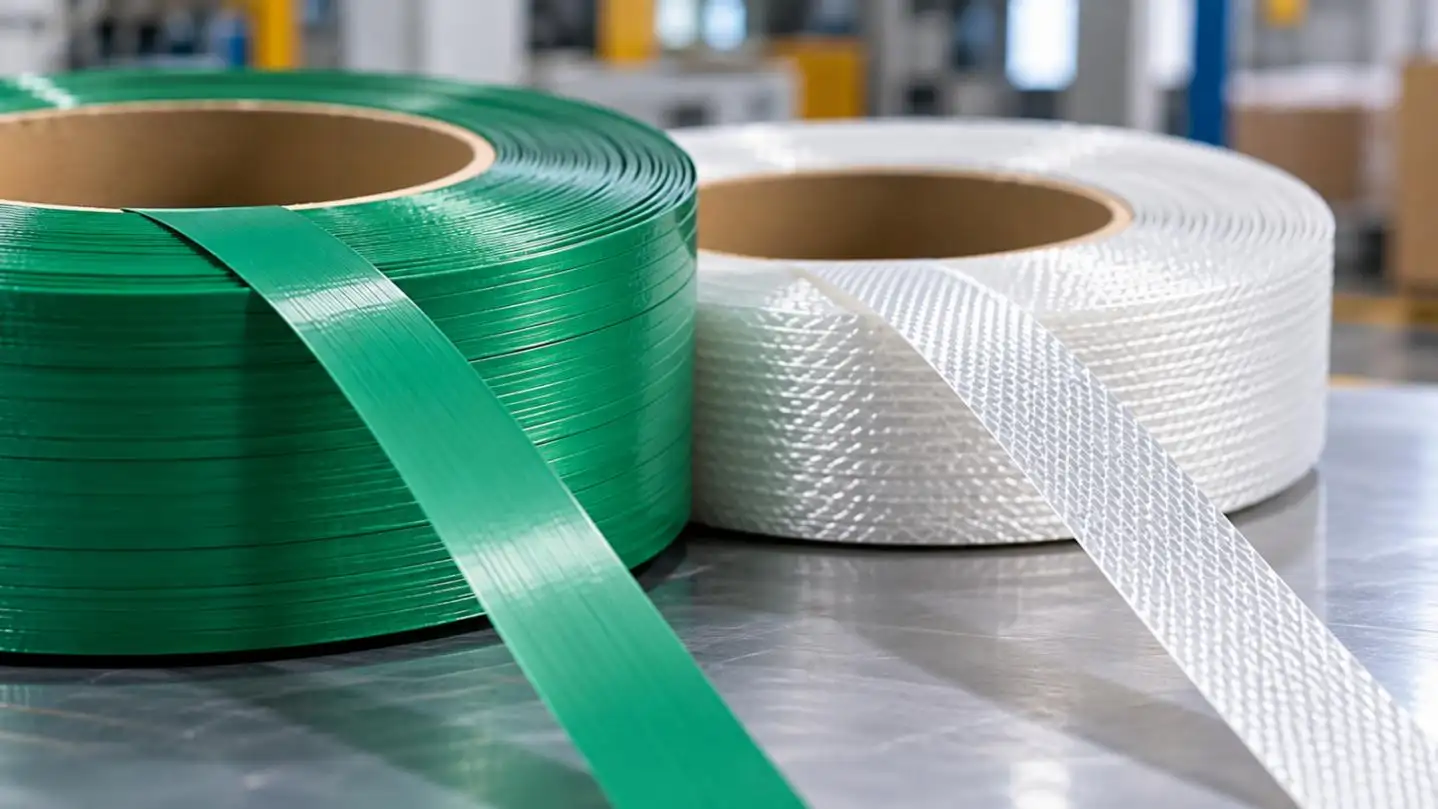
PP Strapping Supplier Guide: Smooth vs Embossed Strapping for Automated Packaging
Oct 21, 2026
Polypropylene (PP) strapping surface will dictate how it will interact with feed rollers, guide tracks and sealing components. Poor interaction can lead to cycle failures in automated packaging.
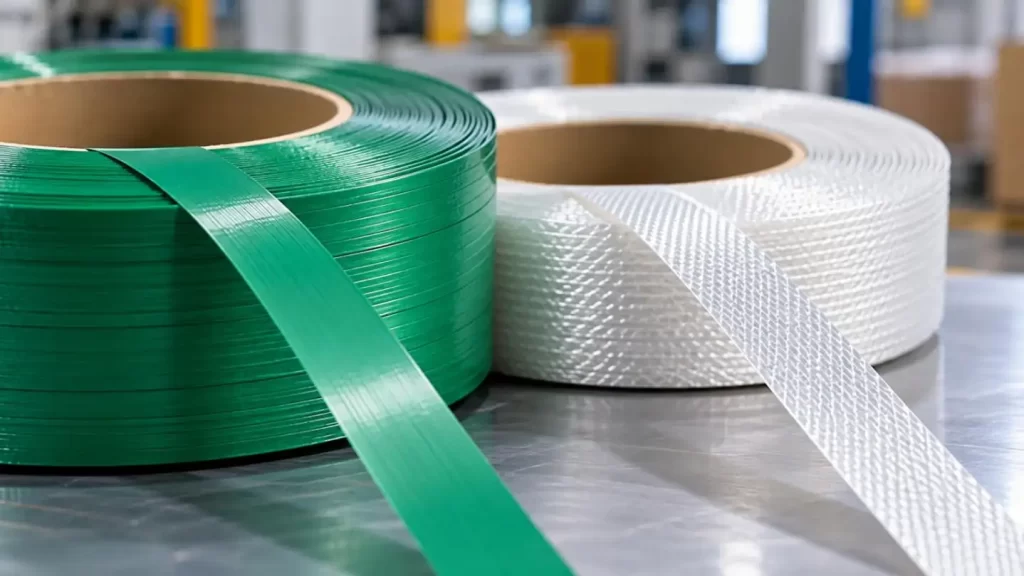
At Yalan Pack, we take a holistic approach when determining material. We evaluate machine-compatibility and process-consistency when deciding on material for our PP Strapping. Before selecting the material, we analyze the following: behavior of friction; tensile properties; dimensional accuracy; sealing conditions, etc.
We consider the interactions of machinery and operating conditions when determining the performance of strapping. Smooth and embossed PP strapping are equally poor or good, based on equipment and operating conditions.
1. Smooth vs Embossed PP Strapping: Surface Structure and Mechanical Properties
Both types of PP strapping start as continuous PP extrusions that are controlled stretched to the desired geometry.
Smooth Strapping
This type of strapping has a relatively uniform surface, and therefore,
• Guides fed by rollers and rails for its entire length.
• May have lower sliding resistance.
• Makes uniform contact during heat sealing.
• Can, however, result in feeding slippage due to insufficient strap-to-roller contact.
Embossed Strapping
• The surface of this strapping is textured by finishing, and
• Can influence local contact geometry and guide bending and heat sealing.
• The performance of embossed strapping is affected by the embossing depth, pattern, and uniformity as well as processing conditions.
Breaking load of embossed strapping is not necessarily higher than that of smooth strapping. Breaking load of both is dependent on the effective load bearing cross section of the strapping.
2. Surface Texture and Automatic Strapping Machines
There are two key friction mechanisms that a reliable PP Strapping Supplier must take into account.
Roller Traction vs. Guide-Track Resistance
Rollers must provide enough traction to advance the strap. Guide tracks must allow movement and not provide too much resistance.
An incorrect balance of the two can cause several operating failures:
• Feeding slippage. Insufficient traction of the rollers causes the strap to not advance consistently.
• Strap buckling. Compressive feeding force, combined with excess resistance of the guide track, can cause the strap to buckle.
• Track jamming. Variations in the width of the track, the stiffness of the track, and the curvature of the strap can all cause the track to bind.
• Unstable tension. Variable friction can cause the strap to be tightened more than intended.
• Surface Texture of the rollers and track is only one variable that can effect feeding reliability. others include how the strap was wound on the rollers, how straight the strap was, machine acceleration and condition of the rollers.
For high speed packaging, we recommend evaluating repeated feeding cycles over selecting a finish solely by appearance.
3. Heat Sealing Performance
A PP strapping supplier should be judged based on their heat sealing performance as well.
In the heat sealing process, the straps are brought together and the polypropylene in the straps is softened and fused.
Three elements of this process need to be balanced:
• Temperature. Not enough temperature results in an incomplete joint. Too much results in a breakdown of the polymer.
• Pressure. Sufficient pressure results in a complete weld.
• Sealing and cooling time. Insufficient time results in a joint that is too weak to support the load.
Joint Efficiency
For comparative purposes, both the joint breaking load and the unjoined strap breaking load must be tested under identical conditions.
Joint Efficiency (%) = Joint Breaking Load / Unjoined Strap Breaking Load x 100
ASTM D3950-23 provides a technical resource regarding nonmetallic strapping properties and the methods for joining straps, including applicable breaking strength, elongation, and joint strength requirements.
4. Smooth vs. Embossed PP Strapping: Technical Comparison
| Performance Factor | Smooth Strapping | Embossed Strapping |
| Surface Contact | Uniform | Relatively uniform; pattern dependent |
| Guide-track Friction | May be lower | Depends on embossing geometry |
| Roller Traction | Texture alters traction | Requires roller engagement |
| Tensile Strength | Material and cross-section dependent | Material and cross-section dependent |
| Heat-seal Response | Controls may affect the response | May require different settings |
| Package Grip | Surface texture affects grip | Texture |
| High-speed Suitability | Requires validation | |
| First Priority | Feeding and sealing traction and consistency | |
5. Selecting PP Strapping for Automated Packaging Lines
Prior to considering surface finishes, we suggest you evaluate the three operating requirements shown below.
Machine Compatibility
Approved by machine manufacturer
Strap width and thickness, and core diameter Feeding speed and guide track clearance Sealing mechanism, operating settings and strap tension range, and winding
Packaging Loads
Breaking load, elongation, and package rigidity and duration; anticipated storage time
Polypropylene can experience stress relaxation and am weakening under sustained tension. Temperature and storage conditions can affect this as can compressible cartons which can reduce retained tension.
Production Trials
Evaluate joints and strap consumption Record number of feed failures and completed cycles Choose the material which is stable with the machine settings and ensure that the material demonstrates consistent and stable performance
6. Manufacturing Precision and Quality Control at Yalan Pack
At Yalan Pack we produce strapping by extrusion and embossing. We check quality by inspecting dimensions and appearance and testing tensile strength.
Our published PP/PET strapping portfolio includes the following specifications:
| Manufacturing Data | Specification |
| Portfolio width range | 5–32 mm |
| Portfolio thickness range | 0.4–1.2 mm |
| Listed core diameters | 200 / 406 mm |
| Quality inspection | 100% inspection reported |
| Customization | Width, thickness, length, color, and core size |
These are general PP/PET portfolio specifications, not guaranteed ranges for every PP machine-strapping grade. Exact manufacturing tolerances and surface-finish availability require product-specific confirmation.
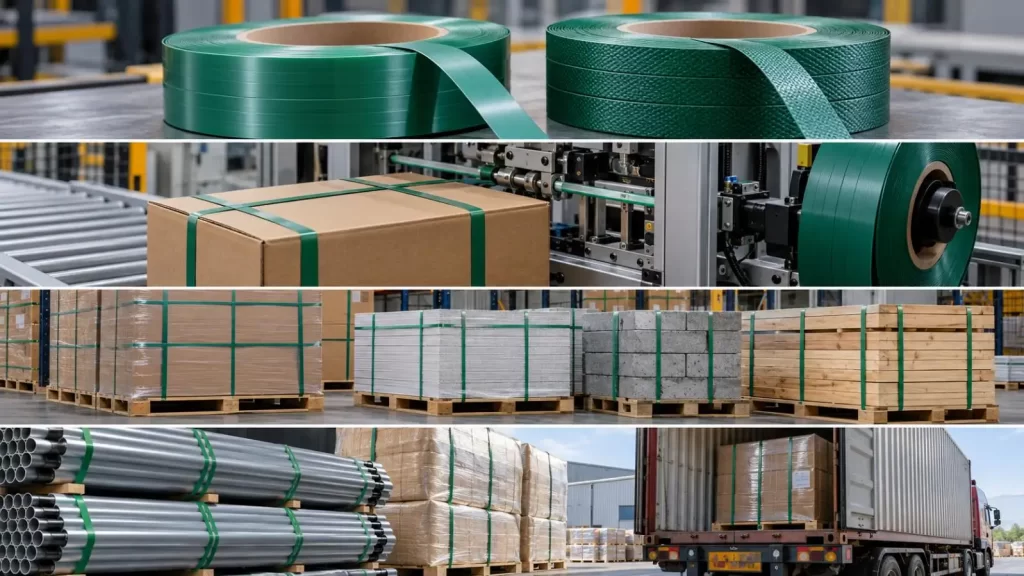
Why Dimensional Consistency Matters
Precision in manufacturing should be assessed by measurable variation rather than nominal dimensions.
The critical controls for machine grade strapping include:
• Width variation: lateral alignment of the guides affects the tracking of the strapping and feeding.
• Thickness variation: affects bending stiffness and rolling resistance.
• Embossing consistency: affects the surface behavior, local contact and surface texture.
• Batch consistency: requires less machine adjustments between shipments.
Strapping suppliers should disclose the agreed tolerances and the results of inspections rather than rely on general product specifications.
7. How to Evaluate a PP Strapping Supplier Before Bulk Procurement
At Yalan Pack, we recommend sample evaluation for large-volume orders to confirm equipment compatibility.
Buyers should request:
- Dimensional measurements and applicable tolerances
- Breaking load and elongation test results.
- Heat seal joint strength
- Results of feeding trials
- Batch identification and Inspection reports.
ASTM D4675-14a(2022) offers information on strapping materials and methods of assessing their suitability for packaging, handling and distribution.
While considering costs per successfully strapped package, strapping material procurement should focus on total costs rather than per unit costs. Total costs may include strapping consumption, machine downtime and the number of defective joints.
We offer different specification samples for machine-grade PP strapping. Please contact us to learn more about our product offerings and request samples.
FAQs
Q1: What types of PP strapping does Yalan Pack manufacture?
We manufacture PP hand strapping and machine-grade PP strapping for carton bundling, industrial packaging, and automated packaging applications.
Q2: Is Yalan Pack PP strapping suitable for automatic strapping machines?
Yes. Our machine-grade PP strapping is designed for automatic and semi-automatic equipment. Compatibility depends on the machine's approved specifications.
Q3: Does Yalan Pack offer smooth and embossed PP strapping?
We use embossing technology in strapping manufacturing. Please contact us to confirm the available surface finishes for specific machine-grade products.
Q4: Can Yalan Pack customize PP strapping dimensions?
Yes. We offer customization of strap width, thickness, length, core size, and color according to packaging requirements.
Q5: How does Yalan Pack maintain consistent PP strapping quality?
Our manufacturing process incorporates extrusion technology and quality inspections covering dimensions, tensile strength, and appearance.


Contact Us
In This Article
Related Posts
PP Strapping for Cartons: Packaging Challenges in E-Commerce Logistics
Oct 21, 2026
Polypropylene Strapping Under Temperature Changes: Effects on Packaging Performance
Oct 21, 2026
PET Strapping Supplier: Heat-Seal Joint Strength and Sealing Reliability
Oct 21, 2026
PP Strapping Supplier Guide: Smooth vs Embossed Strapping for Automated Packaging
Oct 21, 2026


