







Industrial Pallet Wrap Film: Recycling Colored & Printed Film
By hqt
Oct, 2026Related Posts
PP Strapping for Cartons: Packaging Challenges in E-Commerce Logistics
Oct 21, 2026

Polypropylene Strapping Under Temperature Changes: Effects on Packaging Performance
Oct 21, 2026
PET Strapping Supplier: Heat-Seal Joint Strength and Sealing Reliability
Oct 21, 2026
PP Strapping Supplier Guide: Smooth vs Embossed Strapping for Automated Packaging
Oct 21, 2026
Industrial Pallet Wrap Film can be mechanically recycled when its polyethylene structure, coloration, and post-use condition are compatible with the receiving recycling stream. The difficult question is not whether LLDPE can be remelted, but whether a warehouse's used film can be identified, collected, and converted into usable resin.

At Yalan Pack, we distinguish material recyclability from the practical recovery of colored and printed pallet wrap.
1. Industrial Pallet Wrap Film is Truly Recyclable
Most stretch wrap is comprised of LLDPE, which, along with other PE grades, can be used to create the layers of a film structure. However, if one layer of film is comprised of an incompatible polymer, it can ruin film recyclability. Additional additives can also affect film recyclability.
Mechanical recycling of a film typically consists of:
Collecting → Sorting → Shredding → Washing → Extruding → Filtration → Pelletizing
There are two key aspects that define the success of recycling:
•Feedstock quality: A high mix of different polymers or the presence of adhesives or paper labels can increase rejects or require more filtration.
•Recovery: If a recyclable film does not have access to a collection and recycling channel, there is little value to the film, even if it is recyclable.
Recycled content and recyclability are two separate claims.
2. How Do Pigments and Printing Affect PE Recycling?
Colorants and Near-Infrared Sorting
The use of color masterbatch modifies the color of the final recyclate. Most carbon black pigments absorb near-infrared (NIR) radiation and, thus, block NIR sorting of plastics. However, there are dark NIR-absorbant pigments.
The RecyClass guidelines issued in March 2026 outline the following for colored PE flexible packaging:
•Full compatibility: Clear, translucent and pastel colors.
•Limited compatibility: Dark colors that are sortable by NIR.
•Non-compatibility: Colors that cannot be sorted by NIR.
Even if dark colored Industrial Pallet Wrap Film is sorted, conventional melt filtration will not remove disperse pigments. In general, dark colors create darker recyclate.
Ink Chemistry Matters More Than Printed Area Alone
Printed Industrial Pallet Wrap Film adds binders, pigments, and other ink components. These may cause bleeding, discoloration, odor, or degradation during extrusion.
RecyClass identifies the following ink and varnish thresholds for colored PE flexible packaging:
| Ink and Varnish Content | Recycling Compatibility |
| ≤5% by packaging weight | Full compatibility with suitable ink chemistry |
| 5–7% | Limited compatibility |
| >7% | Non-compatible |
Additional restrictions apply to ink bleeding, nitrocellulose binders, and other chemical components.
These thresholds are design-screening criteria, not automatic certification of an individual pallet film.
3. Clear, Colored or Printed Industrial Pallet Wrap Film?
There are tradeoffs with design, warehouse function and recyclability when selecting Industrial Pallet Wrap Film.
| Film Design | Warehouse Application | Recycling Consideration |
| Clear PE | Product visibility and barcode access | Potentially greater recovery of lighter-colored recyclates |
| Light-Colored PE | Load-zone and batch identification | Pigments affect pellet color |
| Dark/Black PE | Cargo concealment | Consider NIR detection and end use |
| Printed PE | Marking and branding | Ink, loading and bleeding |
The color of the base film does not dictate recyclability. It is the total formula and the acceptance of the recycler that determines the preferred option.
4. How Can Warehouses Improve Industrial Pallet Wrap Film Recovery?
For warehouses, the main barrier to film recovery is usually lack of segregation.
The following practices are recommended:
•Industrial Pallet Wrap Film should be kept separate from other packaging materials (i.e. PET straps, paperboard and mixed waste).
•All product residue and paper labels should be removed from the film and excessive tape should be removed.
•Film should be stored dry prior to baling.
•Prior to pick-up, film should be separated into colors based on recycler guidelines.
•Bale purity, moisture, and contamination levels should be assessed and accepted by the recycler.
Separate collections systems for pre and post consumer film may be warranted.
Relying solely on the presence of a recycling symbol does not guarantee a film will be accepted for recycling by a facility.
5. Pallet Load Performance and Manufacturing Precision
There are tradeoffs with film thickness. Thinner film gauges mean lower packaging weights, but frequent breakage and unstable loads can consume potential savings.
There are mechanical performance tradeoffs to consider in addition to recyclability.
Industrial Pallet Wrap Film selection therefore requires mechanical-performance evaluation alongside recycling design.
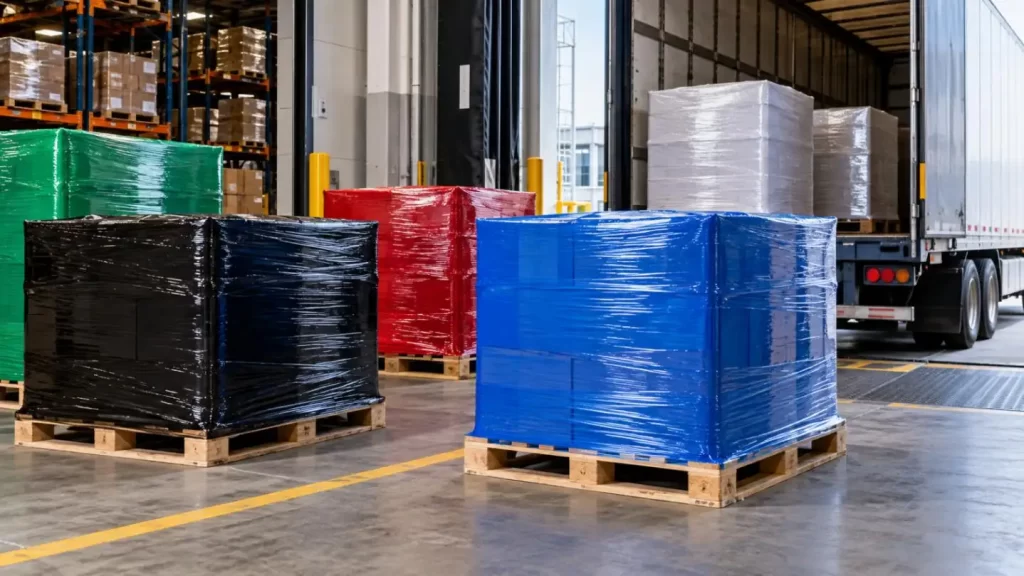
Yalan Pack Manufacturing Specifications
At Yalan Pack, our colored stretch film product range includes the following published options:
| Technical Parameter | Yalan Pack Specification | Engineering Consideration |
| Film Thickness | 10–80 μm | Puncture resistance and material consumption |
| Film Width | 100–1500 mm | Pallet geometry and equipment compatibility |
| Stretch Rate | Up to 350% on suitable options | Film elongation capability |
| Core Diameter | 25, 38, 50, 76 mm | Dispenser and wrapping machine compatibility |
We use multilayer film manufacturing and raw-material, in-process, and finished-product inspections to support specification consistency.
These figures represent available product specifications, not guaranteed dimensional tolerances for every grade.
For orders requiring greater precision, the following information is relevant.
•Thickness uniformity: Nominal gauge tolerance and transverse thickness profile.
•Mechanical strength: Machine-direction (MD) and transverse-direction (TD) tensile strength.
•Film integrity: Puncture resistance and film-break.
•Wrapping behavior: Includes cling, effective pre-stretch and containment force.
Elongation at break, while pertinent to the interpretation of some test methods, is not relevant to operational pre-stretch or load-holding performance.
We recommend the performance of pallet trials to determine the impact of wrapping conditions and the transport of the pallets, on the films performance. Bulk purchases should be considered only after pallet trials.
6. How Should Buyers Verify Industrial Pallet Wrap Film Recyclability?
At Yalan Pack, we advise that recycling feasibility should not be considered with other purchasing criteria.
Material and Recycling Documentation
Buyers should request:
•Polymer and additive composition declarations.
•Pigment identification and NIR sorting evidence where applicable.
•Printing ink chemistry and dry ink-weight percentage.
•Relevant RecyClass and CEFLEX design assessments.
•Written confirmation from intended recycling partners.
Performance Testing and Cost Verification
ASTM D882 can be used for tensile-property evaluations, while ISO 18604 addresses assessment of packaging material recycling. Neither standard individually confirms availability of local recycling.
For procurement decisions, compare:
•Film weight consumed per pallet.
•Film-break frequency during wrapping.
•Load stability and transport damage.
•Waste collection and recycling costs.
•Potential recyclate value.
Where recycled resin is specified, its effect on film consistency should be assessed separately from end-of-life recyclability.
Selecting Industrial Pallet Wrap Film for Practical Recycling
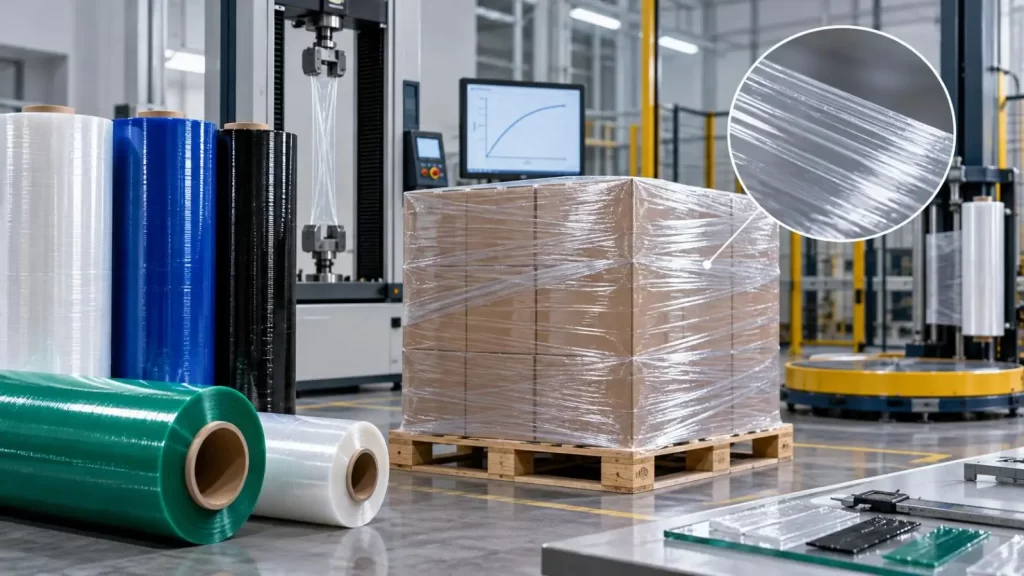
Colored and printed industrial pallet wrap can help identify pallets and help protect cargo while still supporting material recovery. Successful recycling depends on a number of factors including compatible PE formulations, detectable pigments, and suitable inks, as well as clean collection and containment of the load.
At Yalan Pack, we assist customers to select colored stretch film that meets their industrial packaging needs. Check out our Colored Stretch Film and contact us for film dimensions, color choices, performance standards and expectations, and recycling documentation.
FAQs
Q1. What materials does Yalan Pack use for colored Industrial Pallet Wrap Film?
Yalan Pack offers LLDPE-based colored stretch film designed for pallet containment, warehouse identification, and cargo protection.
Q2. Is Yalan Pack's colored Industrial Pallet Wrap Film recyclable?
LLDPE film is mechanically recyclable, but actual recyclability depends on pigment composition, contamination, and local recycling facilities.
Q3. What colors of stretch film does Yalan Pack offer?
Yalan Pack offers black, blue, red, green, orange, and other customized colors for warehouse identification and cargo concealment.
Q4. What thickness and width options are available from Yalan Pack?
Published colored-film specifications list thicknesses of 10–80 μm and widths of 100–1500 mm. Availability depends on the selected film grade.
Q5. Can Yalan Pack customize Industrial Pallet Wrap Film specifications?
Yes. Yalan Pack supports customization of film thickness, width, roll length, core dimensions, colors, and packaging configurations.


Contact Us
In This Article
Related Posts
PP Strapping for Cartons: Packaging Challenges in E-Commerce Logistics
Oct 21, 2026
Polypropylene Strapping Under Temperature Changes: Effects on Packaging Performance
Oct 21, 2026
PET Strapping Supplier: Heat-Seal Joint Strength and Sealing Reliability
Oct 21, 2026
PP Strapping Supplier Guide: Smooth vs Embossed Strapping for Automated Packaging
Oct 21, 2026


