







Pre-stretched Film: Cost-saving Tips for High-volume Warehouse Users
By hqt
Aug, 2026Related Posts
What Packaging Materials Are Commonly Used in North American Warehouses?
Oct 23, 2026
PP Strapping for Cartons: Packaging Challenges in E-Commerce Logistics
Oct 21, 2026

Polypropylene Strapping Under Temperature Changes: Effects on Packaging Performance
Oct 21, 2026
PET Strapping Supplier: Heat-Seal Joint Strength and Sealing Reliability
Oct 21, 2026
For warehouses wrapping hundreds or even thousands of pallets monthly, stretch film represents a significant consumable cost. Even a few extra grams of film per pallet can accumulate into substantial annual packaging expenses over time.
Consequently, warehouses, distribution centers, and logistics companies aiming to control film consumption often turn to pre-stretched film as a cost-effective solution. Unlike traditional stretch film—which is stretched during the on-site wrapping process—pre-stretched film undergoes mechanical stretching during manufacturing. Operators need only apply minimal tension to wrap the load, yet the film maintains sufficient tension to securely hold the goods in place on the pallet.
While pre-stretched film offers significant cost-saving potential, success depends on selecting the right film specifications for the load and adhering to proper operating procedures. Here are six practical tips to help high-throughput warehouses maximize the value of pre-stretched film:
1. Measure Film Cost Per Pallet, Not Price Per Roll
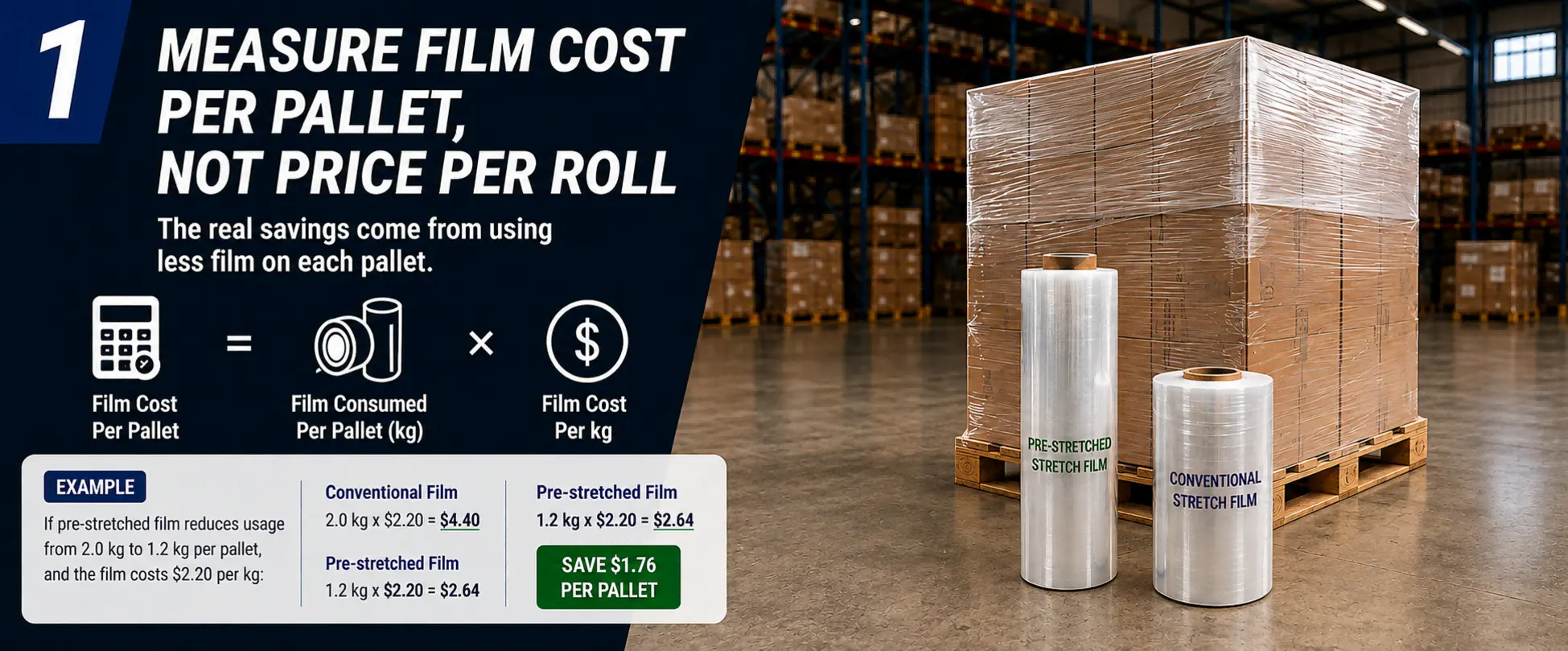
A common mistake when purchasing stretch film is comparing only the price per roll or per kilogram.
A more meaningful metric for actual warehouse operations is: Film cost per pallet = Film consumed per pallet × Price per kilogram.
Although the price per kilogram for pre-stretched film differs from that of standard stretch film, it reduces the amount of film consumed per pallet. This reduction in material usage is its primary cost advantage. However, actual savings will vary depending on the type of goods being wrapped.
Avoid relying on generic savings figures found online; instead, select a few representative pallets and measure actual film consumption before and after switching film specifications. This allows the procurement team to obtain accurate, reliable cost comparisons based on their specific operational environment.
For a warehouse wrapping 20,000 pallets a month, even a slight reduction in film consumption per pallet can translate into substantial total cost savings over the course of a year.
2. Don't Assume Thicker Film Means Better Pallet Stability
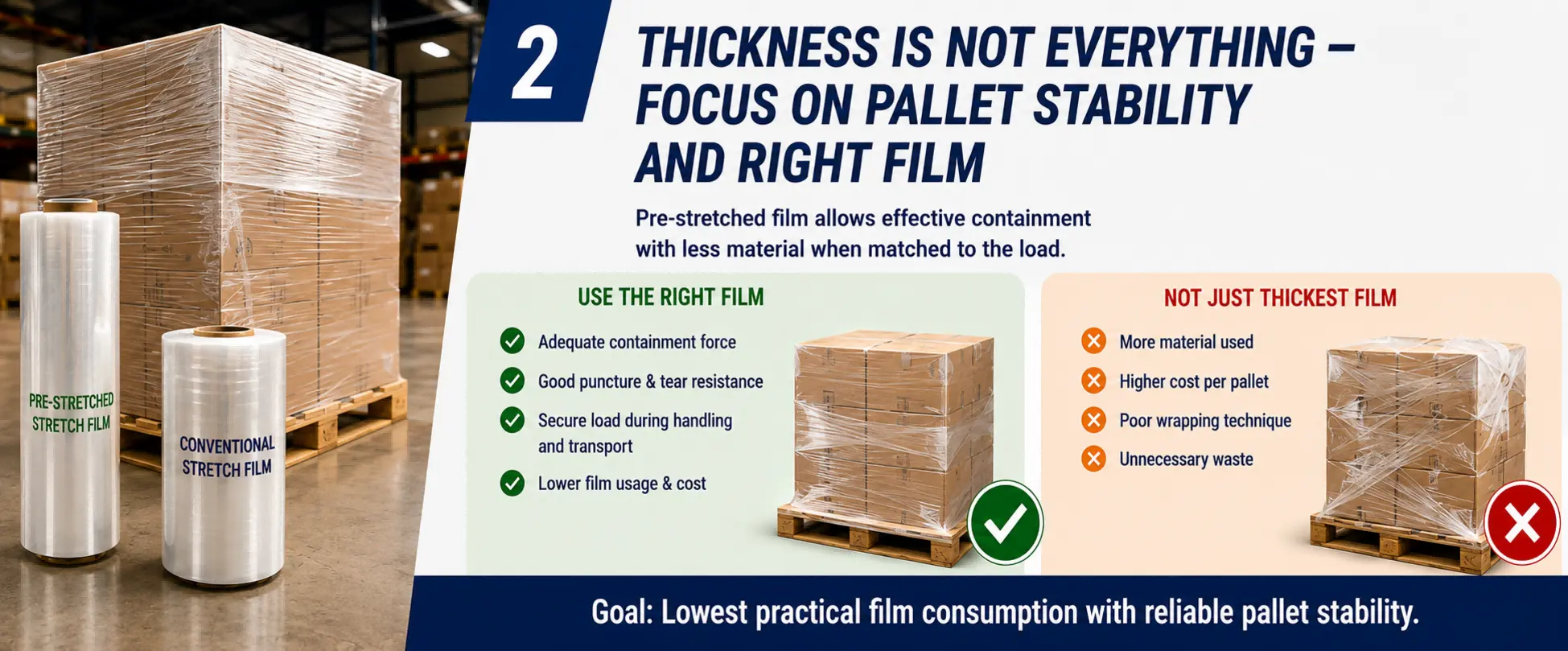
The performance of stretch film is not determined solely by its thickness.
If operators apply too many layers or use incorrect stretching techniques, even a thicker traditional film may fail to deliver optimal results. Pre-stretched film operates differently: the majority of the stretching process is completed within a controlled factory environment.
Consequently, thinner films can effectively secure loads while simultaneously reducing material waste.
However, this does not mean one should blindly pursue the thinnest possible film. There is a vast difference in performance requirements between a standard pallet of neatly stacked cartons and a pallet containing sharp corners, irregular shapes, or heavy industrial goods; factors such as puncture resistance, tear resistance, cling (self-adhesion), and load containment capability must be comprehensively evaluated.
The goal of product selection is not simply to buy the thinnest film on the market. The true objective is to minimize actual film consumption while ensuring the load remains stable and secure throughout the entire process of handling, warehousing, and transportation.
3. Reduce the Variation Between Different Operators
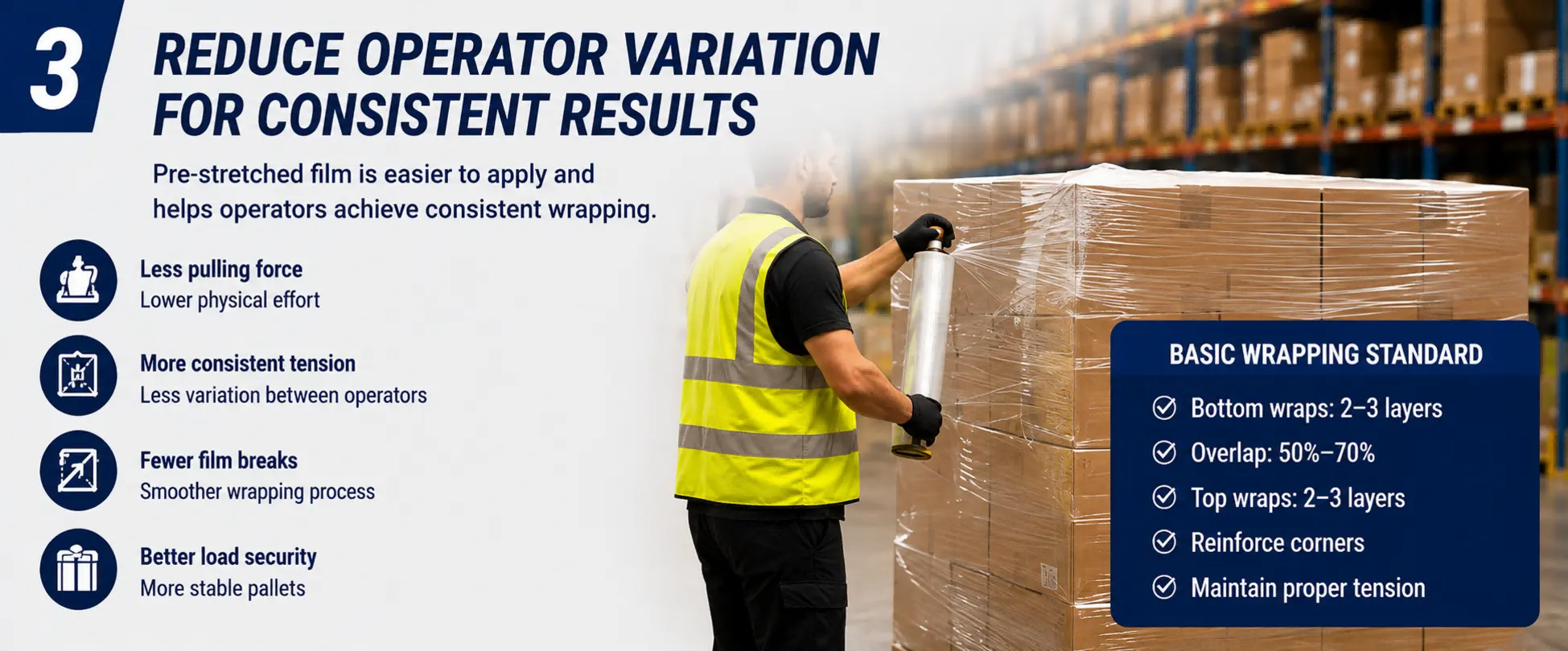
Manual pallet wrapping entails a hidden cost: significant variations in film usage among different operators.
Some operators may stretch traditional film vigorously to reduce consumption, whereas others apply less tension, relying instead on additional wraps to achieve adequate load containment.
When a warehouse processes thousands of pallets, such operational inconsistencies make it difficult to control packaging material usage.
Pre-stretched film requires less tension during application, leading to more consistent results in manual wrapping operations. Additionally, the lighter rolls and reduced physical effort required help alleviate the strain on warehouse staff during repetitive wrapping tasks. However, the warehouse still needs to establish standardized wrapping procedures that clearly specify the following requirements: the number of wraps at the base, the overlap between layers, the number of wraps at the top, the method for handling pallet corners, and the permissible range of film tension.
Even if the film itself is of excellent quality, it cannot compensate for the various issues arising from a lack of standardized control over the wrapping process.
4. Choose the Right Roll Weight for High-volume Work
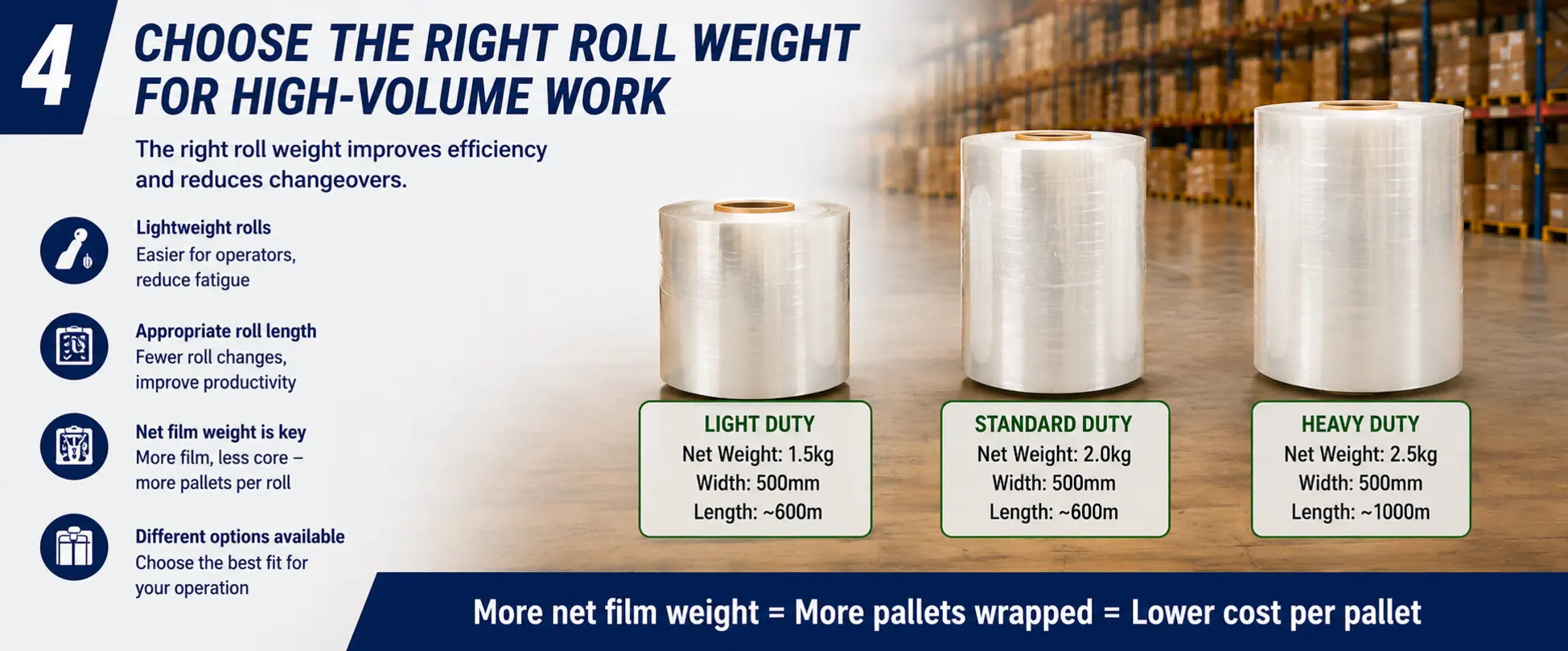
When purchasing pre-stretched film, buyers should not focus solely on film thickness and width. Net film weight, roll length, and core weight are equally important metrics that cannot be overlooked.
For operators performing continuous pallet wrapping throughout a shift, lighter rolls require less physical effort to handle. However, if the roll weight is too low, the frequency of roll changes increases significantly, which can actually reduce overall operational efficiency.
For this reason, Yalan Packing offers pre-stretched film in a wide range of specifications rather than a single, fixed product. Parameters—including film width, thickness, roll weight, core specifications, and outer packaging requirements—can be adjusted to meet specific warehouse needs.
For bulk purchases, it is advisable to verify the net film weight with the supplier rather than relying solely on the gross weight of the entire roll. A heavy core increases the total roll weight, but that extra weight contributes nothing to the actual pallet wrapping process.
5. Test Different Pallet Types Before Changing the Whole Warehouse
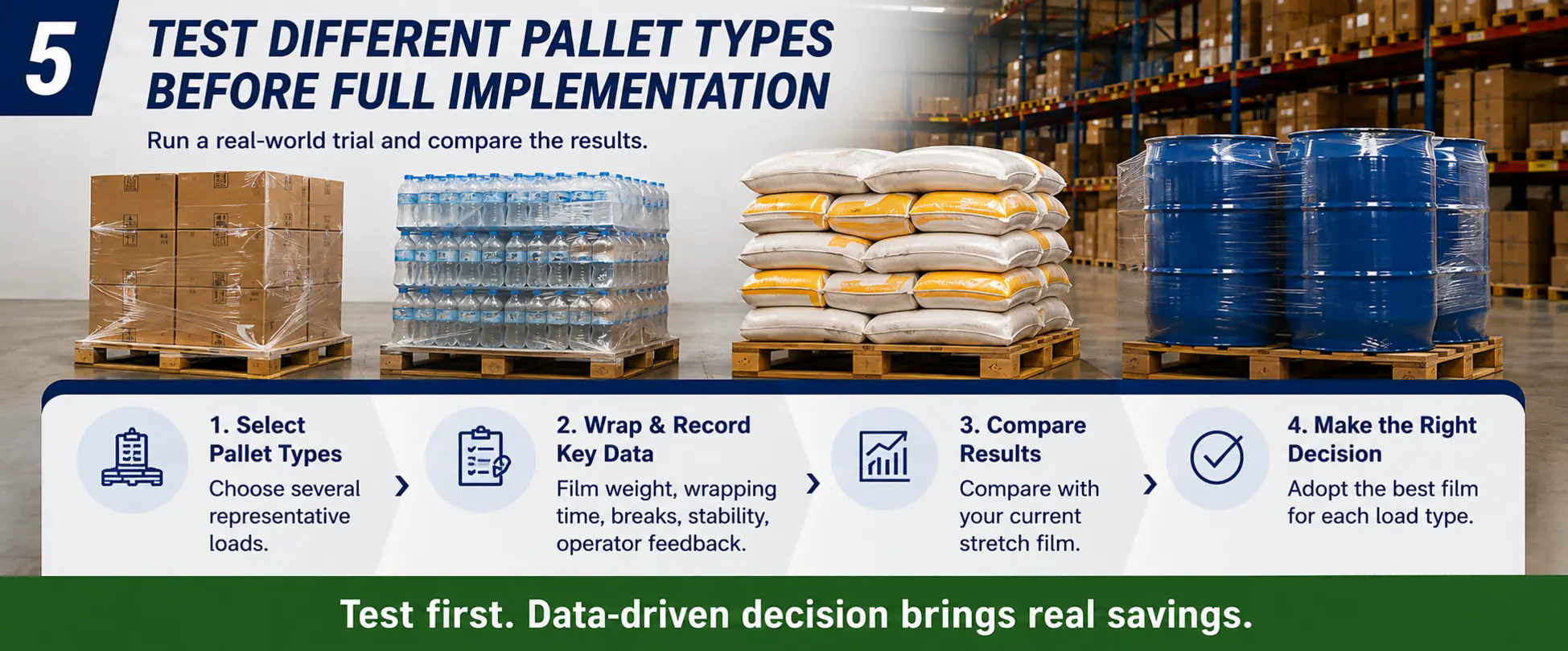
Do not simply replace traditional stretch film with pre-stretched film across the board for all goods.
While pre-stretched film is highly suitable for uniformly shaped cartons, lightweight consumer goods, and standard warehouse pallet loads, items with sharp edges, excessive weight, or highly irregular shapes may require films of different thicknesses or formulations, or adjustments to the wrapping process.
Practical testing should cover the main types of goods handled in the warehouse. Key data points to record include: film consumption per pallet (weight), wrapping time, instances of film breakage, load stability, and operator feedback.
Then, compare this test data against the film currently in use. This approach provides far more valuable insight than simply comparing the unit price of the rolls.
If choosing a thinner film appears to save 25% in material costs but leads to load failure or the need for re-wrapping, those apparent savings will be completely negated.
6. Look at Total Warehouse Cost, Not Only Film Consumption
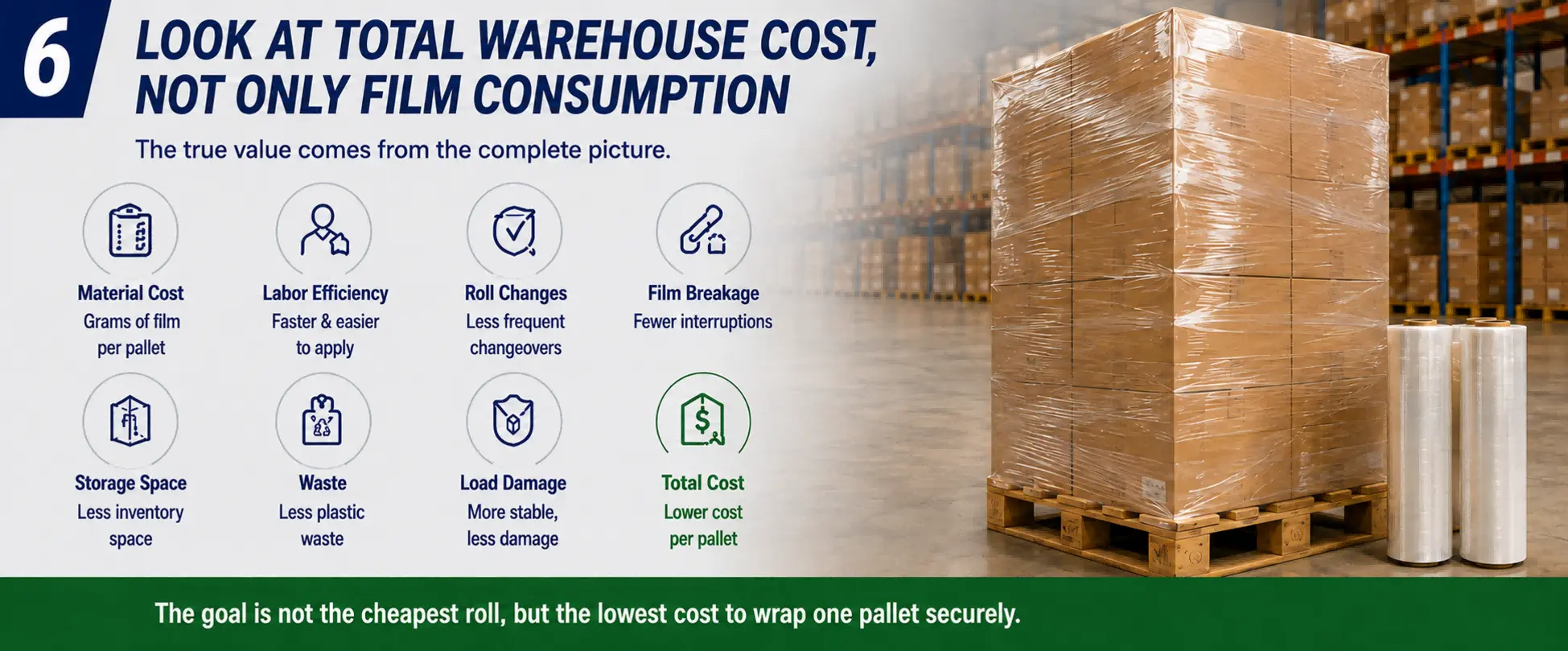
The cost advantages of pre-stretched film extend beyond merely reducing the consumption of plastic materials. For warehouses with high throughput, a comprehensive evaluation of the following factors is also required:
Material cost — How many grams of film are actually consumed per pallet?
Labor efficiency — Is the film easier to handle and does it require less time?
Roll change frequency — How often do operators need to replace the film roll?
Film breakage — Does film snapping interrupt the wrapping process?
Storage footprint — How much inventory of film rolls needs to be stocked?
Waste generation — How much waste film is produced?
Cargo damage — Does the pallet remain stable during internal handling and transportation?
This highlights the core difference between low-priced stretch film and cost-effective stretch film. If wrapping a single pallet requires more material, a film with a lower unit price may not actually be the more economical choice overall.
Is pre-stretched film suitable for your warehouse?
Pre-stretched film is particularly well-suited for operations with high pallet throughput that rely primarily on manual wrapping and aim to consistently control film consumption. It also effectively solves the problem of maintaining consistent tension, which can be difficult for operators using traditional manual stretch film.
However, there is no single universal specification that fits every warehouse. Before making a bulk purchase, you should provide suppliers with key information such as pallet dimensions, approximate cargo weight, product type, current film specifications, monthly consumption, and whether wrapping is done manually or with machine assistance.
Yalan Packing offers pre-stretched films tailored to various pallet wrapping needs, alongside a full range of traditional manual and machine-grade stretch films. Selection should be based on the actual load requirements rather than simply looking at film thickness.
Therefore, the primary concern for bulk purchasers should not be How much does a roll cost? but rather What is the actual cost to securely wrap a pallet?
When procurement teams adopt this logic to evaluate stretch film, it becomes easier to identify ways to reduce material usage and control warehouse packaging costs. Current warehouse management guidelines also recommend establishing material consumption benchmarks based on actual measured data, rather than simply applying industry-wide averages.


Contact Us
In This Article
Related Posts
What Packaging Materials Are Commonly Used in North American Warehouses?
Oct 23, 2026
PP Strapping for Cartons: Packaging Challenges in E-Commerce Logistics
Oct 21, 2026
Polypropylene Strapping Under Temperature Changes: Effects on Packaging Performance
Oct 21, 2026
PET Strapping Supplier: Heat-Seal Joint Strength and Sealing Reliability
Oct 21, 2026


