







Plastic vs Polyester Strapping: Which One Suits Your Pallet Export Packaging
By hqt
Aug, 2026Related Posts
What Packaging Materials Are Commonly Used in North American Warehouses?
Oct 23, 2026
PP Strapping for Cartons: Packaging Challenges in E-Commerce Logistics
Oct 21, 2026

Polypropylene Strapping Under Temperature Changes: Effects on Packaging Performance
Oct 21, 2026

PET Strapping Supplier: Heat-Seal Joint Strength and Sealing Reliability
Oct 21, 2026
Selecting the right strapping for export pallets requires more than just comparing price and tensile strength. As pallets move from the warehouse to the end customer, they undergo multiple handling stages—including warehouse transport, trucking, container loading, ocean freight, unloading, and final local delivery. Throughout this transport cycle, the cargo is subjected to constant vibration, shifting, compression, and fluctuating tension.
In industrial and export packaging, PP (polypropylene) and PET (polyester) strapping are the two dominant types of plastic strapping on the market. While both are plastic strapping materials, they differ significantly in product design and intended application.
By fully understanding the optimal operating conditions for each material, purchasers can avoid issues such as over-packaging or insufficient packaging strength.
1. PP Strapping: A Cost-Effective Solution for Lightweight Loads
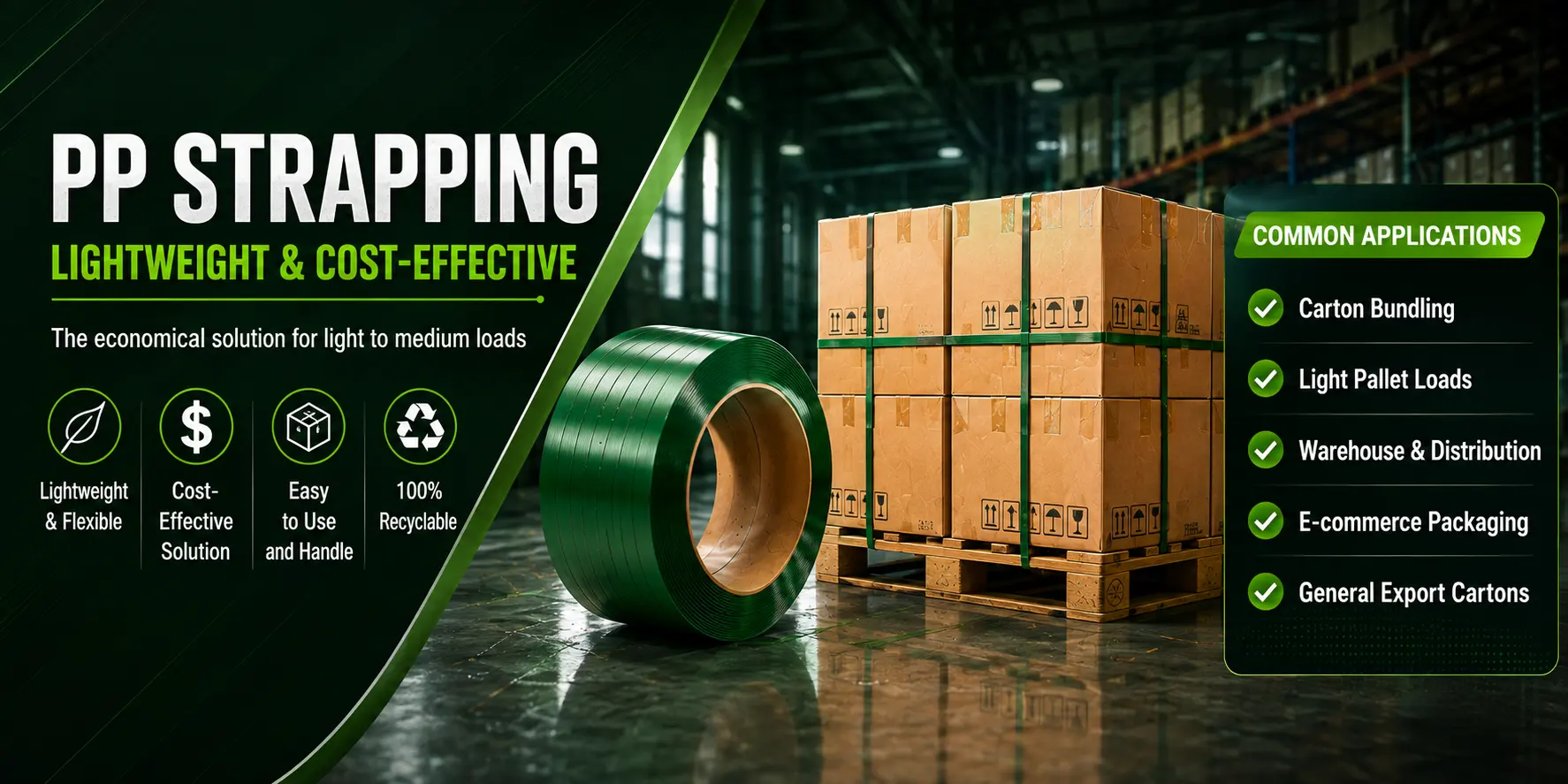
PP (polypropylene) strapping is widely used for bundling cartons, general warehouse packaging, and securing light-to-medium-weight palletized loads.
Cost-effectiveness is its primary advantage. Compared to PET strapping, PP strapping is more affordable and comes in a variety of widths, thicknesses, and coil lengths. It is suitable for both manual application and use with semi-automatic or fully automatic strapping machines, making it ideal for factories and enterprises handling large volumes of carton packaging.
Typical Use Cases:
·Securing cartons
·Packaging lightweight palletized goods
·Sealing food and beverage cartons
·Bundling printed materials and newspapers
·E-commerce warehouse packaging
PP strapping offers excellent flexibility, making it well-suited for carton packaging that does not require extremely high tension.
However, purchasers should be aware of its tension retention characteristics: after application, the initial tension of PP strapping gradually decreases over time. While this is not an issue for lightweight, structurally stable carton pallets, stable and enduring tension is essential for heavy pallets destined for long-distance ocean export.
Therefore, one should not simply choose PP strapping just because thicker specifications are available; the decision to use PP strapping must be based on the actual characteristics of the cargo itself.
PET (polyester) strapping is the preferred choice when superior strength and excellent tension retention are required. Compared to PP strapping, PET strapping is better suited for heavy-duty palletizing and industrial cargo. It can absorb minor shifts during transit while maintaining a secure hold on the load, making it ideal for long-distance transport or products within demanding supply chains. PET strapping is commonly used to secure items such as:
• Construction materials
• Lumber and wood products
• Metal products
• Heavy cartons
• Industrial components
• Machinery and equipment
• Heavy-duty export pallets.
In certain applications, PET strapping serves as an alternative to steel strapping. While PET should not be viewed as a direct, interchangeable substitute for steel due to differing material properties, it offers distinct advantages: lighter weight, corrosion resistance, and the absence of sharp steel edges (making it safer to handle). Its ability to retain tension is particularly critical in export packaging. Consider a heavy pallet transported from a factory to a port, loaded into a container, shipped by sea for weeks, and finally handled again at its destination. If the load shifts or settles slightly during transit, the strapping must ensure the pallet remains stable. For such applications, PET is often the more suitable choice.
2. PET Strapping: The Preferred Solution for Heavy-Duty and High-Standard Pallets
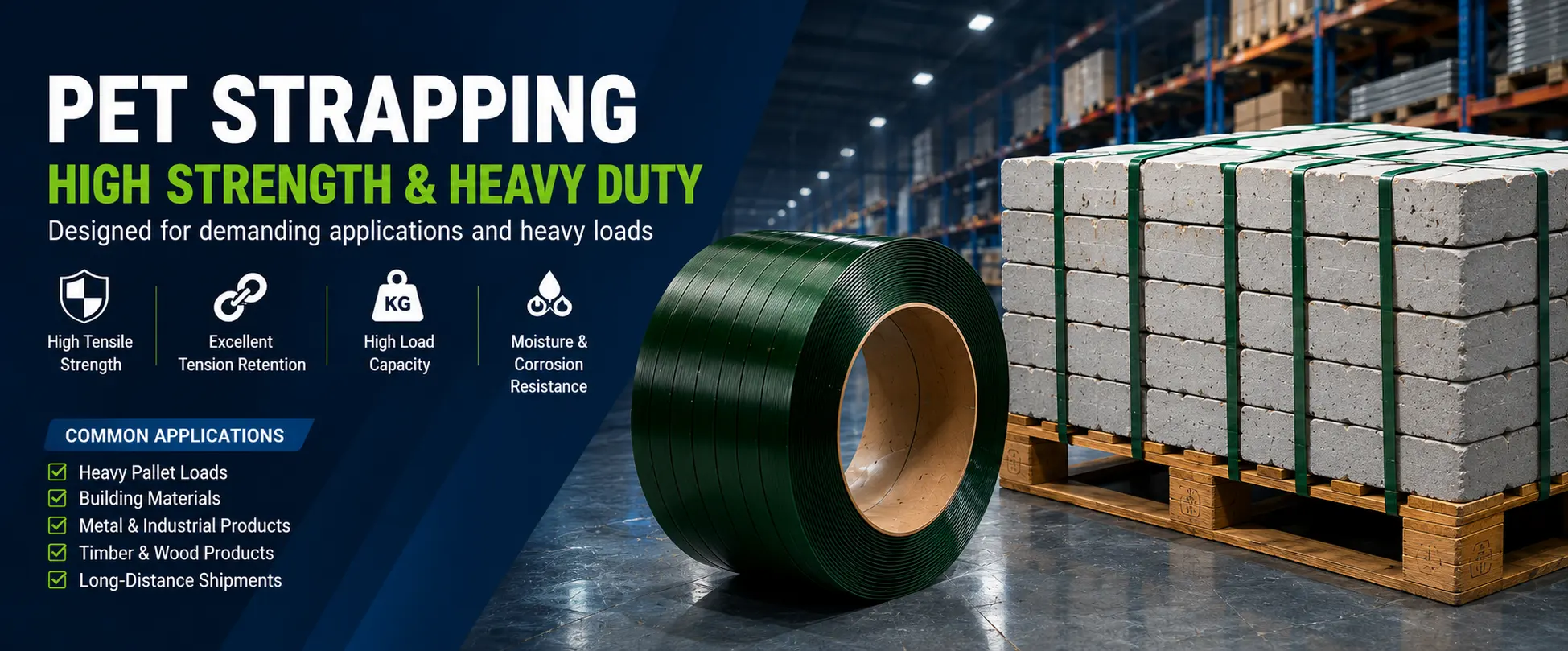
If higher requirements are placed on binding strength and tensile durability, PET (polyester) strapping is the preferred option.
Compared to PP strapping, PET strapping is better suited for heavy-duty pallet stacking and industrial goods. During transport, it can cushion shifting of goods while continuously applying a stable binding force, making it ideal for long-distance transport or export goods with demanding supply chain conditions.
PET strapping is commonly used to bundle the following goods:
· Building materials
· Timber and wood products
· Metal products
· Heavy-duty cartons
· Industrial parts
· Machinery and equipment
· Heavy-duty export pallets.
In some scenarios, PET strapping can replace steel strapping. However, PET and steel have different material properties and are not directly interchangeable. Even so, PET strapping offers several advantages: it is lighter, corrosion-resistant, has no steel edge burrs, and is safer to handle.
In export packaging scenarios, its excellent tensile strength is particularly crucial.
For example, heavy-duty pallets are transported from the factory to the port, loaded into containers, and undergo weeks of sea freight. Upon arrival at the destination port, they undergo multiple loading and unloading operations. Even if the goods experience slight shifting or stacking subsidence during transport, the strapping must maintain the overall stability of the pallet. In such situations, PET strapping is often the more reliable choice.
3. PP vs. PET Strapping: What Are the Key Differences?
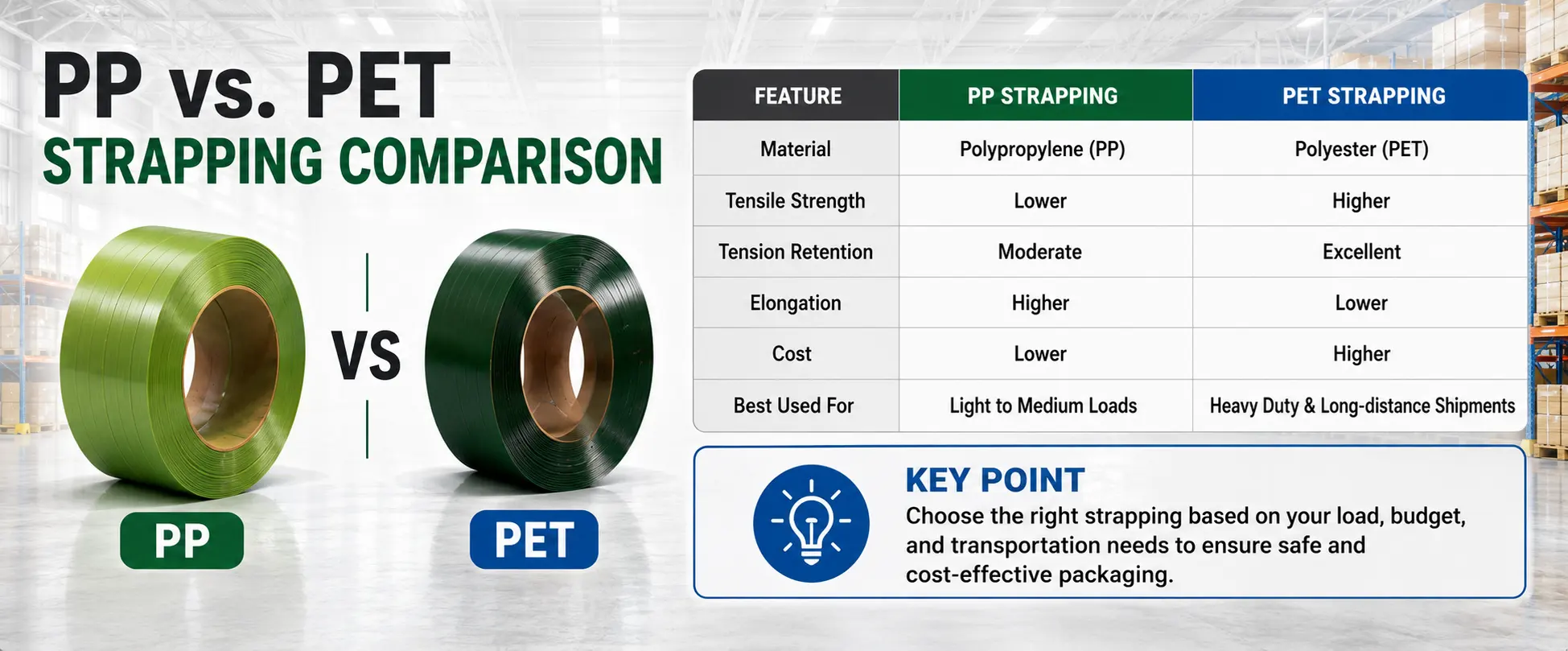
When distinguishing between these two materials, don't get hung up on which one has "better performance" overall; the priority is matching the material to the specific needs of your cargo.
| Comparison | PP Strapping | PET Strapping |
| Material | Polypropylene | Polyester |
| Typical application | Light/medium loads | Medium/heavy loads |
| Initial cost | Generally lower | Generally higher |
| Tensile strength | Lower | Higher |
| Tension retention | Moderate | Better |
| Flexibility | High | Good |
| Long-distance export | Suitable for stable lighter loads | Better for demanding heavy loads |
| Typical products | Cartons, bundles | Heavy pallets, industrial goods |
A common mistake in procurement is comparing only the strap width.For instance, two straps might both be 16mm wide, yet differ significantly in strength and performance. Factors such as material, thickness, manufacturing quality, and breaking strength must all be considered.
The same principle applies when comparing quotes from different suppliers.Don't simply ask, How much does a roll of strapping cost? Instead, ask: What specifications do I need to secure this pallet and ensure safe transport? This small shift in your procurement mindset can significantly improve the effectiveness of your export packaging.
4. Pallet weight is a reference point, but not the sole criterion for selection.
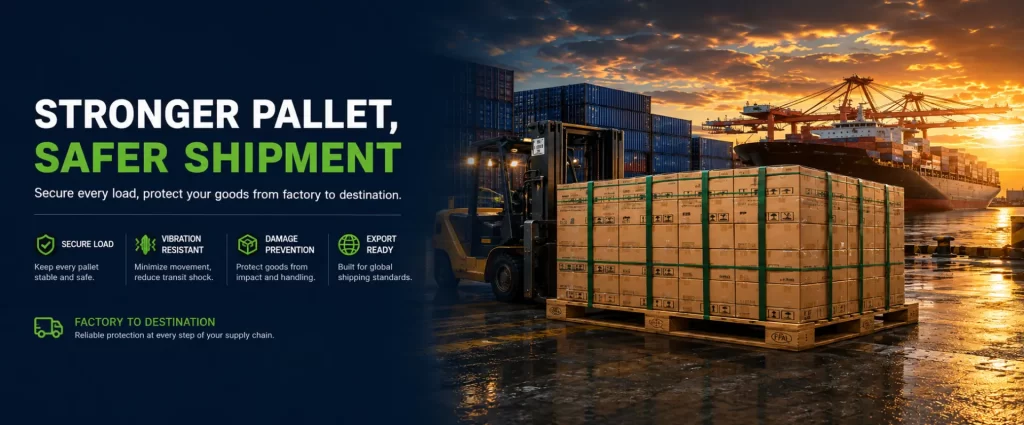
There is no universal industry standard dictating that PP strapping is used below a certain weight threshold and PET above it. While total pallet weight is certainly important, selecting the right strapping requires considering a range of other factors.
Consider two pallets weighing 500 kg: one loaded with neatly stacked cartons forms a relatively stable structure, whereas the other—loaded with irregularly shaped metal parts—exerts immense stress on the strapping.
Therefore, purchasers must evaluate multiple factors: the shape of the goods, product rigidity, the presence of sharp edges or corners, stacking height, transport distance, and the intended number of straps.
The overall packaging solution must not be overlooked.
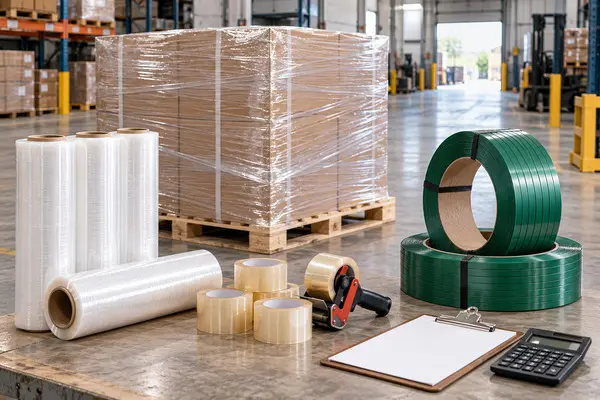
Strapping is just one component of the complete packaging system for export pallets. For carton-based goods, stretch wrap consolidates the load into a single unit, while strapping provides secondary reinforcement; edge protectors distribute the tension from the straps, preventing them from cutting into the corners of the cartons.
For heavy industrial goods, the structural integrity of the pallet itself must also be sufficient to support the total weight of the load.
Clearly, simply switching from PP to PET strapping—or merely opting for a thicker strap—cannot solve every pallet reinforcement challenge. A more scientific approach involves evaluating the entire packaging system: pallet + stacking method + stretch wrap + strapping + edge protectors + transport conditions.
For procurement professionals handling international freight, this holistic evaluation approach is far more practical than simply selecting a specific type of packaging material in isolation.
5. How should export purchasers choose between PP and PET strapping?
PP strapping is often a highly practical solution for lighter cartons, neatly and stably stacked pallet loads, and cost-sensitive applications. If the operating conditions do not require heavy-duty packaging performance, there is no need to incur unnecessary extra costs.
PET strapping is the more reliable choice for heavy pallet loads, industrial products, or transport scenarios that demand high, long-lasting strap tension. However, the final selection should not be based solely on the unit price per kilogram or per roll.
A more meaningful metric is the comprehensive total cost of securely strapping a single pallet. This cost encompasses material waste, the number of straps used, labor and equipment efficiency, overall pallet stability, and potential losses arising from cargo damage.
The strapping material must also be compatible with existing strapping equipment. Manual tools, electric strapping tools, and fully automatic strapping machines have different requirements regarding strap width, thickness, core size, and surface properties.
Before requesting a quote from a supplier, the purchaser can prepare and provide the following information:
• Pallet dimensions and approximate load weight
• Type of goods/products
• Specifications of the strapping currently in use
• Target breaking strength (if known)
• Quantity of straps required per pallet
• Operational method: manual strapping or machine strapping
• Mode of transport and destination country/region
With this information, suppliers can recommend specifications tailored to actual operating conditions, rather than simply offering generic, standardized products.
Selecting the Right Strapping to Build a Complete and Reliable Export Packaging System
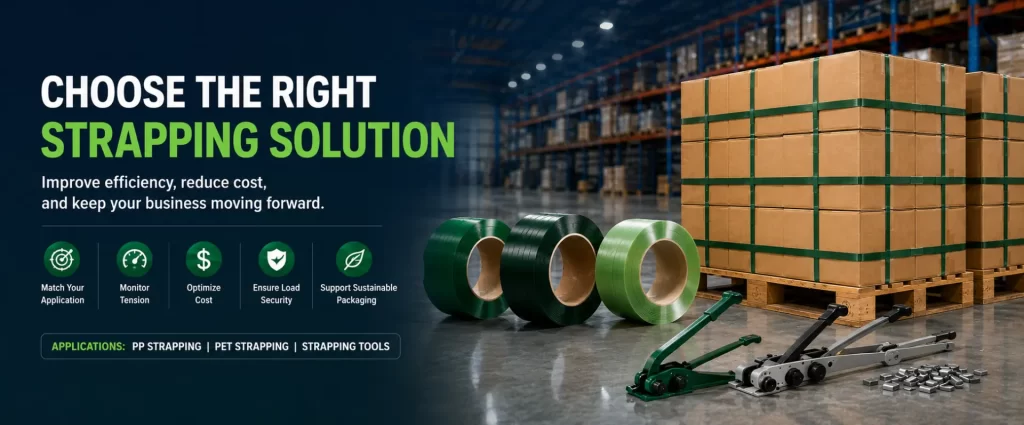
PP (polypropylene) and PET (polyester) strapping materials each have their own advantages; neither is inherently superior to the other in all cases.
PP strapping is highly suitable for cost-effective carton bundling and lightweight pallet packaging, whereas PET strapping—thanks to its higher strength and excellent tension retention—meets the packaging needs of heavy or high-standard cargo. Using PET strapping for all pallets results in unnecessary cost waste; conversely, using PP strapping for goods requiring high-strength securing introduces avoidable risks of transport damage.
For export procurement clients, the core principle is to match the most suitable packaging solution to the specific attributes of the goods.
A robust pallet packaging solution does not rely on a single high-strength material alone; rather, it utilizes a combination of packaging accessories to ensure the stability of the goods throughout the entire transport process, from the warehouse to the final destination.
Share on Social:


Contact Us
In This Article
Related Posts
What Packaging Materials Are Commonly Used in North American Warehouses?
Oct 23, 2026
PP Strapping for Cartons: Packaging Challenges in E-Commerce Logistics
Oct 21, 2026
Polypropylene Strapping Under Temperature Changes: Effects on Packaging Performance
Oct 21, 2026
PET Strapping Supplier: Heat-Seal Joint Strength and Sealing Reliability
Oct 21, 2026


