







45 Micron vs 50 Micron vs 55 Micron Packing Tape: Which Should You Choose?
By hqt
Sep, 2026Related Posts

Adhesive Packing Tape Testing Guide: Peel Adhesion, Tack, Holding Power and Tensile Strength
Sep 20, 2026

Polyester Strapping Supplier for Sustainable Recycled PET Packaging
Sep 20, 2026
How a Polypropylene Strap Supplier Develops PP Strap for High-Speed Packaging Machines
Sep 20, 2026

How a PP Strapping Factory Ensures Consistent Quality for Industrial Packaging
Sep 20, 2026
The primary difference between 45-micron, 50-micron, and 55-micron BOPP sealing tapes lies in their total thickness—a parameter that directly affects backing strength, tear resistance, material usage, and procurement costs.
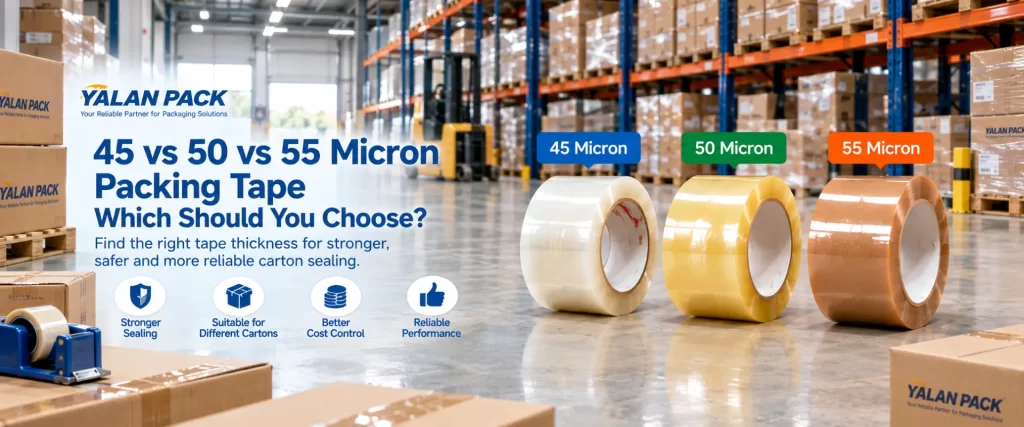
Generally speaking, 45-micron tape is suitable for standard sealing of ordinary cartons; 50-micron tape is appropriate for shipping scenarios with higher demands; and 55-micron tape is used for applications requiring superior mechanical strength.
However, greater thickness does not necessarily equate to stronger adhesion. A tape's ultimate performance is determined by a combination of factors, including the quality of the BOPP backing, the adhesive coating, the condition of the carton surface, and the actual operating environment.
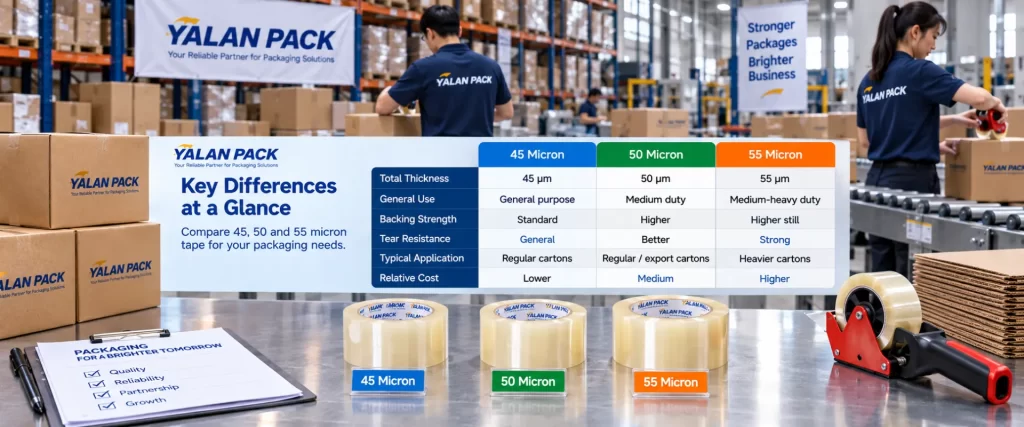
Quick Comparison: Buyers can refer to the table below as a preliminary guide for selecting between 45, 50, and 55-micron BOPP sealing tapes:
| Specification | 45 Micron | 50 Micron | 55 Micron |
| General Positioning | General purpose | Medium duty | Medium-heavy duty |
| Material Use | Lower | Medium | Higher |
| Backing Strength | Standard | Higher | Higher still |
| Tear Resistance | General | Better | More demanding use |
| Typical Cartons | Regular cartons | Regular/heavier cartons | Heavier/demanding cartons |
| Shipping Conditions | Normal | Regular export/shipping | More demanding handling |
| Relative Cost | Lower | Medium | Higher |
| Best For | Cost/performance balance | Added security | Stronger mechanical protection |
The above serves merely as a reference guide for selection and does not constitute a standardized load-bearing classification for cartons. Even if two tapes have the same total thickness, their actual performance may differ due to variations in backing structure and adhesive formulation.
When should you choose 45-micron sealing tape?
45-micron BOPP sealing tape is a practical, all-purpose choice for a wide range of standard carton sealing scenarios.
It is suitable for operations involving clean, flat corrugated carton surfaces and standard storage and transportation conditions.
Typical application scenarios:
・Routine factory packaging
・E-commerce carton sealing
・Warehouse carton sealing operations
・Lightweight to standard freight cartons
・Everyday manual packing
The core advantage of 45-micron tape lies in the balance between strength and material costs.
If 45-micron tape provides reliable sealing—without frequent tearing or adhesive failure and without the need for multiple layers—then blindly opting for thicker tape often yields performance gains that do not justify the increased material costs.
When should you choose 50-micron sealing tape?
If you require better mechanical strength than the standard 45-micron tape offers but do not need to jump straight to higher-specification, thicker products, 50-micron tape is an ideal compromise.
This tape is worth considering for cartons that undergo frequent handling, such as export goods moving through multiple stages of the supply chain.
Compared to 45-micron tape—assuming identical manufacturing processes—the increased thickness results in a more robust overall structure and superior resistance to external impacts.
For most buyers, 50-micron tape strikes a pragmatic balance:
Higher strength + Reasonable material costs + Transport security
It is the optimal choice when 45-micron tape is nearing its performance limits for the application, yet 55-micron tape would represent over-specification (excessive performance).
When should you use 55-micron sealing tape?
55-micron BOPP sealing tape is the right choice when cartons or transportation environments demand high mechanical performance.
Suitable scenarios include heavy-duty cartons, export packaging, long-distance logistics, and cartons requiring repeated loading and unloading.
The thicker backing material provides greater structural integrity, offering superior resistance to tearing and splitting. However, 55-micron tape should not automatically be the default choice for all export cartons.
For lighter goods, 45-micron or 50-micron tape provides sufficient sealing stability; opting for thicker tape merely drives up packaging costs unnecessarily.
The key question when selecting tape is not:
"Which tape offers the highest strength?"
But rather:
"Which specification ensures secure sealing throughout the supply chain while just meeting the minimum requirements?"
How much more material is consumed by 50-micron or 55-micron tape?
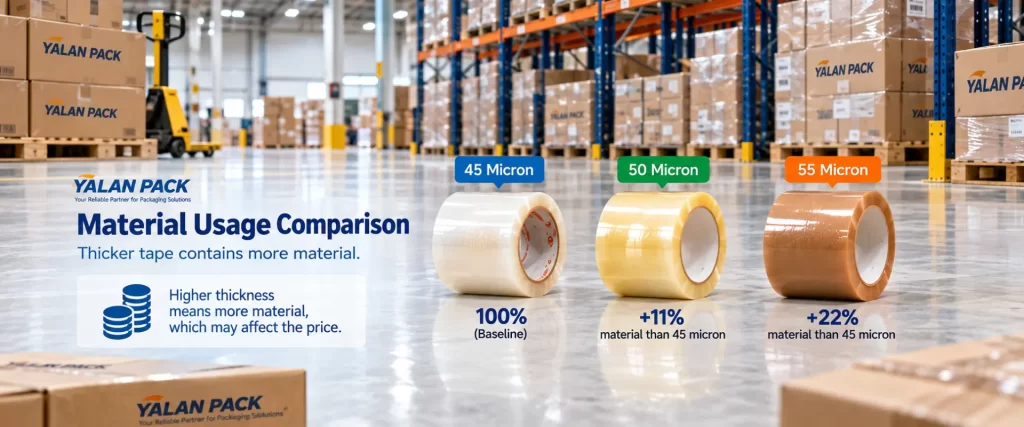
Given similar width, length, and material composition, a greater total thickness results in higher raw material usage per roll.
Using 45-micron tape as a baseline:
45 microns = 100%
50 microns ≈ 111% of the material used for 45-micron tape
55 microns ≈ 122% of the material used for 45-micron tape
To look at it another way:
・50-micron tape is approximately 11.1% thicker than 45-micron tape.
・55-micron tape is approximately 10% thicker than 50-micron tape.
・55-micron tape is approximately 22.2% thicker than 45-micron tape.
However, tape price and performance do not increase in direct proportion to these figures.
Factors such as adhesive formulation, BOPP film material, coating weight, manufacturing processes, and order volume all influence price and actual performance.
Nevertheless, these figures demonstrate that selecting tape significantly thicker than necessary directly increases material consumption.
Is 55-micron tape necessarily tougher than 45-micron tape?
If all other structural parameters remain identical, increasing thickness generally enhances mechanical strength.
In real-world procurement, however, it is rare for two tapes to be identical in all other respects. For example:
Tape A: 55-micron total thickness, standard adhesive
Tape B: 45-micron total thickness, high-performance adhesive optimized for carton surfaces
If the packaging issue involves the tape peeling off the carton surface, Tape B—despite being thinner—actually provides a superior seal.
This is because carton sealing relies on two distinct properties:
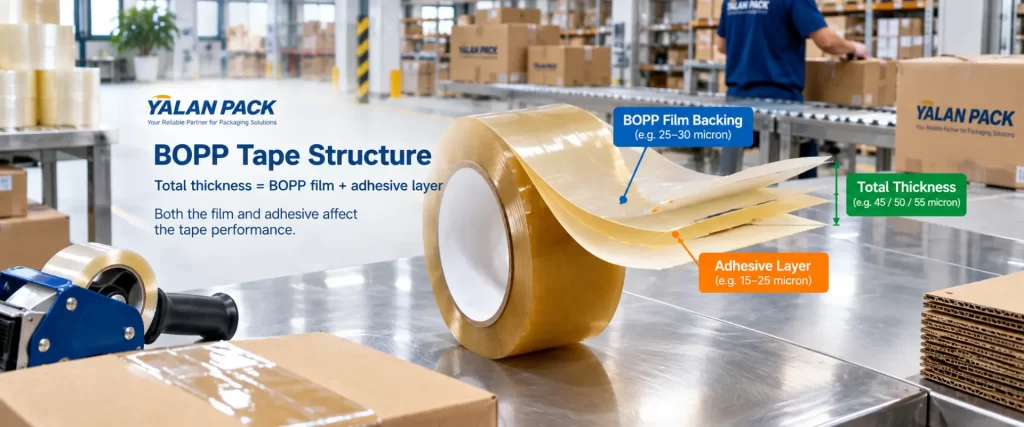
BOPP backing → provides mechanical tear resistance
Adhesive layer → ensures bonding to the carton surface
Total thickness reflects the tape's overall structure but does not fully represent its bonding capability.
Why do two BOPP tapes with the same 50-micron specification perform differently?
This point is particularly crucial when comparing quotes from different suppliers.
Consider a specification like this:
48 mm × 100 m × 50 microns
These parameters alone do not fully capture the tape's characteristics. Two tapes with the same total thickness of 50 microns may differ in the following aspects:
・BOPP film backing thickness
・Adhesive coating weight
・Adhesive formula
・Initial tack
・Peel strength
・Holding power (shear strength)
・Film thickness uniformity
・Unwind performance
For instance, the same total finished thickness can be achieved by adjusting the combination of the BOPP backing thickness and the adhesive coating weight.
Therefore, when comparing 45, 50, and 55-micron tapes, buyers must verify whether the specified thickness refers to the **total finished tape thickness** or merely the thickness of the BOPP backing film.
Which thickness is best suited for recycled cardboard boxes?
Simply increasing the tape thickness is not necessarily the optimal solution for recycled cardboard boxes.
Corrugated cardboard with high recycled content often has a rougher, more porous surface that is prone to dust accumulation. In such cases, adhesive compatibility and initial tack are far more important than simply increasing the backing thickness.
If a 45-micron tape frequently fails to adhere to recycled boxes, switching to a 55-micron tape won't solve the problem if the adhesive formula remains unsuitable.
Buyers need to comprehensively evaluate these factors:
Box surface characteristics + Adhesive type + Sealing pressure + Tape thickness
Conducting on-site tests using actual box samples is a highly effective approach in these scenarios.
Does the thickness difference between 45, 50, and 55 microns matter for automated sealing lines?
It matters significantly, though thickness is just one of many factors to consider.
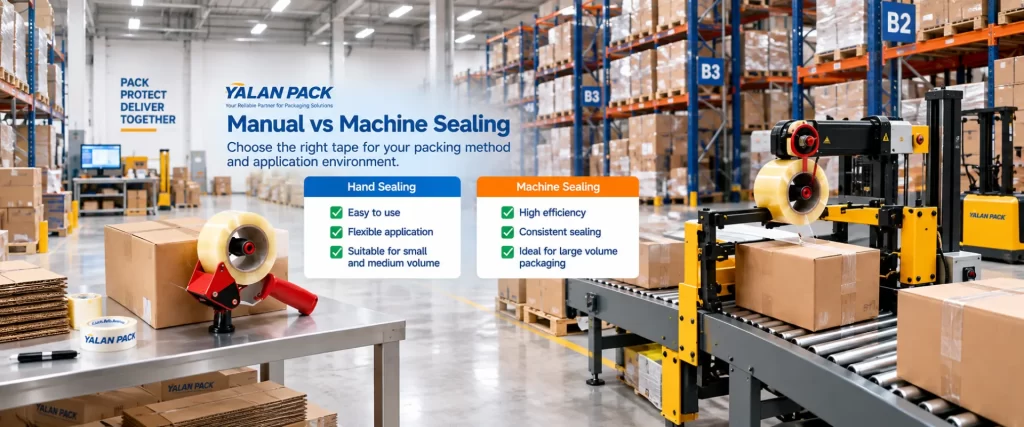
Automated sealing operations require consistent and stable tape performance. In addition to thickness, purchasers should also consider roll dimensions, unwind stability, film strength, adhesive coating quality, and equipment compatibility.
Opting for low-priced tape that frequently snaps or fails to seal boxes properly can directly cause production line downtime and increase labor costs.
Therefore, for large-scale packaging operations, one should not focus solely on:
The purchase price per roll.
Instead, it is more worthwhile to evaluate comprehensive metrics such as:
Tape purchase cost + tape consumption + packaging production efficiency + cost of resealing/rework + risk of carton damage.
Some tapes with a slightly higher unit price can actually result in lower overall packaging costs by reducing downtime and sealing failures.
45, 50, or 55 microns: How should purchasers choose?
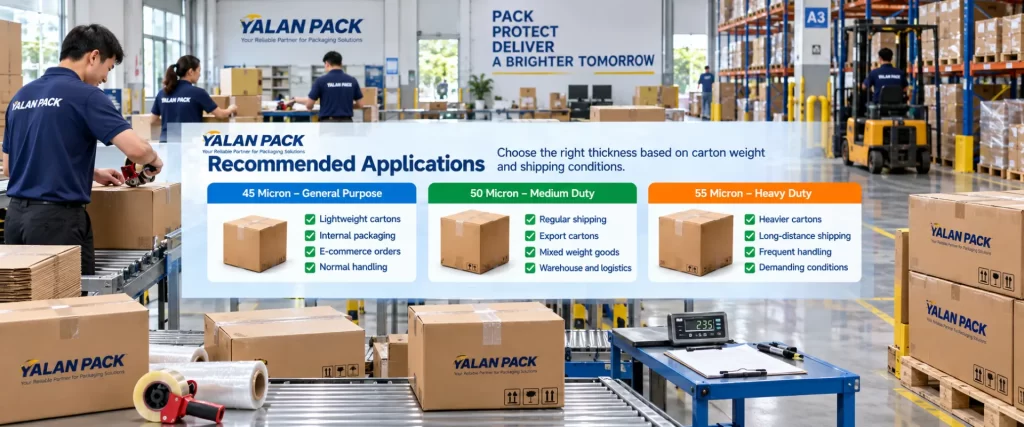
You can refer to this simple selection logic:
For standard cartons and typical shipping conditions where general-purpose tape provides a secure seal, prioritize the 45-micron option.
For scenarios requiring higher mechanical strength—such as general freight, export cartons, or frequent handling—choose the 50-micron option.
For heavy cartons or harsh shipping conditions requiring a backing material with superior tensile and tear resistance, choose the 55-micron option.
However, before relying on thicker tape to solve sealing issues, first identify the root cause of the failure:
If the tape snaps or tears, focus on film strength and thickness;
If the tape peels off the carton surface, focus on checking adhesive performance and the condition of the carton surface;
If the issue occurs only in high-temperature, low-temperature, or humid environments, focus on verifying the adhesive formula against the operating environment.
This troubleshooting approach is far more efficient than simply opting for the thickest tape available.
What factors should purchasers compare before placing an order?
When comparing price quotes for 45, 50, and 55-micron BOPP tapes, ensure that all specifications are comparable on an equal basis. A complete specification list should include:
Width × Length × Total finished thickness × BOPP backing material × Adhesive type × Paper core size × Rolls per carton
Example:
48mm × 100m × 50μm (total thickness)
Water-based acrylic adhesive
3-inch paper core
Clear/Transparent
36 rolls/carton
If conditions permit, the purchaser can provide the supplier with details such as carton material, approximate carton weight, sealing method, and shipping environment.
Recommendations based on this information are more reliable than those based solely on thickness (microns).
Summary: How to choose between 45, 50, and 55-micron sealing tape?
For most standard sealing scenarios, 45-micron tape strikes a good balance between performance and cost.
If higher mechanical strength is required, 50-micron tape is an ideal upgrade, suitable for general cargo transport and export packaging.
For heavy cartons or demanding handling conditions, 55-micron tape offers superior backing protection.
There is no single "universal" tape suitable for every scenario. Selecting high-quality BOPP sealing tape requires a comprehensive evaluation of:
Thickness, adhesive performance, carton surface characteristics, shipping conditions, and the total cost of sealing per carton.
Yalan Pack offers BOPP sealing tapes in a wide range of thicknesses, widths, and lengths, featuring various adhesive systems such as water-based acrylic and hot-melt adhesives. Our product lineup includes clear, colored, custom-printed (logo), low-noise, and high-clarity crystal tapes.
Here is a key principle for purchasers deciding between 45, 50, and 55-micron tapes:
Unless your specific cartons and application scenarios truly demand it, there is no need to pay extra for unnecessary thickness.


Contact Us
In This Article
Related Posts
Adhesive Packing Tape Testing Guide: Peel Adhesion, Tack, Holding Power and Tensile Strength
Sep 20, 2026
Polyester Strapping Supplier for Sustainable Recycled PET Packaging
Sep 20, 2026
How a Polypropylene Strap Supplier Develops PP Strap for High-Speed Packaging Machines
Sep 20, 2026
How a PP Strapping Factory Ensures Consistent Quality for Industrial Packaging
Sep 20, 2026


