







15 Micron vs 17 Micron vs 20 Micron Stretch Film: What Is the Difference?
By hqt
Sep, 2026Related Posts


Stretch film thickness comparison helps buyers understand the practical differences between 15-micron, 17-micron, and 20-micron stretch films for pallet wrapping. As film thickness increases, material usage, puncture resistance, and load-holding capability generally increase as well.
For lighter, uniform pallet loads, 15-micron film is often sufficient. A 17-micron stretch film provides a balanced option for many standard pallet wrapping applications, while 20-micron film is better suited to medium or heavier loads that require additional strength and puncture resistance. However, micron thickness should not be the only selection factor. Film formulation, tensile strength, load shape, sharp edges, pallet stability, and wrapping method can all significantly affect actual packaging performance.
Quick Comparison: 15 vs 17 vs 20 Micron Stretch Film
| Specification | 15 Micron | 17 Micron | 20 Micron |
| Thickness | 0.015 mm | 0.017 mm | 0.020 mm |
| Approx. Gauge | 59 gauge | 67 gauge | 79 gauge |
| Typical Load Type | Light, stable loads | General pallet loads | Medium/heavier loads |
| Puncture Demand | Lower | Medium | Higher |
| Material Use | Lowest of the three | Medium | Highest of the three |
| Typical Goal | Reduce unnecessary film use | Balance performance and cost | More protection for demanding loads |
| Good Starting Point For | Uniform cartons | Regular warehouse/export pallets | Heavier or less uniform pallets |
The gauge conversions above are approximate; mathematically, 1 micron is about 3.94 gauge.
What scenarios are suitable for 15-micron stretch film?
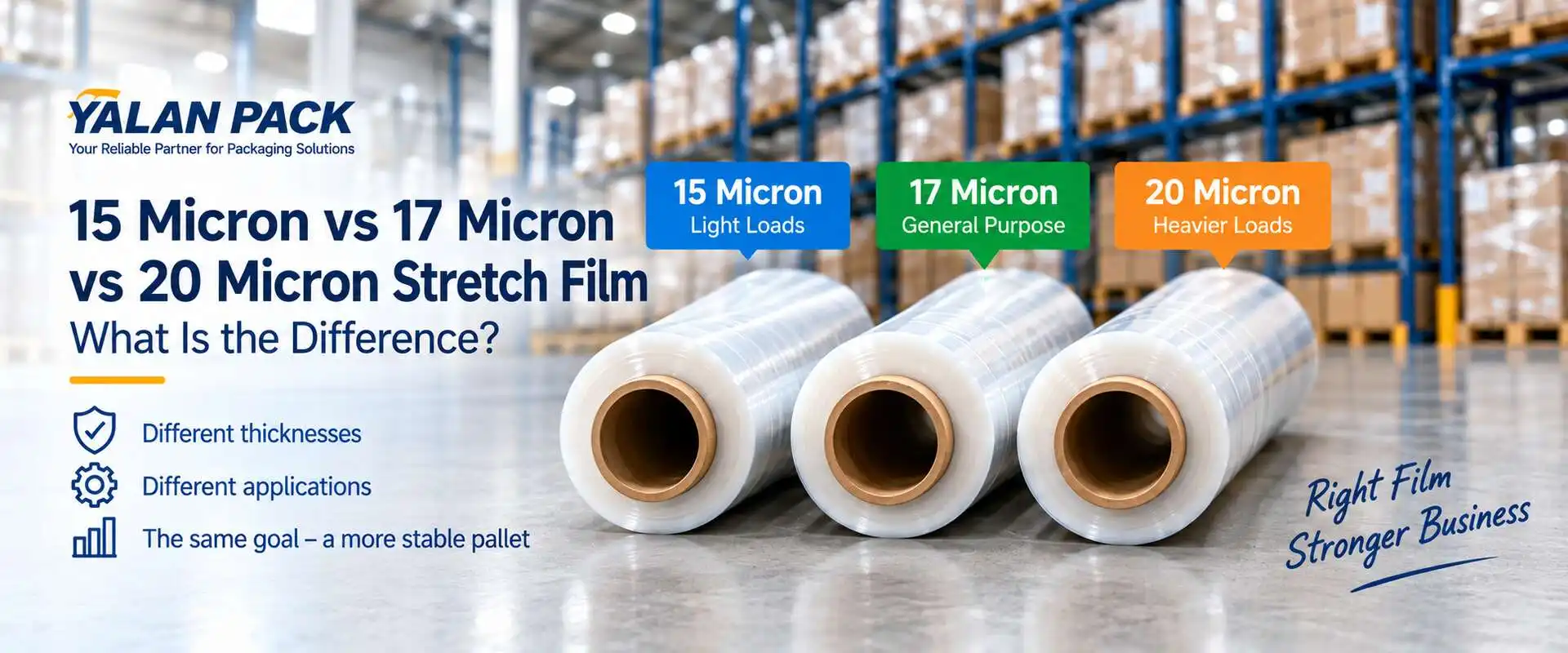
15-micron stretch film is primarily used for lightweight, stably stacked, and regularly shaped palletized goods. Typical applications include lightweight cartons, paper products, textiles, and other goods without sharp edges.
Compared to 17-micron and 20-micron stretch film, 15-micron film uses less material per square meter, reducing film consumption in situations where high-strength protection is not required.
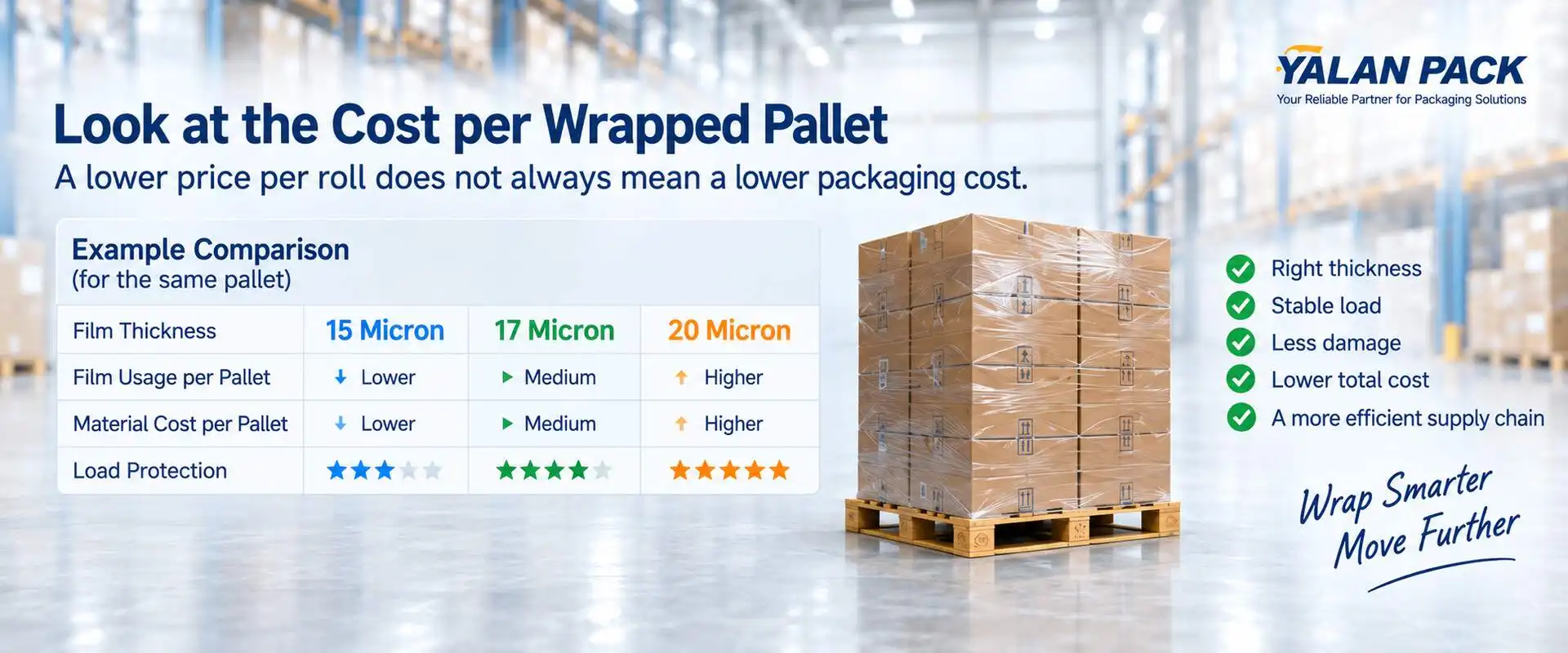
However, 15-micron stretch film should not be chosen simply because it is cheaper per roll. If operators need to wrap multiple layers to ensure pallet stability, or if the film frequently tears, the actual packaging cost per pallet will actually increase.
Therefore, 15-micron stretch film is more suitable for situations where the pallet structure itself is stable and effective wrapping can be achieved without excessive wrapping.
Why is 17-micron stretch film the mainstream and universal choice?
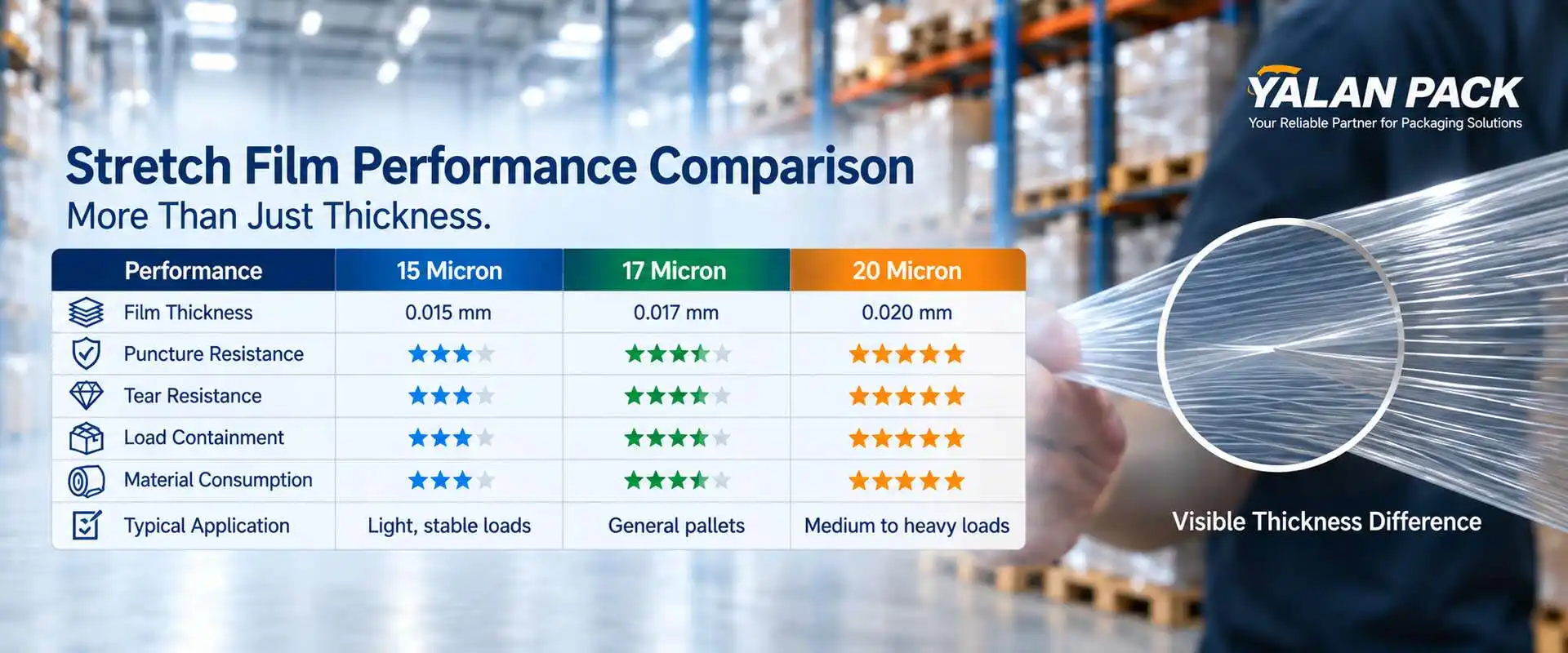
The thickness of 17-micron stretch film falls between the thinner 15-micron and the thicker 20-micron version, making it the preferred choice for most conventional pallet wrapping operations. Widely used for neatly stacked cartons and light to medium-sized general goods in warehouses. Industry standards generally recommend 15-17 micron film for standard and medium loads, but actual selection still needs to be adjusted based on film grade and cargo load.
If the purchaser wants to find a balance between consumable usage, puncture resistance, cargo stabilization, and per-pallet packaging cost, 17 micron stretch film is a suitable option.
Note: 17 microns only represents film thickness, not overall film quality. 500 mm × 17 micron stretch film from different suppliers will perform differently due to variations in raw material formulation, production stability, and mechanical properties.
When to choose 20 micron stretch film?
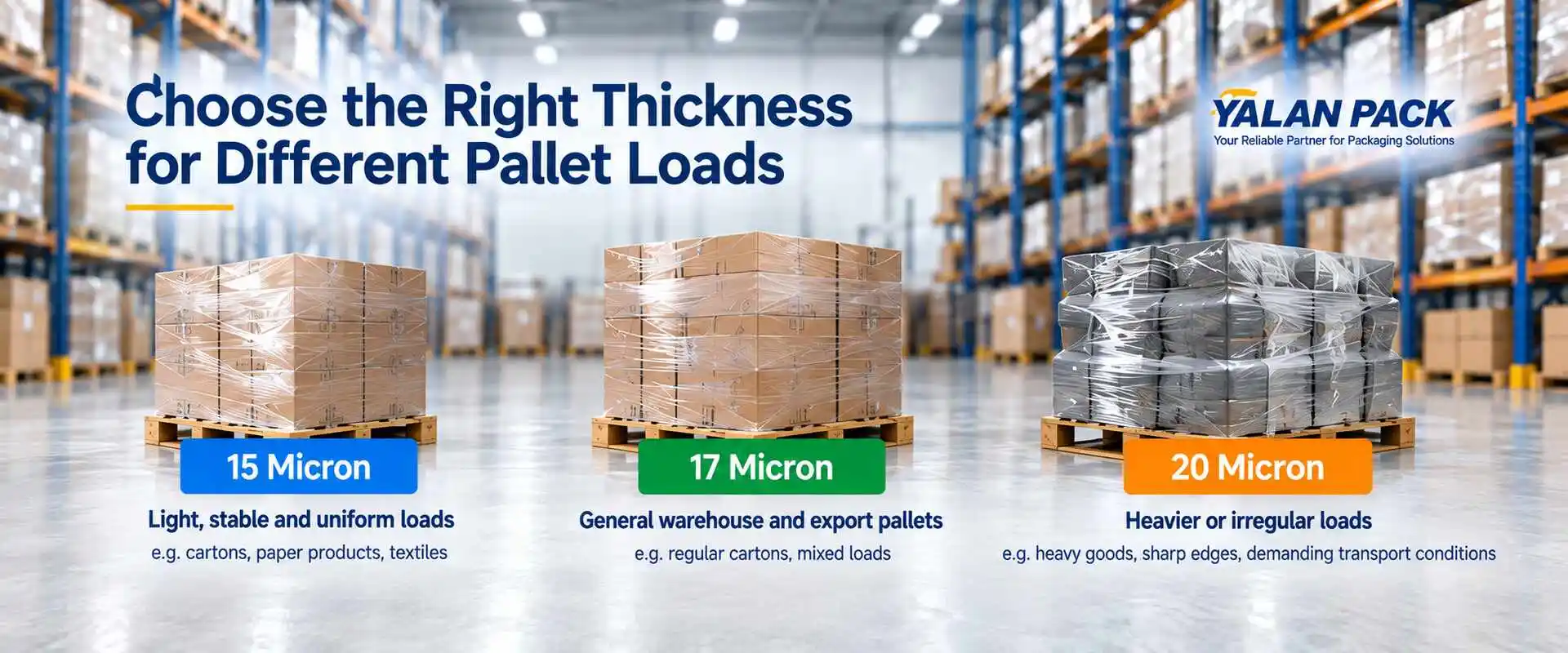
20 micron stretch film can be considered when the pallet load is heavy, the cargo has an irregular shape, or the cargo will exert significant pressure on the film.
For example, mixed cartons, heavy full-case cargo, pallets with long handling cycles, and pallets with complex and protruding edges. Greater thickness allows for more material at the wrapping points, improving puncture and tear resistance.
However, not all export pallets require 20-micron stretch film. If 15-micron or 17-micron film is sufficient to securely strap the pallet, switching to 20-micron will only increase material consumption without providing significant packaging benefits. The core principle in selection is to achieve adequate protection, not simply choosing the thickest film.
Is 20-micron stretch film always stronger than 17-micron?
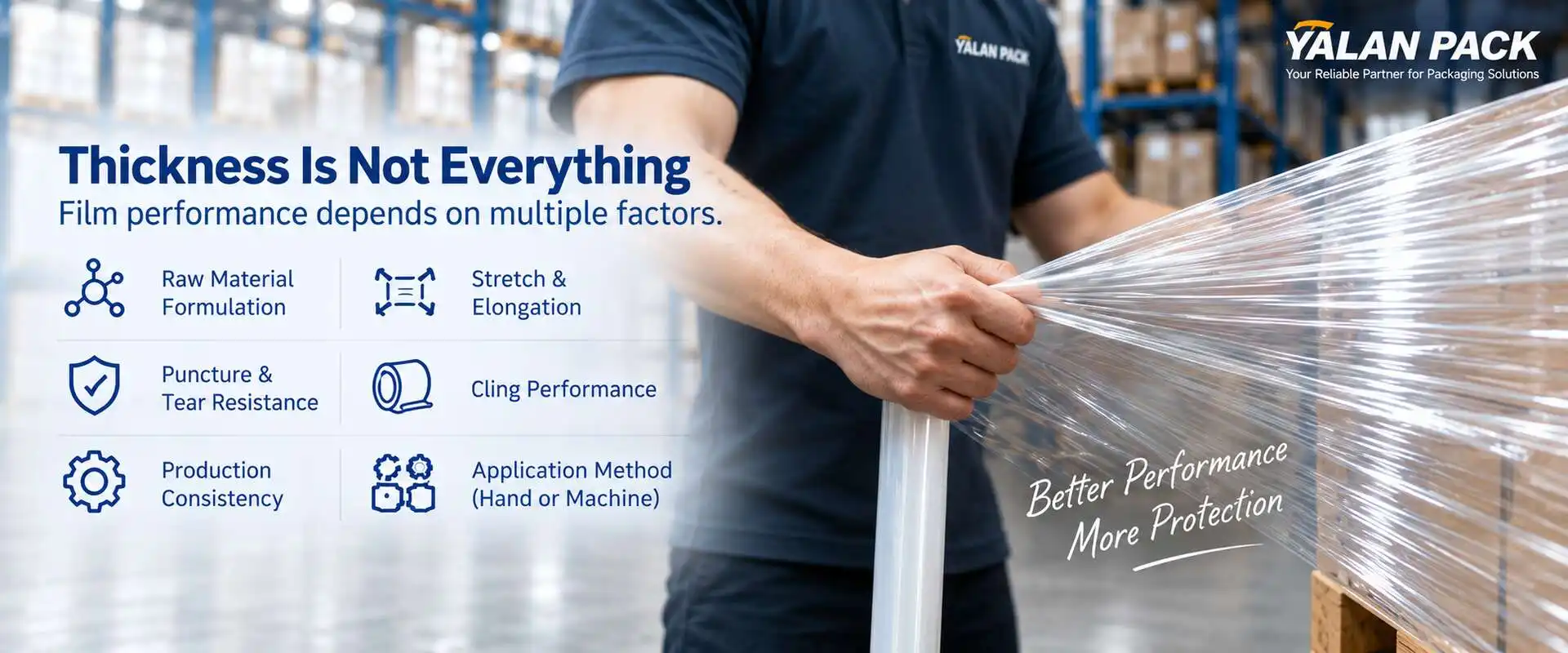
Assuming all other performance parameters are identical, 20-micron film uses more material and can typically handle more demanding packaging conditions. However, in real-world procurement, it's difficult to ensure all performance conditions are perfectly equivalent.
The actual performance of stretch film also depends on: resin formulation, film structure, puncture resistance, tear resistance, elongation, elastic recovery, self-adhesion, thickness uniformity, tensile strength, and on-site winding process.
Therefore, some high-performance 17-micron stretch films may outperform lower-end 20-micron films under certain conditions. Thickness should only be considered as one specification and not the sole criterion for judging film quality.
How much more material is needed for a 20-micron film?
If the width, length, and material density of the film are the same, the film weight is roughly proportional to its thickness.
This means that, theoretically:
A 17-micron thick film uses approximately 13.3% more material than a 15-micron thick film, while a 20-micron thick film uses approximately 17.6% more material than a 17-micron thick film and approximately 33.3% more material than a 15-micron thick film (for the same film area).
This is one reason why buyers shouldn't only compare prices per roll.
For large-volume pallet wrapping, a more appropriate metric is the actual cost of materials per pallet.
How much stretch film is needed to safely wrap a pallet?
A thinner, high-performance film can reduce resin consumption. However, if excessive extra wrapping or frequent tearing is required, the apparent savings may be negated.
Does pallet weight solely determine which micron stretch film to use?
Not at all. Pallet weight is helpful, but the shape of the goods is equally important, sometimes even more so.
Consider two pallets:
Pallet A: 500 kg of neatly stacked cartons with smooth surfaces.
Pallet B: 300 kg of irregularly shaped products with protruding or sharp edges.
While pallet B is lighter, it may place greater puncture stress on the stretch film.
This means that when choosing a stretch film between 15, 17, and 20 microns, the following factors should be considered:
Pallet weight → Goods shape → Sharp edges → Goods stability → Wrapping method → Shipping conditions.
This is more reliable than choosing a stretch film solely based on pallet weight.
Can hand-applied and machine-applied stretch film use the same micron number?
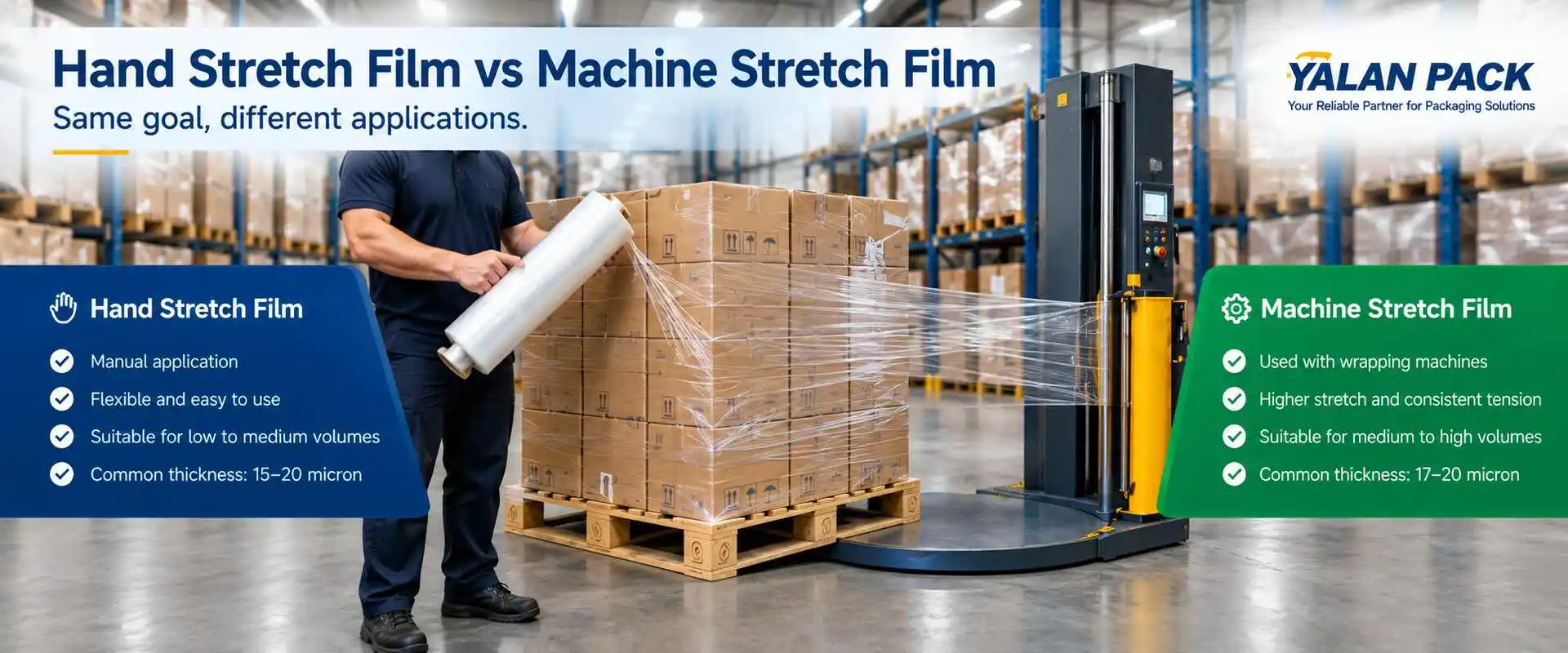
While they may sometimes have the same nominal thickness, hand-stretch film and machine-stretch film should not be chosen solely based on matching micron counts.
The performance of hand-stretch film depends heavily on the operator's pulling force and wrapping skill.
Machine-stretch film is suitable for wrapping equipment, allowing for more precise control over pre-stretch, film tension, and wrapping pattern.
Therefore, when requesting a quote, the buyer should clearly specify: hand or machine use, film width, micron count, roll length/net weight, core specifications, and pallet application.
This provides the supplier with more useful information than simply asking "17-micron stretch film."
Which should you choose: 15 micron, 17 micron, or 20 micron?
A practical guideline is: If the goods are lightweight, regularly shaped, and stable, and your primary goal is to minimize unnecessary material usage, choose 15 micron.
For many common pallet wrapping applications, if you want a balance between film consumption and protection, choose 17 micron.
If the pallet is heavy, irregularly shaped, or requires higher puncture resistance and handling stress resistance, choose 20 micron.
However, these are only selection reference standards, not universal load standards.
Optimal specifications should ensure pallet stability during handling and transportation, while using an appropriate amount of film.
For regular or large-volume orders, testing each candidate film on representative pallets is generally more effective than selecting based solely on micron count.
Besides micron count, what other factors should buyers compare?
Before placing an order, compare the following parameters:
Film thickness – 15, 17, 20 microns or other specifications
Film width – e.g., 500 mm
Roll length – Actual length per roll (meters)
Film net weight – Excluding core
Core size and weight
Tensive properties
Punch resistance and tear resistance
Manual or machine handling
Pallet type and approximate load
Film usage per pallet
Alan Packaging supplies hand stretch film, machine stretch film, pre-stretch film, colored stretch film, and custom LLDPE stretch film in various thicknesses, widths, roll weights, and core specifications.
For buyers comparing 15, 17, and 20 micron films, the most effective approach is not to simply ask, Which film is thicker?, but rather: Which size of film can securely wrap my pallet with the lowest actual film usage and total packaging cost?
This is a more meaningful comparison.
Share on Social:


