







Key Packaging Material Trends for Export Manufacturers in 2026
By hqt
Aug, 2026Related Posts


For export-oriented manufacturers, procuring packaging materials used to be a relatively straightforward task: select the right specifications, compare prices, and ensure the safe delivery of goods.
As we enter 2026, this procurement decision-making process is becoming increasingly complex.
On one hand, manufacturers face pressure to reduce packaging waste and material consumption; on the other, customers still demand robust product protection during long-distance transport, secure carton sealing, and stable pallet stacking. Meanwhile, regulations in major markets are imposing stricter requirements regarding recyclability, the proportion of recycled content, and structural design.
This means the core of the decision-making process is no longer simply about which packaging material costs less.
The critical consideration should be: what kind of packaging system can ensure reliable product protection throughout the supply chain while simultaneously optimizing material usage?
Below, we outline several key packaging material trends that export manufacturers should focus on in 2026.
1. Packaging is moving toward lightweighting, yet performance remains the top priority.
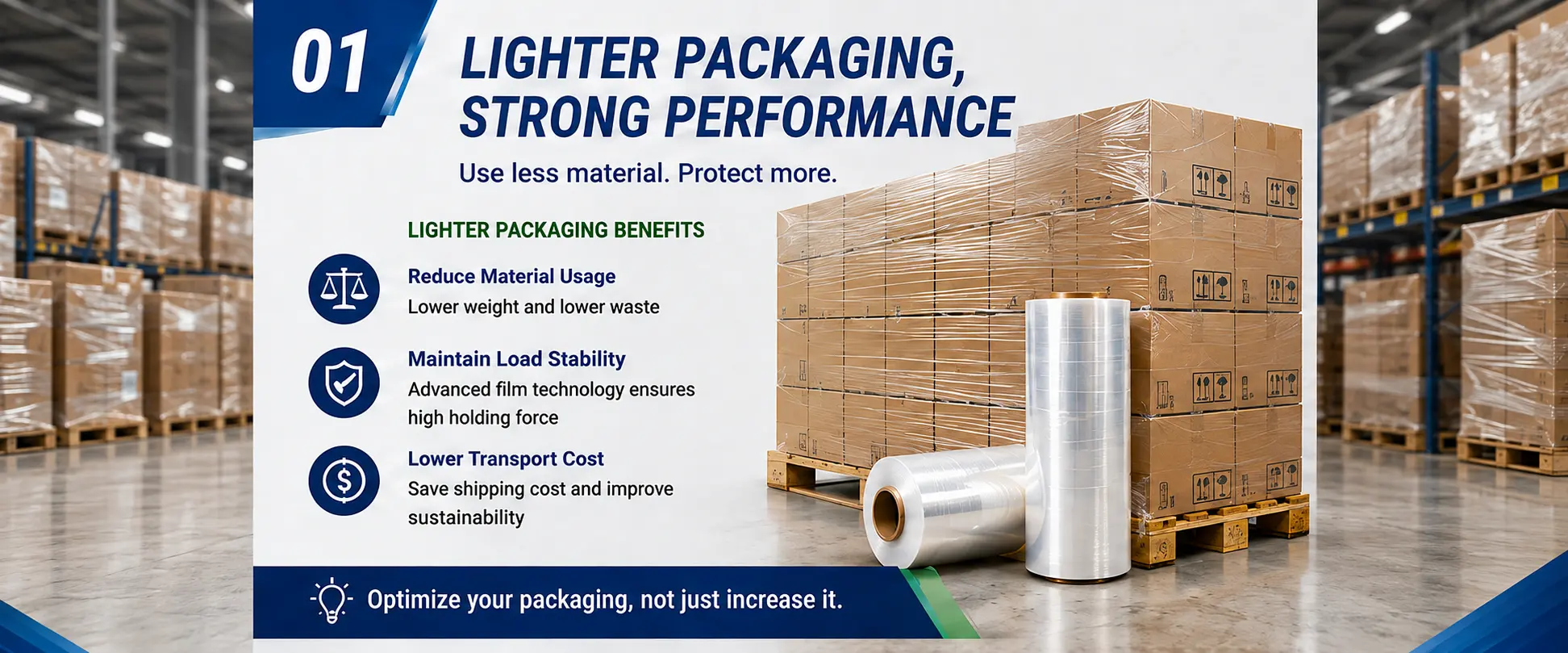
Reducing material consumption is one of the most significant trends in industrial packaging.
Take stretch wrap, for example: manufacturers increasingly seek to use thinner films that achieve the same load-securing performance as traditional, thicker films. This concept applies equally to cartons, adhesive tapes, and other secondary packaging consumables.
However, lightweighting does not simply mean choosing thinner materials.
Using stretch wrap again as an example, a film's actual performance is determined by a combination of factors: its formulation, puncture resistance, stretchability, holding force, and the wrapping method employed. A specific film might be suitable for one type of palletized load but ill-suited for loads with sharp edges or irregular shapes.
Therefore, the true goal is material optimization, not merely a reduction in the quantity of material used.
This trend aligns with regulatory changes. The EU’s Packaging and Packaging Waste Regulation (PPWR) is set to come into full effect on August 12, 2026; it mandates that packaging minimize its weight and volume while still fulfilling its essential functions.
2. Recyclability Becomes a Key Consideration in Packaging Design
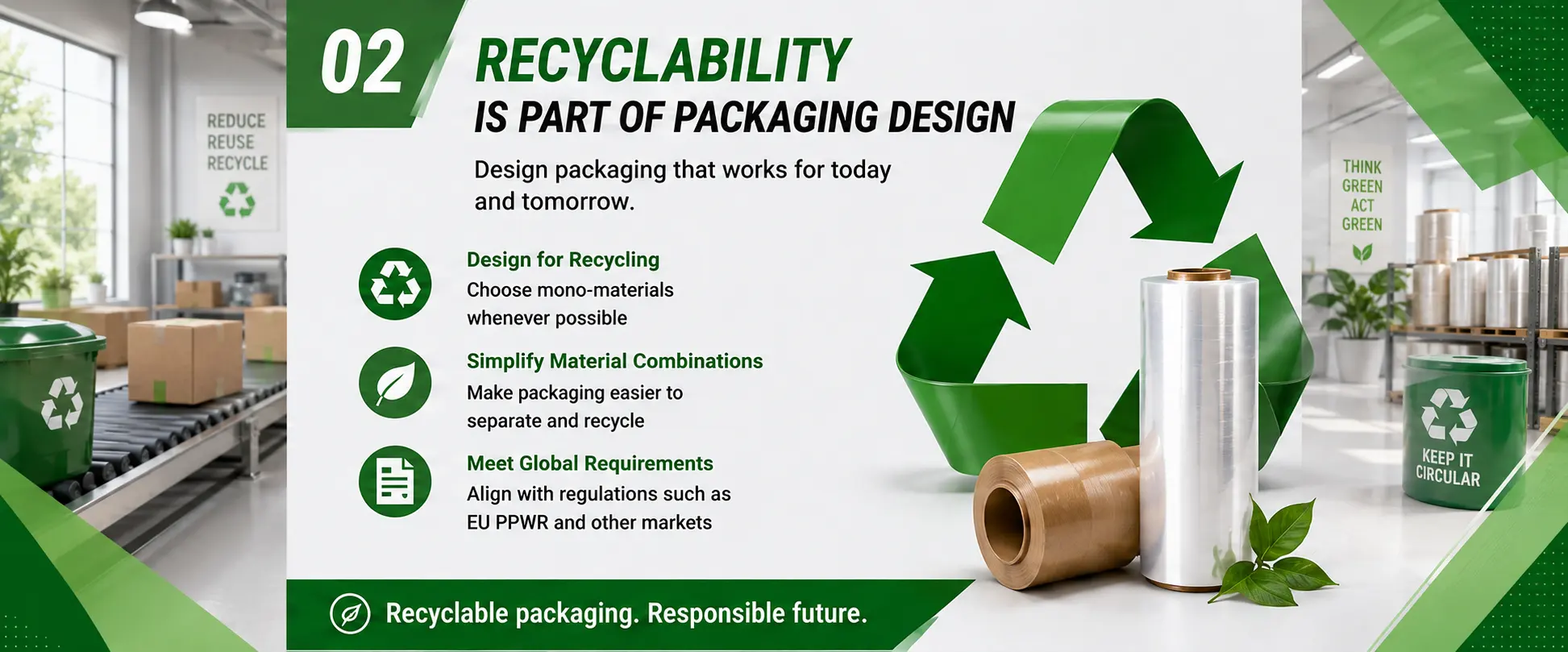
Export-oriented manufacturers must place increasing importance on how packaging waste is handled after goods arrive in the destination country.
This is particularly critical for companies exporting to markets where regulations regarding packaging waste are still evolving.
For instance, the EU’s PPWR (Packaging and Packaging Waste Regulation) mandates that packaging placed on the market must be recyclable, with corresponding performance criteria to be implemented in phases starting in 2030.
For purchasers of industrial packaging, this necessitates a more prudent evaluation of material combinations. Excessively complex composite material structures complicate the processes of disassembly and recycling. Wherever technically feasible, simplifying the packaging structure can effectively reduce the challenges associated with downstream waste disposal.
When sourcing products such as stretch wrap, PP/PET strapping, and carton sealing tape, and while confirming specifications with suppliers, purchasers should—in addition to dimensions and mechanical properties—prioritize verifying material composition, recyclability, available recycled content ratios, and compliance documentation. These factors are increasingly becoming standard items of inquiry in international packaging procurement.
3. Recycled content shifts from an option to a core procurement metric
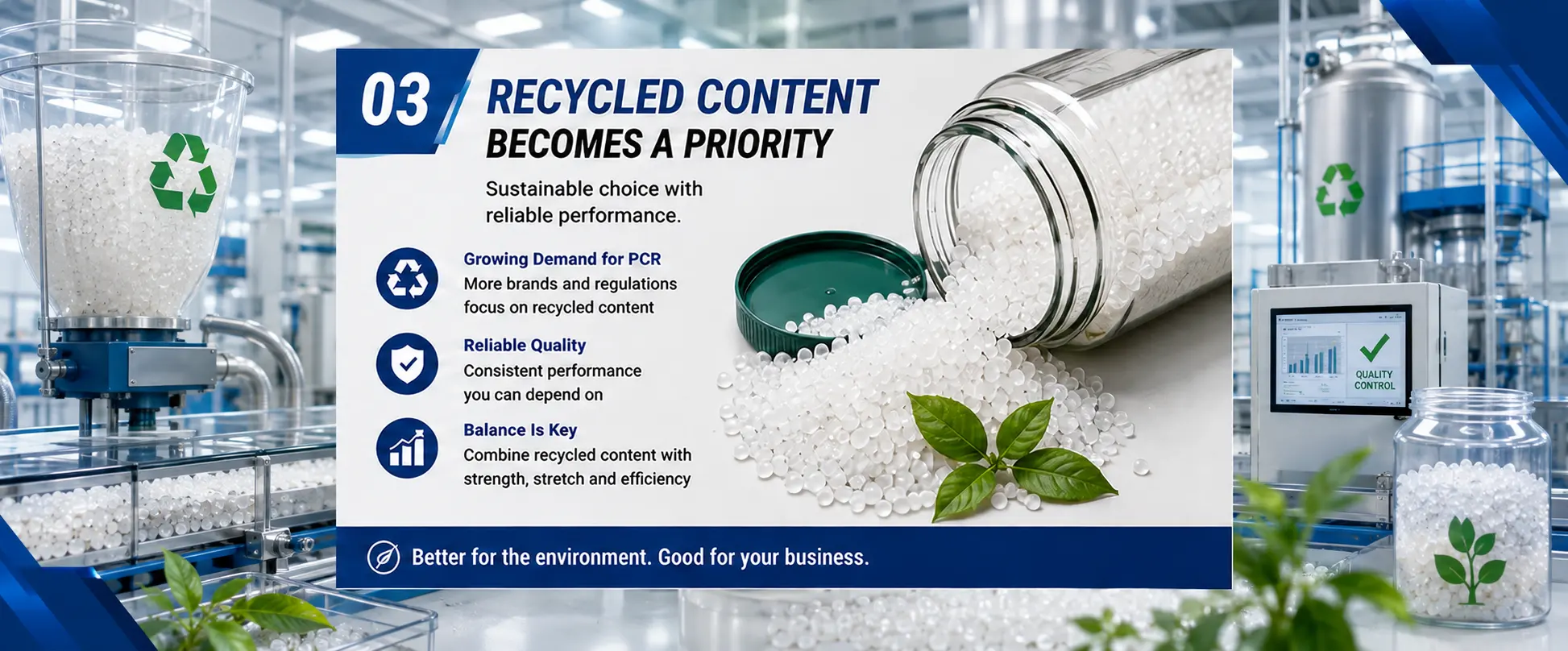
Another significant trend is the steadily rising market demand for packaging materials containing recycled content. The EU’s Packaging and Packaging Waste Regulation (PPWR) mandates that, starting in 2030, certain plastic packaging must meet minimum post-consumer recycled (PCR) content requirements; for standard plastic packaging not on the exemption list, the requirement is set at 35% (subject to final regulatory details and exemption clauses).
While these regulations do not require export-oriented enterprises to switch entirely to products made from recycled materials by 2026, they clearly signal the future direction of the market.
When sourcing stretch film and other plastic packaging, one cannot simply ask: Does this product contain recycled material?
Actual product performance cannot be compromised. When selecting packaging materials with PCR content, it is essential to evaluate performance stability, stretchability, puncture resistance, and load stability based on actual usage scenarios. An ideal solution balances recycled content, material efficiency, and actual transport protection performance.
4. Procurement perspective: Moving beyond the unit price per roll
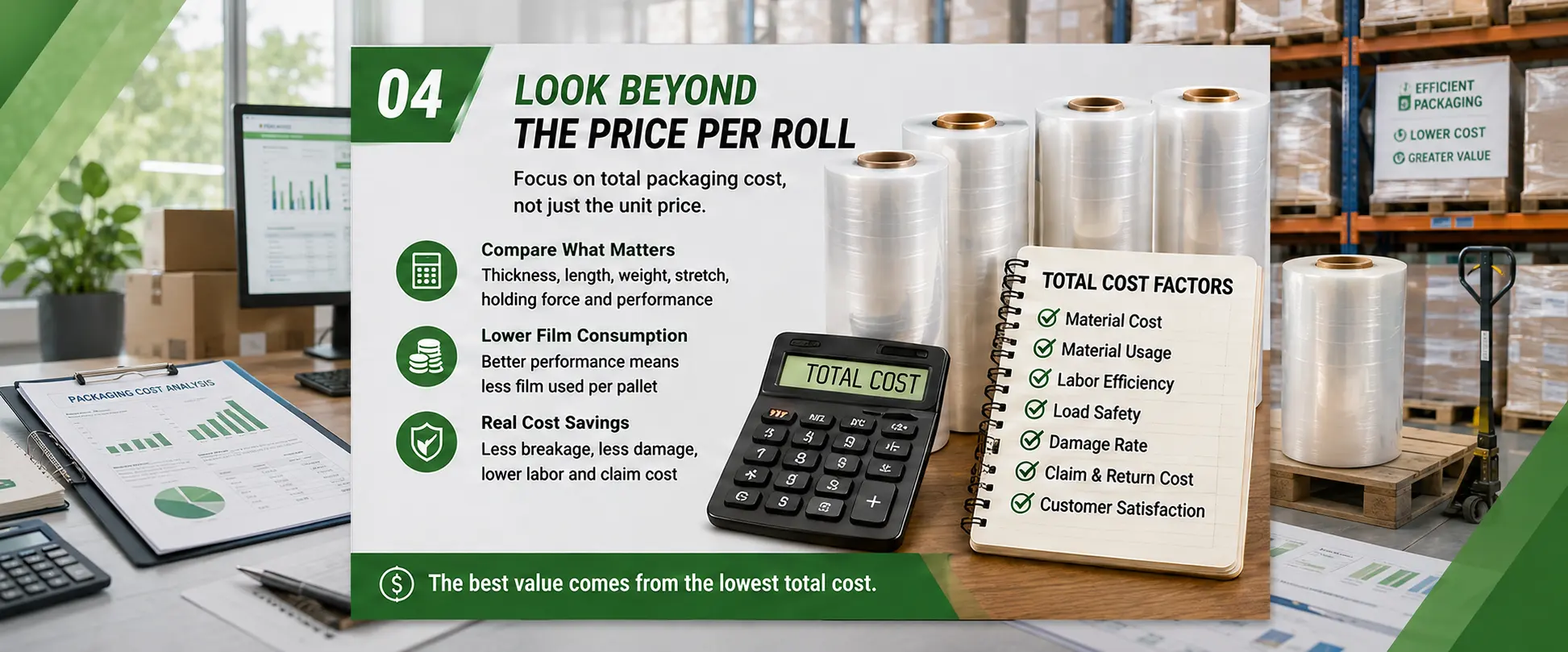
The focus of packaging procurement is shifting from the unit price of individual items to the total comprehensive packaging cost.
Take stretch wrap as an example: if there is a price difference between two products, comparing prices in isolation is meaningless without considering the following key parameters:
·Net film weight
·Film thickness
·Actual film length
·Stretch performance
·Film consumption per pallet
·Total number of pallets wrapped per roll
The same logic applies to strapping and carton sealing tape. A tape might appear inexpensive at first glance, but if it requires more wraps, breaks frequently during use, or fails to keep cartons sealed (causing them to spring open), it will ultimately drive up total packaging costs.
Selection between PP (polypropylene) and PET (polyester) strapping also requires consideration of specific operating conditions. PP strapping is cost-effective and suitable for light-to-medium loads, whereas PET strapping offers higher strength and superior tension retention, making it ideal for heavy palletized loads.
In summary, the packaging material with the lowest unit price does not necessarily equate to the packaging solution with the best overall cost-efficiency.
5. Packaging materials must be compatible with automated equipment
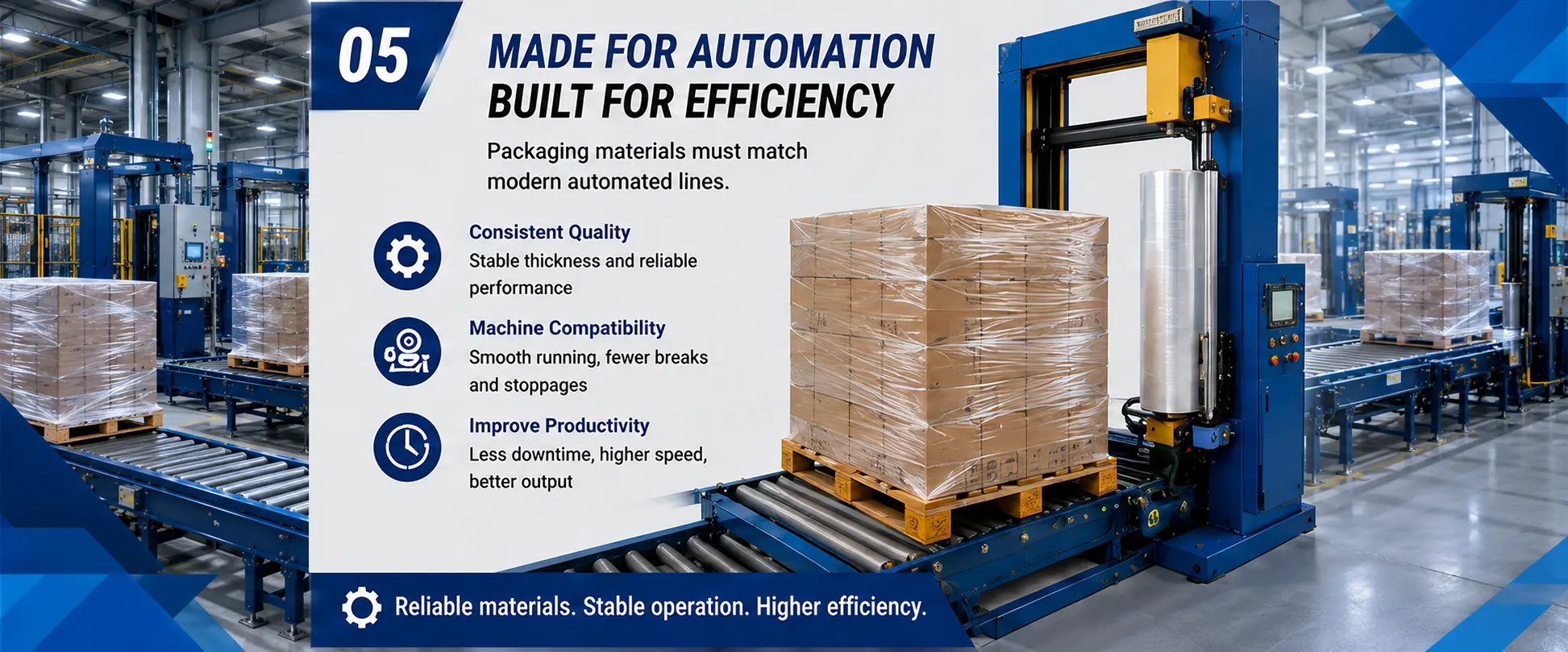
As labor costs rise and warehousing operations demand greater standardization and consistency, the compatibility of packaging materials with automated and semi-automated equipment has become increasingly critical. This applies to a full range of products, including machine-grade stretch wrap, carton sealing tape, and PP/PET strapping.
For machine-grade stretch wrap, consistency in film thickness, roll quality, and stretch performance is vital; fluctuations in material properties can lead to film breakage, directly causing production line downtime.
Equipment operation for automatic carton sealing and strapping is also influenced by factors such as roll dimensions, core specifications, winding techniques, and material stability.
Therefore, when sourcing materials for automated production lines, one must evaluate material-equipment compatibility and process stability in addition to verifying physical specifications. Materials with stable performance often deliver greater overall value than cheaper alternatives that frequently cause downtime due to malfunctions.
6. Export packaging is increasingly evaluated using a systems-based approach
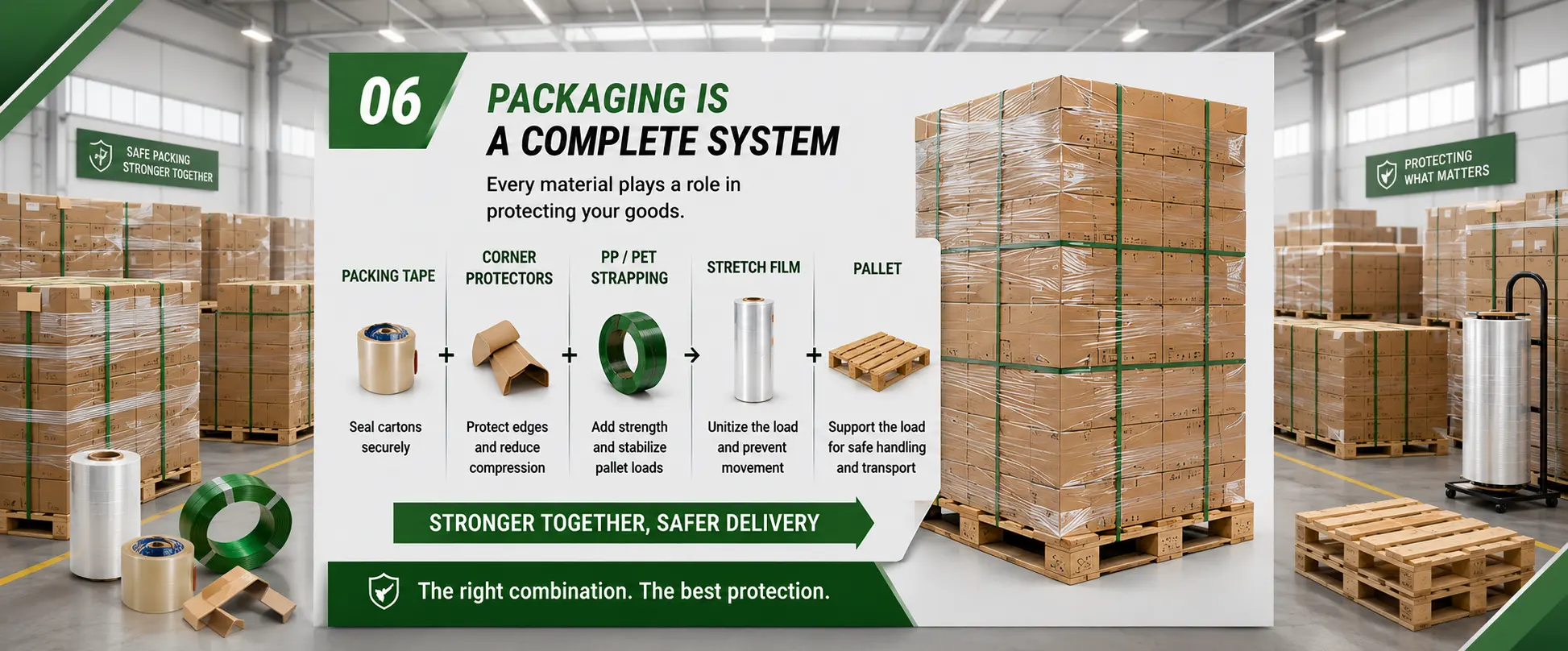
A trend with significant practical relevance is that companies are moving away from viewing various packaging consumables in isolation; instead, they evaluate the entire packaging setup as an integrated system.
A typical export pallet packaging assembly consists of: cartons, sealing tape, edge protectors, PP/PET strapping, stretch wrap, and the pallet itself.
Each component serves a specific function: sealing tape closes the carton; strapping provides structural binding and restraint; edge protectors distribute pressure and safeguard vulnerable corners; and stretch wrap unitizes the load, minimizing shifting during transit.
Changing any single material can alter the performance of the others. For instance, optimizing the stretch wrap strategy to enhance pallet stability can reduce unnecessary material consumption; similarly, selecting the correct PET strapping specifications can improve the stability of heavy-load pallets without simply increasing the number of straps used.
Additional Information: In February 2026, the European Commission ruled that certain pallet stretch wraps and strapping bands would be exempt from the strict 100% reusability requirements mandated by the PPWR (Packaging and Packaging Waste Regulation). Official assessments indicate that mandating reusable packaging solutions in these specific scenarios would entail prohibitively high costs for system retrofitting and adaptation. However, general regulatory requirements regarding recyclability and recycled content remain in effect.
This offers a crucial insight: sustainable packaging is not merely about swapping one material for another; it requires a balanced consideration of protective performance, material consumption, logistics conditions, and recyclability.
Key Priorities for Export Manufacturers' Packaging in 2026
For packaging procurement managers, the core focus in 2026 will not be on chasing novel packaging materials, but rather on optimizing the selection and application of existing ones.
Before adjusting specifications for stretch wrap, sealing tape, or strapping, companies must thoroughly evaluate actual operational conditions—including cargo weight, pallet dimensions, carton surface characteristics, transport distances, wrapping equipment types, required tension, and regulatory requirements in target markets.
This is likely to be one of the most significant trends in export packaging for 2026: reducing material consumption where conditions permit, while selecting high-strength materials when operational needs dictate; and evaluating packaging quality based on actual protective performance rather than simply the volume of material used.


