








Related Posts
How to Select Pallet Packaging Materials for Humid Seaport Shipping
Sep 01, 2026
Pre-stretched Film: Cost-saving Tips for High-volume Warehouse Users
Aug 31, 2026
How Storage Environment Influences the Service Life of BOPP Packaging Tape
Aug 28, 2026

What Packaging Materials Does the Global E-commerce Logistics Market Need?
Aug 27, 2026
The environmental conditions encountered by export pallets differ significantly from the storage environments found in standard warehouses.
During ocean transit, cargo passes through humid ports, container yards, and tropical climate zones, all while enduring drastic temperature fluctuations. Even if the goods are not directly exposed to rain or seawater, ambient moisture and condensation can still damage cartons, pallet structures, and various packaging materials.
Therefore, export companies shipping from humid ports should not simply prioritize the strongest stretch film or the thickest tape when selecting packaging materials.
The entire packaging system must ensure the stability of the cargo throughout the journey—from the factory floor to the warehouse in the destination country.
Understand Where the Moisture Risk Comes From
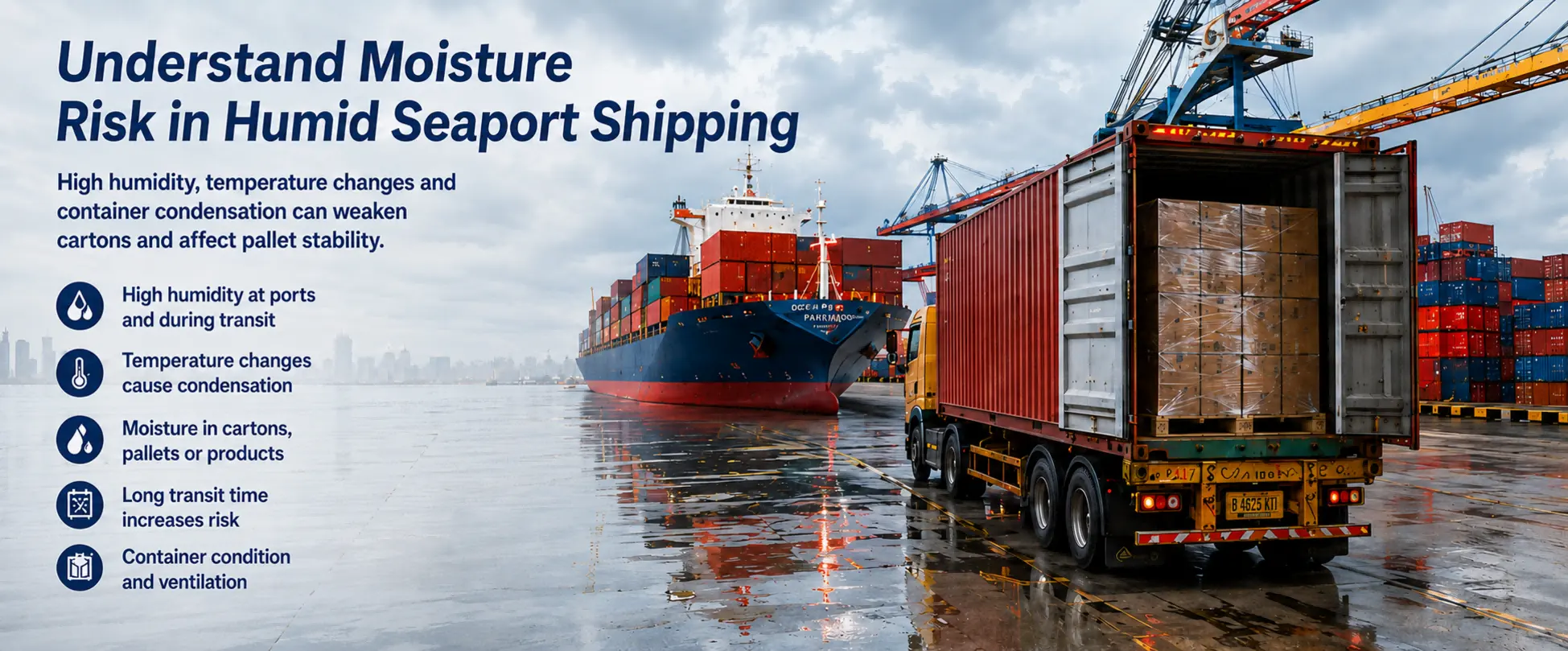
High humidity is just one aspect of the risk.
During ocean transport, containers experience diurnal temperature differences, and traversing different climate zones leads to significant temperature shifts. When surface temperatures drop, humid, warm air condenses into water; in the logistics industry, this is known as container condensation or container rain.
Moisture can also enter the supply chain before the container is even sealed. Cartons, wooden pallets, and other materials loaded in humid environments inherently carry moisture.
Export companies need to comprehensively consider the following factors: the climatic conditions at the ports of origin and destination; estimated total transit time; the moisture content of cartons and pallets; the condition of the container itself; temperature fluctuations throughout the journey; and the product's own sensitivity to moisture.
While packaging cannot completely eliminate all risks associated with moisture, selecting the right materials can mitigate moisture-related issues—such as the loss of carton compressive strength or the loosening and shifting of palletized loads.
Use Stretch Film to Maintain Pallet Stability
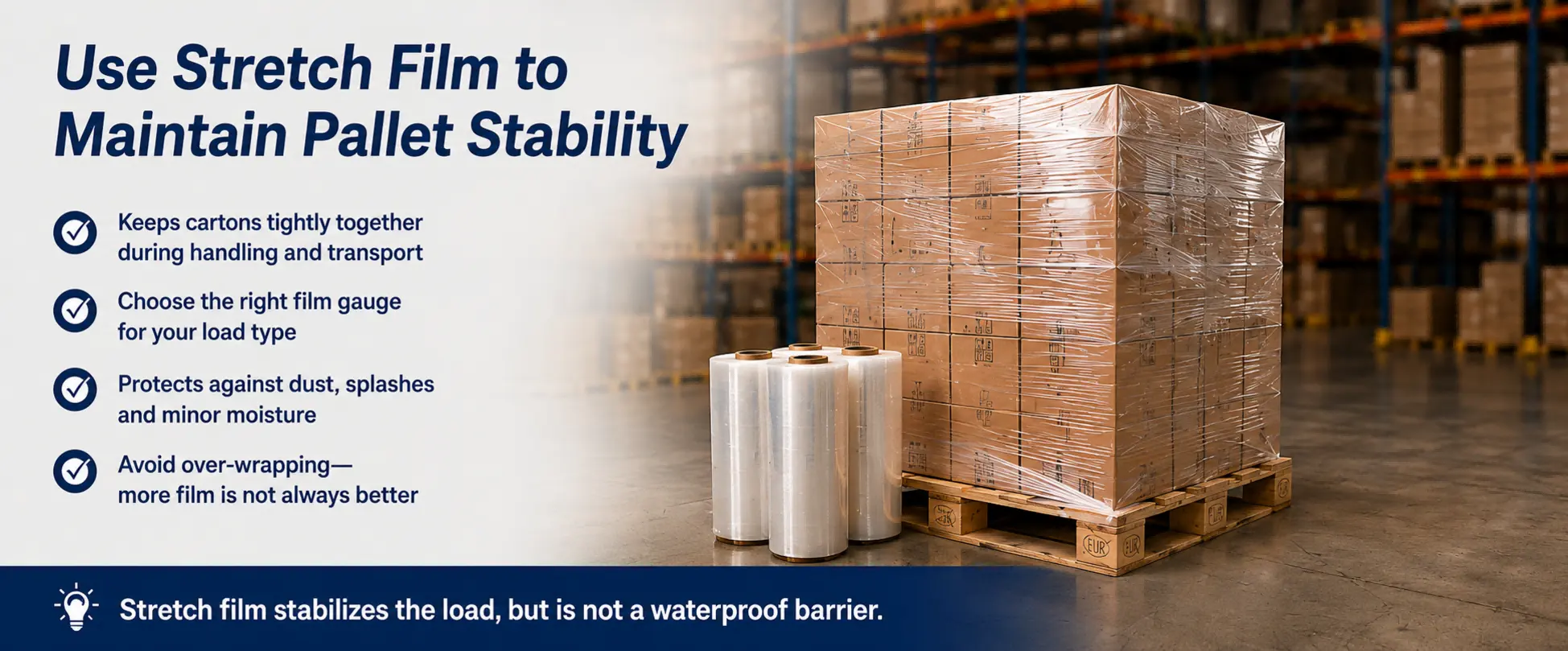
Stretch film is one of the most commonly used packaging materials for unitizing export pallet loads.
Even in high-humidity maritime environments, its primary function remains securing and stabilizing the cargo. Once corrugated cardboard boxes absorb moisture, their stacking load-bearing capacity decreases; properly applied stretch film binds the boxes into a cohesive unit, resisting displacement caused by forklift operations or the jolts and vibrations of transport.
The choice of stretch film should align with the specific characteristics of the cargo; film thickness alone should not be the sole criterion for selection.
For regularly shaped carton loads, standard LLDPE (linear low-density polyethylene) hand-wrap film is sufficient for basic bundling and securing needs. For high-volume assembly line operations, machine-grade stretch film is preferable, as it offers more uniform tension and allows for better control over film consumption.
If the cargo is heavy, irregularly shaped, or has sharp edges, priority should be given to the film's puncture resistance and holding force.
More film does not necessarily yield better results. Excessive wrapping merely increases material costs unnecessarily and cannot compensate for flaws in the pallet stacking design itself.
Don't Treat Stretch Film as Waterproof Packaging
.
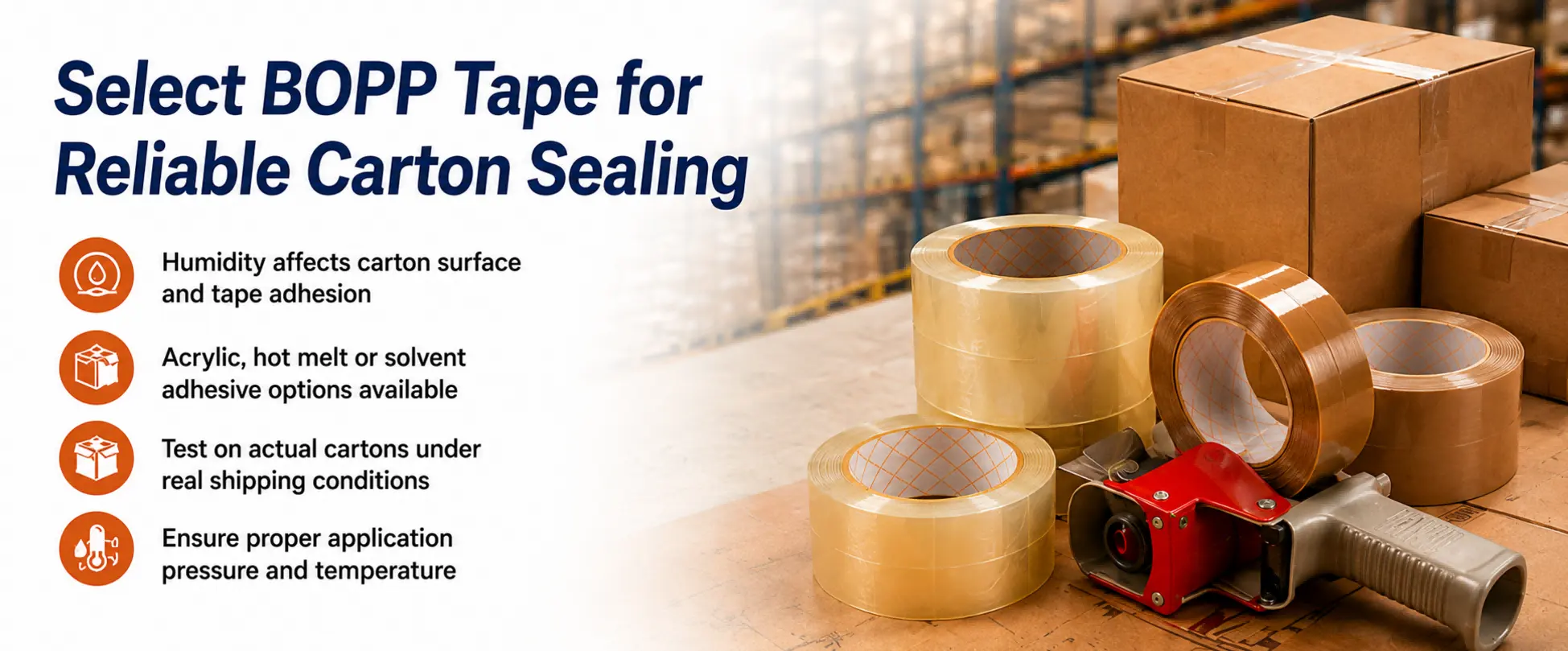
There is a common misconception that tightly wrapping a pallet in stretch film makes the cargo waterproof.
This is not the case.
While stretch film protects against dust and splashes and withstands brief exposure to the elements, standard wrapping methods cannot create a completely airtight, moisture-proof barrier.
Furthermore, if the cartons or products are already damp during packing, tight wrapping can trap moisture inside the pallet, exacerbating the dampness issue and proving counterproductive.
For products requiring high levels of moisture protection, exporting companies should employ additional safeguards, such as container liners, moisture-proof bags, desiccants, and other specialized moisture-protection accessories.
In short, stretch film is primarily intended for bundling and stabilizing cargo while offering basic protection; it cannot serve as a comprehensive moisture-proofing solution.
Select Carton Sealing Tape for the Actual Carton Surface
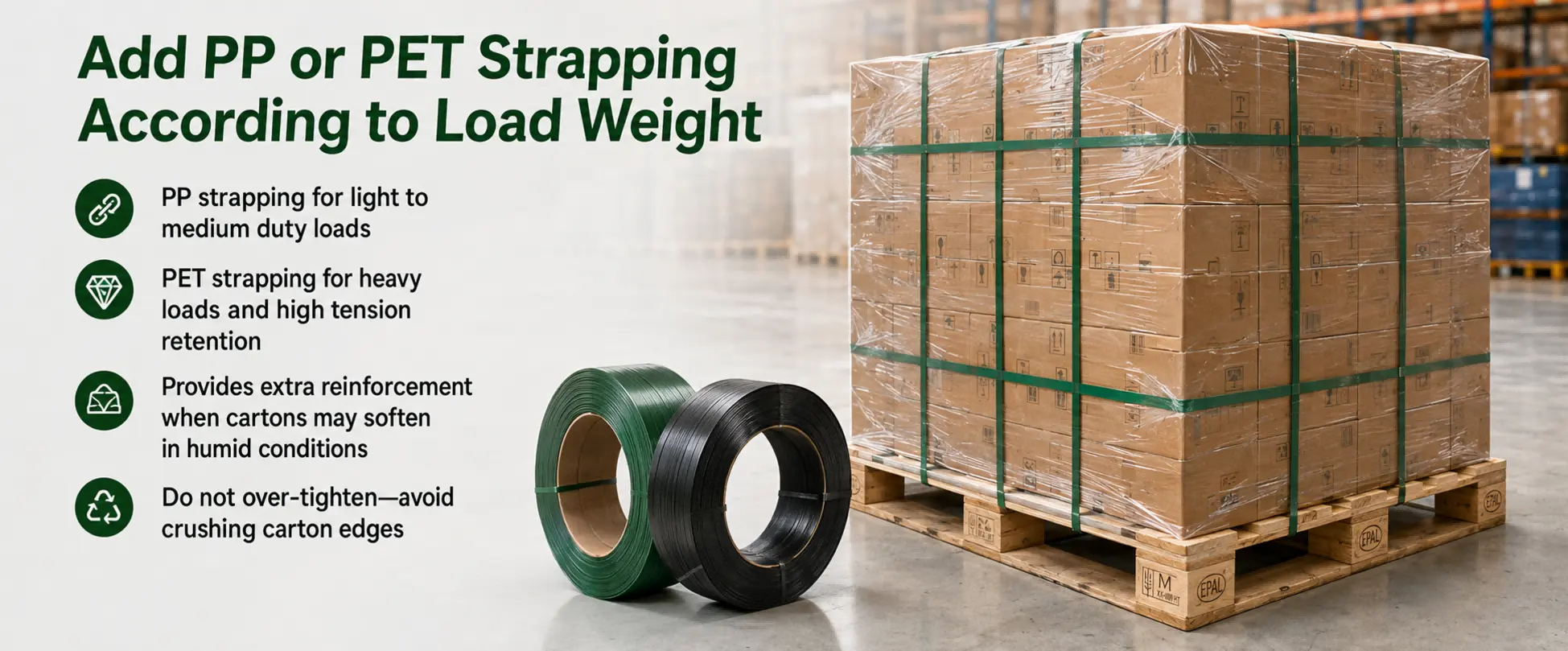
Humidity indirectly affects sealing performance, as corrugated cardboard is highly susceptible to moisture. If a carton becomes soft due to moisture or its surface is contaminated with dirt, the tape's adhesion can become unreliable. Cartons with a high content of recycled fibers often have rougher surface textures, making them more difficult to seal effectively.
Therefore, selecting the right adhesive system is crucial. Water-based acrylic BOPP packaging tape is commonly used for standard export cartons and offers excellent aging resistance in most scenarios. However, if higher initial tack or specific performance characteristics are required, hot-melt or solvent-based adhesive tapes may be used.
Relying solely on the adhesive type does not guarantee reliable sealing results. It is essential to conduct actual tests using the specific cartons intended for shipment; this step is particularly important when goods will undergo long-term storage in humid environments or be transported via sea freight. Factors such as carton surface quality, tape width, adhesive coating weight, application pressure, and ambient operating temperature all influence the final sealing outcome.
Match PP or PET strapping to the cargo weight
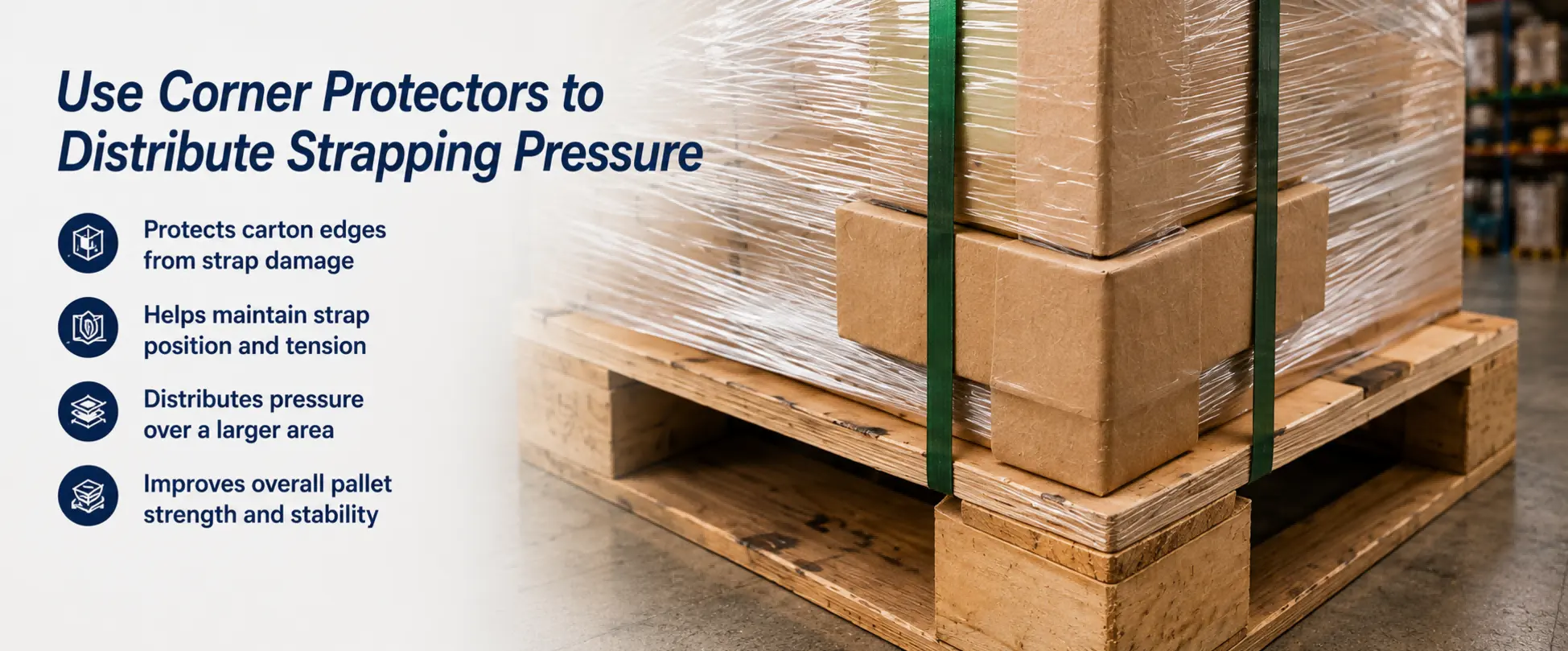
Stretch wrap and strapping serve different packaging functions. Stretch wrap binds palletized goods into a single, cohesive unit, whereas strapping provides additional reinforcement for loads requiring greater mechanical fastening strength.
PP strapping is a cost-effective solution for light-to-medium-weight palletized loads. For heavy export cargo requiring higher strength and tension retention, PET strapping is more suitable. The reinforcing role of strapping becomes especially critical when cartons are exposed to humidity and their structural rigidity is compromised.
However, strapping should not be overtightened. Excessive tension can crush carton corners—damage that is more likely to occur if the corrugated cardboard has absorbed moisture. The primary goal of strapping is to secure the load, not to deform the cartons through compression.
Use Corner Protectors to Distribute Strapping Pressure
Edge protectors and corner boards are simple packaging accessories, yet they play a significant role in the strapping of export pallets. Placing edge protectors between the strapping and the cartons distributes localized pressure over a larger contact area, preventing damage to carton edges caused by stress concentration. Additionally, edge protectors keep the strapping in place, preventing it from slipping or shifting during loading, unloading, and transit.
This enables the creation of a more balanced and stable pallet packaging structure: Cartons → Edge Protectors → PP/PET Strapping → Stretch Wrap.
For loads with high stacking heights or cartons made of softer materials, the structural support provided by this combination is far superior to simply increasing the number of stretch wrap layers.
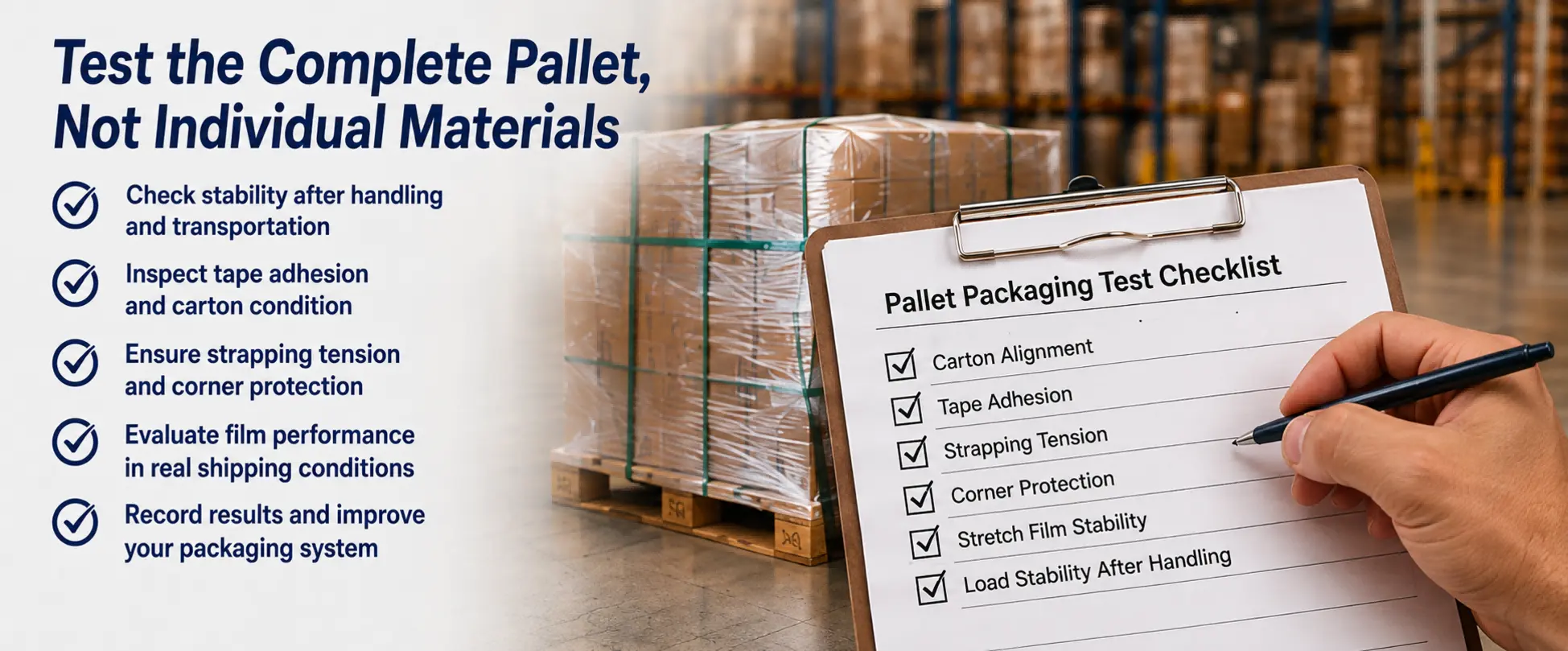
Test the Complete Pallet, Not Individual Materials
Even if the tape, stretch wrap, and strapping perform excellently on their own, they cannot compensate for risks caused by poor pallet stacking methods. Before implementing a packaging solution for high-humidity maritime shipping, exporters should conduct actual tests on the complete pallet load configuration.
Focus on verifying the following:
• Cartons are stacked neatly and aligned.
• Cartons do not extend beyond the pallet edges (minimizing overhang).
• Stretch wrap provides effective securement, with special attention paid to corners, the pallet base, and the top layer of goods.
• Strapping tension is appropriate—tight enough to reinforce the pallet but not so tight that it crushes the cartons.
• Sealing tape adheres securely; re-inspect carton seals after simulating warehouse handling.
• The entire load remains stable after shaking or shifting.
Some pallets may appear very secure immediately after wrapping, but their stability can degrade after forklift handling and prolonged vibration during sea transport. Actual simulation testing yields more valuable results than simply comparing material specifications on paper.
Build a Packaging System Around the Shipping Environment
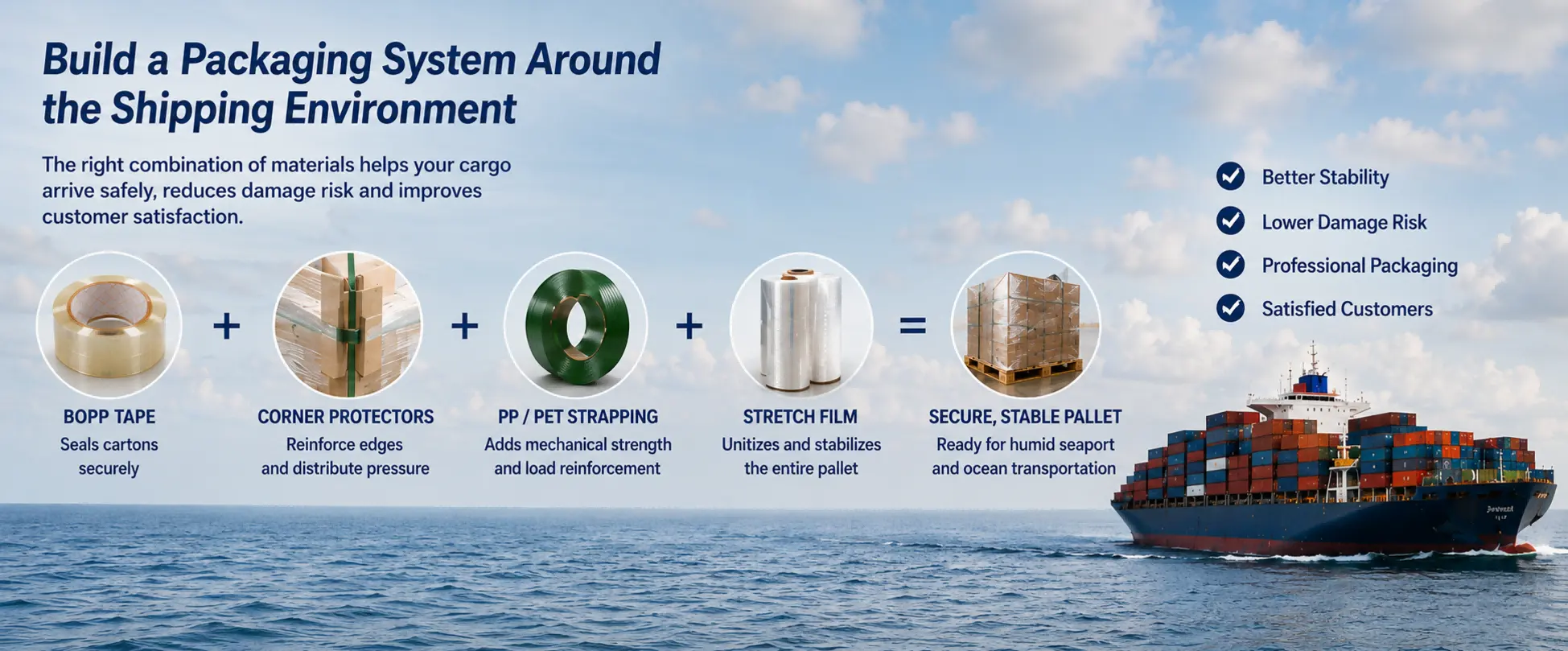
There is no single universal moisture-proof pallet packaging material suitable for every scenario. For the vast majority of export scenarios, the optimal solution lies in combining the strengths of various packaging materials:
• BOPP sealing tape to seal the cartons
• Edge protectors to safeguard vulnerable carton corners
• PP or PET strapping to provide mechanical tension and security
• Stretch wrap to unitize and secure the entire pallet load
Yalan Packing offers a comprehensive range of export packaging consumables, including manual and machine-grade stretch film, BOPP sealing tape, PP/PET strapping, and other pallet-related packaging materials.
Material specifications should be determined based on a combination of factors—such as cargo weight, pallet type, carton quality, transport routes, and storage conditions—rather than relying solely on price or film thickness. When dealing with high-humidity port environments, simply using more packaging material is not necessarily better; the key is selecting the right combination of materials to ensure the pallet maintains structural stability throughout the entire transport chain.
Share on Social:


-
PREV:
Pre-stretched Film: Cost-saving Tips for High-volume Warehouse Users
- NEXT: Null
Contact Us
In This Article
Related Posts
How to Select Pallet Packaging Materials for Humid Seaport Shipping
Sep 01, 2026
Pre-stretched Film: Cost-saving Tips for High-volume Warehouse Users
Aug 31, 2026
How Storage Environment Influences the Service Life of BOPP Packaging Tape
Aug 28, 2026
What Packaging Materials Does the Global E-commerce Logistics Market Need?
Aug 27, 2026


